
AI-driven vendor risk assessment uses machine learning and automation to evaluate supplier risks faster and more effectively than manual methods. It replaces outdated processes like questionnaires and periodic reviews with continuous monitoring and real-time analysis. This approach saves time, reduces costs, and improves risk detection, helping businesses manage their vendor networks more efficiently.
Key Takeaways:
- Faster Assessments: AI completes risk evaluations in under 2 minutes, compared to 4–6 hours manually.
- Cost Savings: Traditional assessments cost $200–$600 per vendor; AI reduces this to about $16.
- Continuous Monitoring: Real-time updates keep risk scores current, unlike static annual reviews.
- Improved Accuracy: AI tools detect inconsistencies, analyze compliance documents, and reduce errors by up to 90%.
- Scalable Solutions: AI allows businesses to monitor thousands of vendors without expanding teams.
By automating repetitive tasks and providing actionable insights, AI helps companies focus on critical decisions while staying compliant with evolving regulations like the upcoming EU AI Act. This guide explains how to implement AI in your vendor risk management process, from organizing vendor data to using predictive analytics for continuous oversight.
How to Use AI in Third-Party Risk Management
Why AI-Driven Vendor Risk Assessments Matter for Business Growth
AI-driven assessments take the hassle out of manual processes, making it easier for businesses to scale. Traditional vendor due diligence can take 4–6 hours per vendor and cost between $200 and $600 in analyst time. For a company reviewing 50 vendors annually, this adds up to labor costs between $10,000 and $30,000. By streamlining these processes, AI supports a risk strategy that aligns with growth goals.
How AI Reduces Manual Workload
AI tools drastically cut both costs and time. Take ThirdProof's Starter Plan, for example - it costs $399 per month for 25 vendor investigations, which breaks down to about $16 per assessment. That’s over a 90% reduction in per-vendor costs compared to manual methods. While traditional vetting can take 2–3 weeks, AI tools deliver results in under 2 minutes . They achieve this by pulling data from multiple sources simultaneously, such as sanctions lists, business registries, and cyber risk databases.
"The best use of AI is not replacing expertise. It is increasing the productivity of that expertise." – CheckFirst
AI also tackles "questionnaire fatigue" by auto-filling responses, flagging inconsistencies, and aligning answers with compliance standards. For companies that partner with more than 1,000 third parties - about 60% of organizations - this automation reduces the errors often seen with spreadsheet-based tracking. These tools not only save time but also prepare businesses to scale operations efficiently while keeping risks in check.
Scaling Operations While Managing Risk
AI shifts risk management from periodic checks to continuous, real-time monitoring. Risk scores are updated instantly whenever new information arises . This allows businesses to oversee hundreds or even thousands of vendors without needing to expand their teams proportionally .
For example, AI-driven anti-money laundering (AML) screening can reduce false positives by up to 90%. These systems maintain over 99% accuracy while working up to 10 times faster than human teams. This efficiency makes it possible to monitor not just Tier 1 suppliers but also Tier 2 and Tier 3 vendors - tasks that are usually too resource-intensive for manual teams.
AI also simplifies risk triage. By calculating aggregate risk scores based on factors like liability, intellectual property rights, and data access, these systems can automatically approve low-risk renewals or standard contracts. High-risk cases are flagged for senior staff. This lets legal and compliance teams spend their time on strategic decisions rather than repetitive data collection .
Setting Up an AI-Driven Vendor Risk Assessment Framework
Before introducing AI into your vendor risk assessment process, it’s essential to organize your vendor data and define clear risk categories. These steps lay the groundwork for integrating AI capabilities into your business operations effectively.
Centralizing Vendor Data and Documentation
Start by creating a comprehensive inventory of your vendors. This should include details like their industry, the type of data they access, and how critical they are to your business operations. If your vendor data is scattered across spreadsheets, emails, shared drives, or outdated systems, centralize it into a single repository. This consolidation ensures AI can access and analyze the information it needs.
To make unstructured files (like PDFs, Word documents, and spreadsheets) usable, set up a document ingestion pipeline. This pipeline should convert these files into structured, searchable data, which can then be stored in a semantic knowledge base that uses vector-based retrieval. Additionally, integrate a library of machine-readable questionnaires with predefined questions, answers, and scoring logic. This setup allows AI to extract evidence automatically, fill out questionnaires, and provide citations and confidence scores for human review. Once this system is in place, centralize all risk reports, audit-ready PDFs, and final human decisions in a Governance, Risk, and Compliance (GRC) platform to ensure consistent audit coverage.
Defining Vendor Tiering Criteria
With your data centralized, the next step is to establish risk tiers for your vendors. This classification helps streamline AI-driven assessments. Vendors can be grouped into three categories:
- Tier 1 (Critical): Vendors that handle sensitive data or provide essential services. These should undergo annual reassessments.
- Tier 2 (Important): Vendors managing operational data, reviewed every 18 months.
- Tier 3 (Standard): Vendors with limited data access, reassessed every 24 months.
For vendors providing AI solutions, it’s also important to evaluate their data ingestion methods, model training processes, and how they handle output liability. Assign weights (on a scale of 1–10) to key contract clauses, such as Limitation of Liability or Data Privacy (which might score 8–10), and less critical aspects like Governing Law (scoring 1–3). Use these weights to calculate an overall risk score (Weight × Deviation), enabling AI to sort vendors into low-risk and high-risk categories automatically.
For further insights on incorporating AI into vendor risk frameworks, you can explore expert resources like Patrick Frank’s guidance at https://patrickfrank.com.
Implementing AI in Vendor Risk Assessments
Using centralized vendor data and clearly defined risk tiers, AI can significantly enhance your risk assessment process. By automating repetitive tasks like data screening, questionnaire management, and continuous monitoring, AI allows human experts to focus on critical decision-making.
AI-Powered Vendor Screening and Assessment
AI simplifies the initial screening process by scanning Open-Source Intelligence (OSINT) sources, including news feeds, breach reports, and public databases. This automated approach handles tasks like sanctions screening (OFAC, EU, UN lists), verifying business registrations, and analyzing domain security (TLS certificates, DNS records, and certificate transparency logs). AI can process data from up to 24 sources and deliver a documented risk assessment in under two minutes.
Beyond data gathering, AI also analyzes vendor questionnaires. It flags contradictions, identifies vague responses, and maps answers to compliance frameworks such as SOC 2 or ISO 27001. By assigning weighted scores (on a scale of 1–10) to specific clauses, AI calculates an overall risk score. This scoring system helps fast-track low-risk vendors while prioritizing high-risk ones for further human review.
Automating Compliance Questionnaire Creation
AI harnesses natural language processing (NLP) to align terms like "data encryption" with related concepts such as "cryptographic controls", even when the wording varies. This capability not only improves efficiency but also ensures better alignment with risk management objectives. For example, in February 2026, Front, a customer communication platform, reduced the time needed to complete security questionnaires from three hours to just 30 minutes by introducing AI-powered automation.
"Andersen Yu, Director of Customer Solutions, noted that this efficiency gain eliminated sales bottlenecks and made collaboration between sales and security teams seamless."
Dedicated AI modules can handle classification, retrieval, synthesis, and review tasks. Current AI tools achieve first-draft accuracy rates between 90% and 96%. These systems also provide direct citations to internal documents or past responses, enabling human reviewers to verify information quickly. For instance, OfficeSpace Software managed to complete over 70 RFPs and 350 security questionnaires annually with just four Solutions Consultants by leveraging such AI-driven workflows. Automating questionnaire creation not only streamlines compliance but also strengthens the overall risk management process.
Continuous Monitoring with AI
AI transforms vendor risk management from a static, once-a-year task into a dynamic, real-time process. By ingesting data streams from sources like financial news, cyber telemetry, and regulatory filings, AI ensures ongoing oversight. Machine learning algorithms help deduplicate alerts, cutting down noise by 90–95% by recognizing when multiple sources report the same event. Despite the importance of continuous monitoring, only 13% of organizations currently engage in it, even though 60% of companies work with over 1,000 vendors.
Predictive analytics take this a step further by flagging vendors at risk based on patterns in credit ratings or patch cycles. Companies using AI for threat detection and response have reported saving an average of $2.2 million in breach costs. AI tools can prioritize alerts based on vendor context - for instance, a vulnerability in a payment processor would demand immediate attention, while the same issue in a non-critical tool might follow standard workflows. For AI-specific vendors, tracking "model drift" is essential to ensure performance remains consistent as real-world data evolves away from the original training conditions.
These AI-driven processes ensure that vendor risk management remains proactive and effective, even in complex, fast-changing environments.
Integrating AI-Driven Risk Assessments into Business Operations
Implementing AI tools effectively requires a step-by-step approach. Start by focusing on a single, high-friction task - like handling questionnaire triage or summarizing evidence. This targeted strategy helps your team familiarize themselves with the technology while minimizing disruptions to daily workflows.
While AI can handle much of the analysis, ensure that experts retain oversight on final risk decisions. For example, global losses from AI inaccuracies, such as hallucinations, reached an estimated $67.4 billion in 2024. This underscores the importance of having human validation for critical decisions. By phasing in AI tools, you create a solid framework for delivering actionable insights directly into your operational systems.
Building Vendor Performance Dashboards
Once you've established centralized vendor data and risk scores, the next step is to create dashboards that provide real-time, actionable alerts. Use APIs to connect your AI platform to tools like Jira, Slack, ServiceNow, Coupa, or Archer, ensuring that risk data is available exactly when and where decisions are made. Tailor your dashboards to track key metrics for different risk categories:
- Operational risks: Monitor API uptime and P95/P99 latency to catch reliability issues early.
- Model performance: Keep an eye on accuracy rates, drift patterns, and hallucination frequencies to detect and address degrading AI systems.
- Financial metrics: Track token consumption and compare it to seat costs to avoid unexpected billing spikes caused by poorly configured integrations.
To streamline workflows, assign weights (1–10) to contract clauses. Low-risk renewals (scores ≤10) can be flagged for automated fast-track reviews, while high-risk cases are routed for human evaluation. This setup allows your team to focus on vendors that truly require attention.
Ensuring Compliance and Scalability
Automated insights don’t just improve decision-making - they also make compliance easier as your vendor network grows. Companies using AI-powered assessments report significant benefits, including 90% faster onboarding, 80% time savings, and 65% fewer security incidents. These gains come from identifying threats in real time, rather than months later during annual reviews.
To maintain control over AI adoption, establish an AI Governance Council with representatives from your CISO, Legal, and Procurement teams. Additionally, create an internal AI Request Portal to manage tool adoption and prevent unvetted "Shadow AI" practices.
As regulations tighten, staying compliant with high-risk AI vendor standards is crucial. For example, the EU AI Act will begin enforcement in August 2026, with penalties reaching $35 million or 7% of global annual revenue for violations. To prepare, require vendors to provide "Model Cards" and "Datasheets for Datasets" during due diligence. These documents clarify model architecture, training data sources, and known limitations. With 66% of B2B buyers now requiring SOC 2 certification before signing contracts, and ISO 42001 gaining traction as a standard for AI management systems, compliance is becoming a key competitive factor.
Map vendor responses to established frameworks like SOC 2, ISO 27001, HIPAA, or ISO 42001 to ensure consistency and audit readiness. Also, verify the complete chain of sub-processors, including foundational model providers like OpenAI and Anthropic, to understand your data's flow. This level of visibility is essential, especially since over 40% of AI vendors struggle to explain their high-stakes decisions.
Measuring the ROI of AI-Driven Vendor Risk Assessments
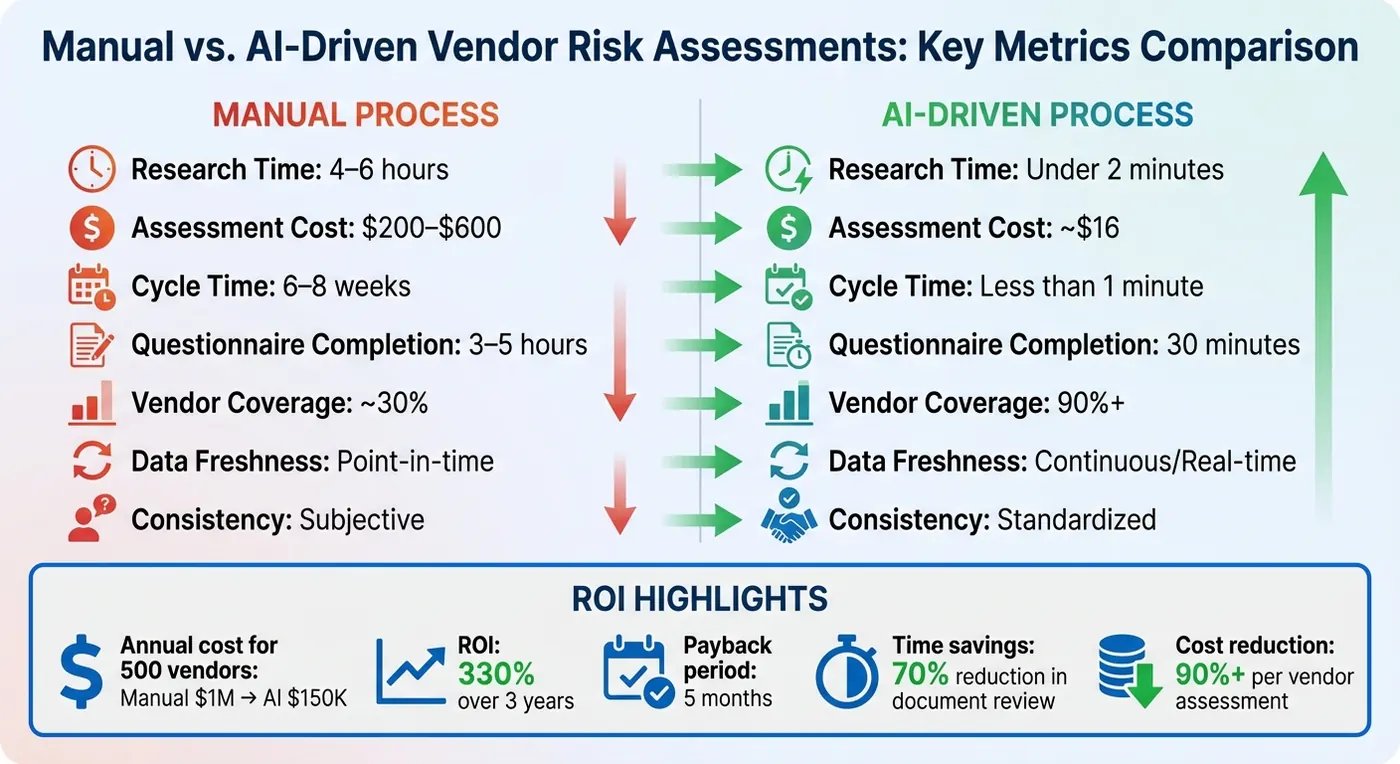
When it comes to vendor risk management, the numbers make a strong case for adopting AI-driven solutions. These tools significantly cut manual costs and improve efficiency. For example, traditional vendor due diligence costs between $200 and $600 per vendor and takes 4 to 6 hours of research per assessment. In contrast, AI-driven platforms complete the same task in under 2 minutes at approximately $16 per vendor. For a mid-sized program managing 500 vendors, this translates to annual labor costs of up to $1 million for manual processes compared to $100,000 to $200,000 with enterprise-grade AI platforms.
The benefits go beyond just cost savings. AI allows organizations to assess a much larger portion of their vendor portfolio. While manual processes typically limit coverage to about 30% of vendors, AI can increase that number to 90% or more without requiring additional staff. This expanded reach is crucial, especially when the average cost of a data breach in 2024 hit $4.88 million. Proactive risk detection powered by AI can help avoid such costly incidents.
Tracking Key Metrics and Cost Savings
To measure the impact of AI-driven vendor risk assessments, focus on the following metrics:
- Time-to-assessment reduction: AI slashes the time needed for vendor investigations from hours to minutes, freeing analysts to focus on strategic tasks.
- Analyst productivity: AI enables a single team member to manage over 1,000 vendors without additional headcount.
- Vendor onboarding velocity: Faster onboarding means vendors move through the risk pipeline quicker, directly benefiting project timelines and revenue.
- Risk detection and response efficiency: AI improves response rates to 98% and delivers replies three times faster.
Additionally, track how many intelligence sources your AI system monitors - such as sanctions lists, adverse media, and cyber risk databases - and how many high-risk anomalies it identifies that manual reviews might miss. For large enterprises, the time savings add up quickly. Manual vendor questionnaires alone can consume over 15,000 hours annually, but AI reduces document review times by an average of 70%.
For a 500-vendor program, these efficiencies translate to a dramatic cost reduction - from nearly $1 million annually to around $150,000 - resulting in a 330% ROI over three years with a 5-month payback period. To calculate your cost savings per evaluation, compare your compliance analyst's hourly rate (typically $50 to $100) to the subscription or per-report cost of your AI tool. Also, monitor metrics like compliance gap closure time (how quickly risks are remediated) and dwell time (how long it takes to initiate a response after detecting a risk event).
Comparison: Manual vs. AI-Driven Assessments
A direct comparison between manual and AI-driven assessments highlights the efficiency gains:
| Metric | Manual Process | AI-Driven Process |
|---|---|---|
| Research Time | 4–6 hours | Under 2 minutes |
| Assessment Cost | $200–$600 | ~$16 |
| Cycle Time | 6–8 weeks | Less than 1 minute |
| Questionnaire Completion | 3–5 hours | 30 minutes |
| Vendor Coverage | ~30% | 90%+ |
| Data Freshness | Point-in-time | Continuous/Real-time |
| Consistency | Subjective | Standardized |
To start measuring ROI, pilot AI-driven assessments with a small group of 10 to 15 vendors. This approach can quickly demonstrate time savings and quality improvements to stakeholders. Begin with high-friction tasks like questionnaire triage and evidence summarization, where the benefits are most apparent. As the program scales, tier your vendors and assign different levels of automation based on their criticality - performing annual deep dives for Tier 1 vendors and leveraging automated monitoring for Tier 3. This ensures AI resources are applied where they make the biggest impact while keeping human oversight for the most sensitive relationships.
Conclusion: Using AI for Risk Management Success
AI is changing the way businesses approach risk management, especially in vendor risk assessments. Tasks that once took weeks can now be completed in minutes, cutting down operational effort significantly. This means businesses can manage more vendors without needing to grow their teams.
The secret to getting this right is combining automation with human expertise. AI can handle repetitive tasks like data collection, evidence parsing, and sanctions screening. Meanwhile, human experts step in for crucial decisions, like evaluating high-risk vendors or addressing major gaps. As CheckFirst explains:
"The best use of AI is not replacing expertise. It is increasing the productivity of that expertise".
To make AI work for your organization, start small. Focus on a single high-friction task, such as sorting through questionnaires. Track how much faster assessments are completed and expand your AI use from there. It’s also important to create risk taxonomies that reflect your organization’s specific needs - whether it’s HIPAA compliance for healthcare or ISO 42001 standards for AI vendors - rather than relying on generic scoring systems. Monitoring key metrics will help prove the value of your AI tools.
Regulations are also becoming stricter. For example, the EU AI Act will begin enforcement in August 2026, with penalties as high as €35 million or 7% of global revenue. This makes continuous monitoring essential - not just to meet compliance standards but also to gain a competitive edge. As John Ozdemir, CEO of DSALTA, puts it:
"The question for 2026 is not whether to use AI in vendor risk management. It's about using AI responsibly, transparently, and in ways auditors trust".
FAQs
What vendor data should I centralize before using AI?
Before diving into AI-driven vendor risk assessments, it’s crucial to centralize all relevant vendor data. This includes information like security assessments, compliance statuses, model transparency, data handling practices, risk scoring, and contractual protections.
Make sure to gather key specifics such as:
- SOC 2 certifications
- Explanations of model behavior
- Sources of training data
- Results from bias testing
- Details on regulatory compliance
By consolidating this information upfront, you'll build a strong foundation for evaluating vendor risks effectively with AI tools.
How do I decide which vendors can be auto-approved vs. human-reviewed?
Vendors may qualify for automatic approval if they satisfy low-risk criteria, such as holding robust security certifications like SOC 2, dealing with minimal data sensitivity, and adhering to regulatory requirements. On the other hand, human review is advised for vendors considered higher-risk - those managing sensitive data or missing key certifications. To streamline this process, many organizations rely on AI-driven risk scoring. This approach helps by automatically approving vendors deemed low-risk while flagging those with higher risks for a more thorough evaluation, ensuring both efficiency and careful risk oversight.
How can I prove ROI from AI vendor risk assessments in my first 90 days?
To prove ROI within a 90-day window, prioritize efficiency, cost savings, and clear risk visibility. AI can transform processes by slashing assessment times from hours to just minutes. This not only reduces labor costs but also expands coverage significantly.
Focus on tracking key metrics, such as:
- Faster cycle times: Completing tasks quicker without sacrificing quality.
- Lower manual costs: Cutting down on time-intensive, labor-heavy processes.
- Improved risk insights: Gaining a clearer picture of potential threats.
Many organizations have seen major efficiency boosts, allowing them to make faster decisions and identify threats proactively. These early wins translate into measurable value right from the start.