
Scaling influencer partnerships can drive better results while keeping your efforts efficient and cost-effective. Here’s how you can grow your program without overwhelming your resources:
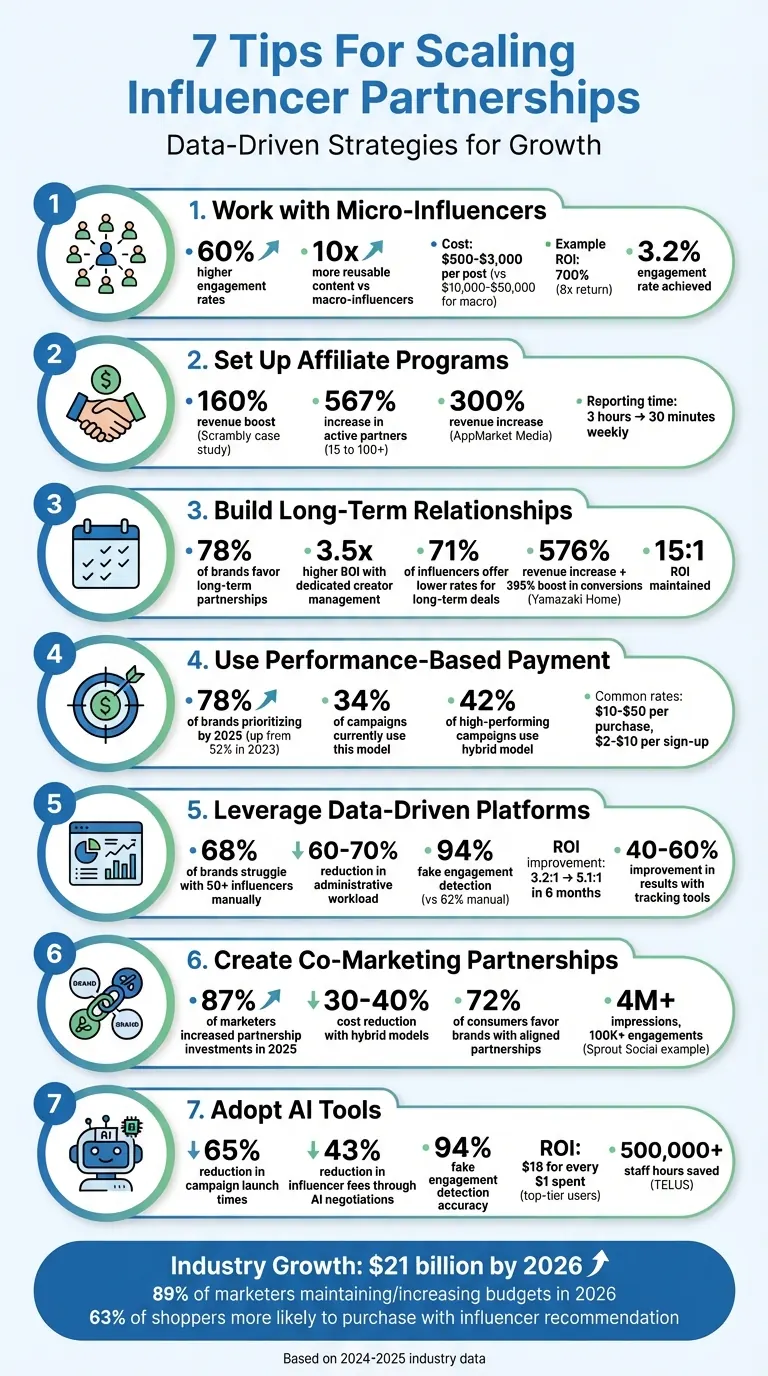
- Work with Micro-Influencers: They cost less, generate 3–5x higher engagement, and deliver better ROI compared to larger influencers.
- Set Up Affiliate Programs: Pay for performance (sales or leads) to reduce upfront costs and scale with minimal risk.
- Build Long-Term Creator Relationships: Consistent partnerships save time, reduce costs, and increase conversions over time.
- Use Performance-Based Payment Models: Pay influencers based on results like sales or leads, ensuring your budget is focused on outcomes.
- Leverage Data-Driven Platforms: Automate tasks like influencer discovery, tracking, and payments to save time and improve efficiency.
- Create Brand Co-Marketing Partnerships: Collaborate with aligned brands to share resources and expand reach to new audiences.
- Adopt AI Tools: Automate repetitive tasks, detect fake engagement, and optimize campaign performance with AI-driven solutions.
These strategies help brands manage large-scale influencer programs while staying focused on measurable results. Whether you’re leveraging micro-influencers, automating with AI, or building long-term partnerships, the key is to align your approach with clear goals and efficient tools.
1. Work with Micro-Influencers
Scalability Potential
Imagine working with 20–50 micro-influencers instead of relying on a single macro-influencer. This approach doesn’t just spread your reach - it amplifies it. Micro-influencers provide 60% higher engagement rates and produce 10 times more reusable content compared to their macro counterparts. By creating a network of these smaller influencers, you turn influencer marketing into an ongoing strategy rather than a one-time event. This method also allows you to test your product’s appeal across different audience segments.
Take this example: In 2025, a sustainable fashion brand collaborated with 15 micro-influencers in the eco-conscious niche, each with 25,000–75,000 followers. The total cost? $18,000 - far less than hiring a single macro-influencer. The results? A 3.2% engagement rate and 12% month-over-month sales growth. This approach not only saved money but also offered a broader reach across diverse audiences.
Cost-Effectiveness
Micro-influencers are far more affordable than macro-influencers. While macro-influencers charge $10,000 to $50,000 (or more) per post, micro-influencers typically cost between $500 and $3,000 per post. The savings can be significant, but the returns are even more impressive.
Here’s a real-world example: HostZealot’s Chief Marketing Officer, Vladimir Lebedenko, spent $1,500 on three sponsored posts. These posts led to 100 trial sign-ups, 20 of which converted into paying customers. With a customer lifetime value (LTV) of $600, the campaign generated $12,000 in revenue. That’s a 700% ROI - an 8x return compared to broader paid social media campaigns.
"Let's say we invest $1,500 for three sponsored posts and those posts generate 100 trial sign-ups. Twenty sign-ups convert into paying customers with an LTV of $600. That makes the total revenue $12,000... That's roughly an 8x return compared to what we'd get from broader paid social media campaigns."Vladimir Lebedenko, Chief Marketing Officer, HostZealot
Operational Efficiency
Managing a large group of micro-influencers may seem daunting, but it doesn’t have to be. You can streamline the process by creating a single creative brief with slight personalizations for groups of 10–15 influencers. Pre-vetted pools of 50–100 potential partners make it easy to identify top performers. Following a 70/30 rule - focusing 70% of your efforts on the top 30% of performers - helps maximize results without overcomplicating operations.
2. Set Up Affiliate and Referral Programs
Scalability Potential
Affiliate programs take the efficiency of micro-influencer campaigns and push it to the next level by focusing on performance-based rewards. Rather than paying upfront for posts that may or may not convert, these programs ensure you only pay when influencers deliver actual sales or leads. This approach transforms influencer marketing into a revenue-driving strategy that can scale across hundreds of creators without the financial risks tied to traditional campaigns.
Let’s look at the numbers. In 2024, Scrambly - a company managing its affiliate program with just one person - switched to the impact.com platform to automate tasks like recruitment and tracking. The results? A 160% revenue boost and a 567% increase in active partners - growing from 15 to over 100 in just three months. Plus, their weekly reporting time dropped from three hours to just 30 minutes. This is the power of automation: scaling operations without needing to expand your team.
"Your friend is scale. You want thousands of creators in your program creating content every day. That's what's going to drive meaningful results."Mike Balducci, CreatorIQ
With performance-driven models, you can streamline your campaigns while maximizing results.
Operational Efficiency
Scaling revenue through affiliate programs requires ditching manual processes. Managing influencers manually can quickly become a bottleneck. In fact, 68% of brands struggle to manage 50+ influencers due to inefficient systems, and manual workflows eat up as much as 40% of a team’s productive hours. The fix? Automated platforms that handle everything from partner vetting to tracking and payments.
For example, you can implement tiered commission structures that reward creators based on their performance - offering different rates for new versus returning customers. Automated email sequences can onboard creators, while branded portals provide them with everything they need, like logos, product details, and tracking links. This eliminates time-consuming back-and-forth communication and ensures everyone stays on the same page without constant oversight.
Cost-Effectiveness
Affiliate programs are particularly effective when working with micro- and nano-influencers (1,000–100,000 followers). These creators are often open to performance-based compensation or product seeding, which means you only pay when they deliver tangible results. This ensures you’re protecting your budget while achieving a strong ROI.
Take AppMarket Media as an example. By adopting performance-based models through the Affise partner marketing platform, they achieved a 300% revenue increase while automating user-engagement strategies to maximize ROI. Automated platforms also help prevent budget-draining issues like click fraud, trademark bidding, and unauthorized promo code use - problems that would otherwise fly under the radar.
3. Build Long-Term Relationships with Creators
Scalability Potential
Running one-off campaigns can feel like reinventing the wheel every time - new creators, new onboarding processes, and fresh rounds of brand education. On the other hand, long-term partnerships create a steady content pipeline that’s easier to manage. When creators already know your brand voice, product details, and timelines, launching new initiatives becomes quicker and smoother. In fact, 78% of brands now favor long-term partnerships with creators over short-term collaborations, and those with dedicated creator management teams report a 3.5x higher ROI compared to brands without structured strategies.
A great example of this shift is Yamazaki Home. Over an 18-month period ending in 2025, they tripled their influencer-driven revenue by moving away from one-off campaigns to a performance-focused, "always-on" approach. By managing fewer partnerships but focusing on quality, they saw better results. Similarly, UK retailer B&Q saw their click-through rate triple by working with a select group of long-term creators who showcased their products through ongoing home renovation projects.
"We're seeing brands shift away from 'one-and-done' collaborations and toward long-term, sustainable partnerships. Creators become a consistent voice over time, weaving brand stories naturally into their content. That continuity builds trust - and ultimately drives stronger conversions."Lollo Nene, Campaign Associate, impact.com
Operational Efficiency
Long-term partnerships don’t just scale - they simplify. By eliminating repetitive vetting and onboarding, you save time and resources. Implementing an "always-on" framework with quarterly performance reviews ensures your messaging stays fresh and data-driven. A good balance is giving creators 70% direction and 30% creative freedom, which keeps content authentic while maintaining brand consistency. Rebooking top-performing creators while their momentum is strong further reduces operational headaches.
Cost-Effectiveness
Sustained collaborations often come with financial perks. 71% of influencers offer lower rates for long-term deals, making it easier to secure volume discounts and cut onboarding expenses. For instance, in 2024, Yamazaki Home teamed up with JEBCommerce and impact.com to shift from transactional partnerships to long-term relationships. By reactivating previously high-performing creators and introducing better commission structures, they achieved a 576% revenue increase and a 395% boost in conversion rates within just six months - all while maintaining an impressive 15:1 ROI.
"It's a lot harder to build trust off of a single collaboration than it is to allow a creator to build that credibility indirectly for you over time."Brianna Doe, Founder, Verbatim
Consistent exposure through trusted creators fosters authenticity, which translates into better conversions. Creators involved in long-term partnerships often see a 40% year-over-year revenue increase compared to those in short-term deals. This approach not only builds trust but also strengthens your brand’s foundation for sustainable growth.
4. Use Performance-Based Payment Models
Scalability Potential
Performance-based payment models offer a smart way to grow your influencer network without taking on unnecessary financial risk. Instead of paying upfront, you compensate creators only when they deliver measurable results - whether that's sales, sign-ups, or quality leads. This approach is becoming increasingly popular: by 2025, 78% of brands are expected to prioritize performance-based models, compared to just 52% in 2023. Currently, brands use this pricing structure for about 34% of their influencer campaigns.
The beauty of this model lies in its efficiency. You’re not gambling on whether an influencer’s audience will convert; instead, you’re paying for actual results. This makes it easier to scale your partnerships across regions without blowing your budget. Brands using performance-based models have reported success in managing hundreds of influencer relationships without a proportional increase in costs. It’s a system that streamlines operations while keeping costs under control.
Operational Efficiency
Performance-based models also simplify the operational side of influencer campaigns. Tools like unique discount codes (e.g., "SARAH20") and UTM parameters make it easy to track conversions and attribute results accurately. This eliminates disputes over performance and ensures creators are paid fairly based on their contributions. Automated tracking platforms handle the heavy lifting, cutting down on the time spent verifying results and calculating payments.
To make this work, it’s essential to define "performance" clearly in your contracts. For example, specify what counts as a conversion - like a "completed purchase within a 30-day click window" - and set clear benchmarks, such as "achieving a 3:1 ROAS with 150 conversions in Q1 2026". When everyone understands the expectations upfront, it reduces confusion and keeps the campaign focused on achieving tangible results.
Cost-Effectiveness
Another advantage of performance-based models is their ability to protect your ROI. You’re no longer spending large sums on content that looks great but doesn’t generate results. Instead, you’re paying for outcomes. Common rates include $10–$50 per purchase, $2–$10 per sign-up, or $5–$20 per lead. For e-commerce brands, ROAS-based payments are gaining traction, with creators often earning around $0.10 for every $1 of revenue they generate.
The hybrid model has also proven effective. In this approach, creators receive a guaranteed base fee - typically $500–$2,000 for micro-influencers - to cover production costs, along with performance bonuses for exceeding targets. This structure ensures creators are compensated fairly while keeping your brand focused on driving conversions rather than vanity metrics. It’s no surprise that 42% of high-performing campaigns now use this model.
Alignment with Business Growth Goals
Performance-based incentives naturally encourage creators to prioritize conversions over less meaningful metrics. When their earnings depend on driving actual sales, they become more invested in your success.
"The smartest brands build programs that reward both creativity and conversion, giving creators a seat at the performance table. It's no longer about how many people saw the post, but how many acted because of it." - Kayla Lee, VP of Growth, Autumn Communications
Take Yamazaki Home as an example. Between 2024 and 2025, they transitioned from flat-fee campaigns to a performance-based system. By tracking which influencers drove revenue and doubling down on those relationships, they tripled their influencer-driven revenue in just 18 months. At the same time, they reduced the number of partnerships they had to manage. By aligning payments with outcomes, they successfully scaled their influencer program while focusing on meaningful growth. This strategy ties directly into broader growth initiatives, setting the stage for even greater success. This approach aligns with broader marketing strategy and growth initiatives.
5. Use Data-Driven Influencer Platforms
Scalability Potential
Managing influencer campaigns manually becomes nearly impossible as programs grow. In fact, 68% of brands face challenges when working with 50 or more creators. The problem isn’t just the sheer number of influencers - it’s about juggling contracts, payments, content approvals, and performance tracking across endless spreadsheets and email chains. This fragmented system creates inefficiencies. Data-driven platforms solve this by centralizing all creator activities. With AI-powered tools, marketers can filter and identify ideal partners in minutes based on audience demographics and engagement rates. This streamlined approach can save over 10 hours a week compared to manual research. However, 39% of marketing teams still rely on outdated manual methods, which slows their ability to scale.
"You don't need a bigger team to run a bigger program. You need smarter tools." - Aspire
Operational Efficiency
The true power of these platforms lies in their automation capabilities. They simplify campaign management by automating tasks like sending content guidelines or shipping products through integrations with tools like Shopify once contracts are signed. Automation can cut administrative workloads by 60% to 70%. For example, a fashion D2C brand managing 30 influencer partnerships with Google Sheets spent 10 hours a week on manual tasks. After adopting tracking tools, they automated payment processing - saving 4 hours weekly - and identified their top-performing influencers. This shift boosted their campaign ROI from 3.2:1 to 5.1:1 in just six months. Additionally, AI-powered fraud detection identifies 94% of fake engagement, compared to just 62% with manual reviews. This helps protect budgets from influencer fraud, which costs an estimated $1.3 billion annually. By streamlining operations, brands not only save time but also reduce costs.
Cost-Effectiveness
While these platforms come with an upfront cost - ranging from $99 to over $10,000 per month depending on features - they often save more money than they require. Hybrid management models, which combine platform use with in-house teams, can be 30–40% less expensive than relying solely on internal teams. A small in-house team of 2–3 people can cost $150,000 to $300,000 annually. Furthermore, repurposing top-performing influencer content into whitelisted ads can generate click-through rates (CTRs) four times higher than traditional studio-produced assets. By 2025, 73% of brands are expected to use dedicated influencer tracking solutions, up from 54% in 2023. Brands that adopt structured tracking tools see a 40–60% improvement in their influencer marketing results.
Alignment with Business Growth Goals
Modern platforms go beyond vanity metrics like likes and followers. They focus on meaningful KPIs such as Cost Per Lead (CPL), Return on Ad Spend (ROAS), and direct sales through pixel and UTM integrations. This level of transparency makes it easier to justify budgets and demonstrate ROI to leadership. For instance, one brand combined influencer content with webinars, gifting, and events, achieving over 4 million impressions and 100,000+ engagements. Tools like "Brand Safety Reports" and "Brand Fit Scores" allow brands to vet creators effectively, turning influencer marketing into a reliable, revenue-generating strategy.
How to scale influencer marketing
6. Create Brand Co-Marketing Partnerships
Teaming up with other brands through co-marketing partnerships can be a smart way to grow your business by leveraging shared audiences and resources.
Scalability Potential
Co-marketing partnerships allow you to tap into a partner's audience, gaining what some call "borrowed trust." Instead of building credibility from scratch, you benefit from the trust your partner has already established with their audience. The trick is to find brands that share your ideal customer profile (ICP), so their followers are likely to become your customers too. This approach has proven effective - 87% of marketers increased their partnership investments in 2025 to expand their reach beyond their existing customer base. By collaborating, you not only broaden your audience but also set the stage for more efficient joint efforts.
Operational Efficiency
Strategic partnerships thrive on shared goals and resources. By pooling efforts for content creation and distribution, both brands can reduce their workload and adapt more quickly to market changes.
"If you combine B2B partnerships (brand-to-brand partnerships) with P2P partnerships (people-to-people partnerships)... that's where you really create accelerated scale." - Jeff Frommer
To avoid hiccups, it's crucial to establish clear decision-making processes early on. This prevents delays caused by needing dual approvals for minor decisions. Standardizing KPIs across campaigns also ensures both parties are accountable for measurable results.
Cost-Effectiveness
Co-marketing can be a budget-friendly option. For instance, two brands could split a $50,000 campaign budget, cutting individual costs in half. Brands that use hybrid models - combining internal teams with partner support - can reduce expenses by 30–40% compared to relying solely on in-house resources. For startups or companies with tighter budgets, in-kind exchanges (like trading products or services) can be a great alternative to cash investments. Plus, 72% of consumers favor brands that collaborate with aligned organizations, showing that partnerships can naturally enhance trust and credibility.
Alignment with Business Growth Goals
Successful co-marketing often requires a longer commitment, typically 6–12 months, rather than short-term campaigns. This extended timeline allows results to build over time, creating a steady flow of high-conversion opportunities. For example, in 2024, Sprout Social partnered with Design Miami (Art Basel) for a co-marketing campaign that included influencer activations with creators like Maxine the Fluffy Corgi and Vin Matano. The effort resulted in over 4 million impressions, 100,000+ engagements, and a significant number of leads.
"Partnerships are the best way to scale... find who already had the trust of your customers, and is willing to extend that trust to you." - Jeff Frommer, Founder
Start by identifying your top 10 potential brand partners - those with the trust of your target audience. Look for businesses offering complementary products or services to create bundled deals or cross-promotions. And don’t forget to check all co-marketing content for legal compliance, especially when it involves intellectual property like music or images.
7. Add AI Tools to Improve Efficiency
Integrating AI tools into your influencer marketing efforts can take your operations to the next level. By automating repetitive tasks like finding creators, drafting outreach emails, and tracking campaign performance, AI frees up your team to focus on higher-value activities like strategy and relationship building.
Scalability Potential
AI tools make it possible for a single marketer to manage tasks that used to require an entire team. This allows brands to scale their campaigns significantly without increasing headcount. For instance, TELUS used Claude AI to save over 500,000 staff hours across its 57,000 employees, resulting in a US $90 million business benefit. Similarly, GoPro automated the tagging and curation of over 43,000 user-generated content entries, enabling them to grow their social presence without expanding their team.
"The future agency isn't 50 people managing 500 creators; it's 2 people managing 20 agents who oversee 5,000 creators." - Stormy AI Blog
Operational Efficiency
AI can cut campaign launch times by up to 65%, handling tasks like creator discovery, vetting, and outreach much faster than traditional methods. Instead of relying on rigid keyword searches, natural language prompts like "Find eco-conscious parents in the Pacific Northwest" can help identify creators who align with your brand. AI also streamlines negotiations using real-time market data, reducing influencer fees by as much as 43%. These tools have helped brands like Dunkin' Donuts achieve a 57% increase in app downloads and enabled Unilever to cut content costs by 30% while speeding up campaign launches by 50%.
Cost-Effectiveness
AI-powered fraud detection identifies 94% of fake engagement, far outperforming manual detection rates of 62%. This helps prevent wasted budget and boosts return on investment. Top-tier users report ROI as high as US $18 for every US $1 spent, compared to the industry average of US $5.78. Additionally, AI allows content to be reformatted and optimized for multiple platforms like TikTok, Reels, and Shorts, ensuring you get the most out of every piece of creator content while lowering customer acquisition costs.
Alignment with Business Growth Goals
The key to leveraging AI effectively is to let it handle the repetitive, time-consuming tasks while keeping your team focused on creative strategy and relationship building. For example, AI can manage the first 80% of tasks - like creator discovery and initial outreach - so your team can focus on the final 20% that requires human insight. Establishing tools like a persistent context file () with your brand's voice and customer profiles ensures AI outputs align with your identity. This human-in-the-loop approach strikes a balance between efficiency and authenticity.
"AI handles the logistics of 1,000 creators so that you have the time to build a real relationship with the top 10." - Stormy AI Blog
Platform Comparison Table
Selecting the right influencer platform is essential for scaling your marketing efforts effectively. With 89% of marketers now prioritizing data-driven influencer partnerships over instinct-based decisions, the right platform can make all the difference. Below is a breakdown of five top platforms, highlighting their key strengths, ideal use cases, and features designed to help you grow.
| Platform | Core Benefit | Ideal Use Case | Scalability Feature |
|---|---|---|---|
| HypeAuditor | AI-powered fraud detection (98.3% accuracy) | Mid-market brands needing deep audience authenticity checks | Lookalike audience tool to find creators similar to top performers |
| AspireIQ | Enterprise-grade compliance and multi-channel attribution | Fortune 500 companies with complex regulatory needs (GDPR/CCPA) | White-label options and proprietary AI matching for global teams |
| Upfluence | Performance marketing and affiliate tracking | E-commerce brands focused on direct revenue measurement | Native Shopify integration and automated commission management |
| InfluenceFlow | Free-forever access with professional media kit tools | Startups and SMBs launching their first campaigns | Automated workflows and digital contract signing |
| Grin | Brand safety AI and advanced analytics | Large brands with high brand protection needs (luxury, finance) | End-to-end automation from discovery to payment for large-scale campaigns |
Pricing for these platforms can vary widely. For instance, HypeAuditor starts at $99/month, while enterprise solutions like Grin range between $3,000 and $10,000/month. If you're just starting out, InfluenceFlow offers a free-forever plan, making it an excellent choice for businesses testing the waters with influencer marketing. The key is to align the platform's strengths - whether it's fraud detection, compliance, or revenue tracking - with your specific goals.
Dedicated influencer platforms can speed up campaign execution by 40% compared to manual methods. For example, in 2023, Colgate-Palmolive adopted Traackr to centralize influencer management, cutting campaign costs by 40% and improving workflows across global teams. Groupe SEB also successfully implemented their platform in 28 markets within a single year. These examples highlight how the right platform can streamline processes and drive measurable results for your brand.
Conclusion
Scaling influencer partnerships isn’t just about increasing the number of creators you work with - it’s about creating the right framework to support growth without overwhelming your resources. It’s worth noting that 68% of brands struggle when managing over 50 influencers, which highlights the need for smarter systems to handle this complexity effectively. The key lies in a balanced approach that integrates data-driven decisions, meaningful long-term relationships, and efficient technology.
Data helps you make informed choices by pinpointing which influencers genuinely drive conversions. Building strong, trust-based relationships with creators transforms one-off collaborations into lasting partnerships that resonate with audiences. Meanwhile, technology steps in to handle time-consuming tasks like influencer discovery, vetting, and contract management, freeing up your team to focus on strategy. By implementing standardized workflows and performance-based incentives, you can create a scalable system that supports sustainable growth. As Acceleration Partners aptly states:
"You can't scale what you can't track, and you can't invest your money in high-performing channels if you don't know which strategies are driving conversions".
This structured approach not only streamlines operations but also positions your brand to thrive in a rapidly growing market. With the influencer marketing industry projected to surpass $21 billion by 2026, and 89% of marketers planning to maintain or increase their budgets that same year, the opportunities are immense. But success will favor brands that approach growth with a clear, strategic plan. Standardized vetting processes and performance-based incentives align influencer goals with your business objectives, while giving creators the freedom to connect authentically with their audiences. After all, 63% of shoppers are more likely to purchase when a trusted influencer recommends a product.
Scaling doesn’t have to take years - it’s achievable in just a few months with the right structure in place.
"With the right structure in place, you can scale your influencer program in a matter of months, not years".
FAQs
How many influencers should I start with to scale safely?
Start with a small group of 10 to 20 influencers. This size makes it easier to manage relationships and campaigns while keeping everything organized. Plus, it sets the stage for steady, structured growth.
What’s the simplest way to track sales from influencers?
The easiest way to track influencer-driven sales is by blending tools like UTMs, discount codes, and post-purchase surveys.
- UTMs monitor sessions, signups, and purchases originating from influencer posts.
- Discount codes tie conversions directly to individual influencers.
- Post-purchase surveys help identify delayed impacts or activity from less trackable sources like dark social.
Using these methods together provides a clearer picture of how influencers contribute to your sales.
When should I switch from one-off posts to long-term creator deals?
When your goal is to build stronger connections with your audience and encourage long-lasting brand loyalty, consider focusing on long-term creator partnerships. These collaborations are better suited for delivering impactful outcomes and nurturing trust with your customers over an extended period.