
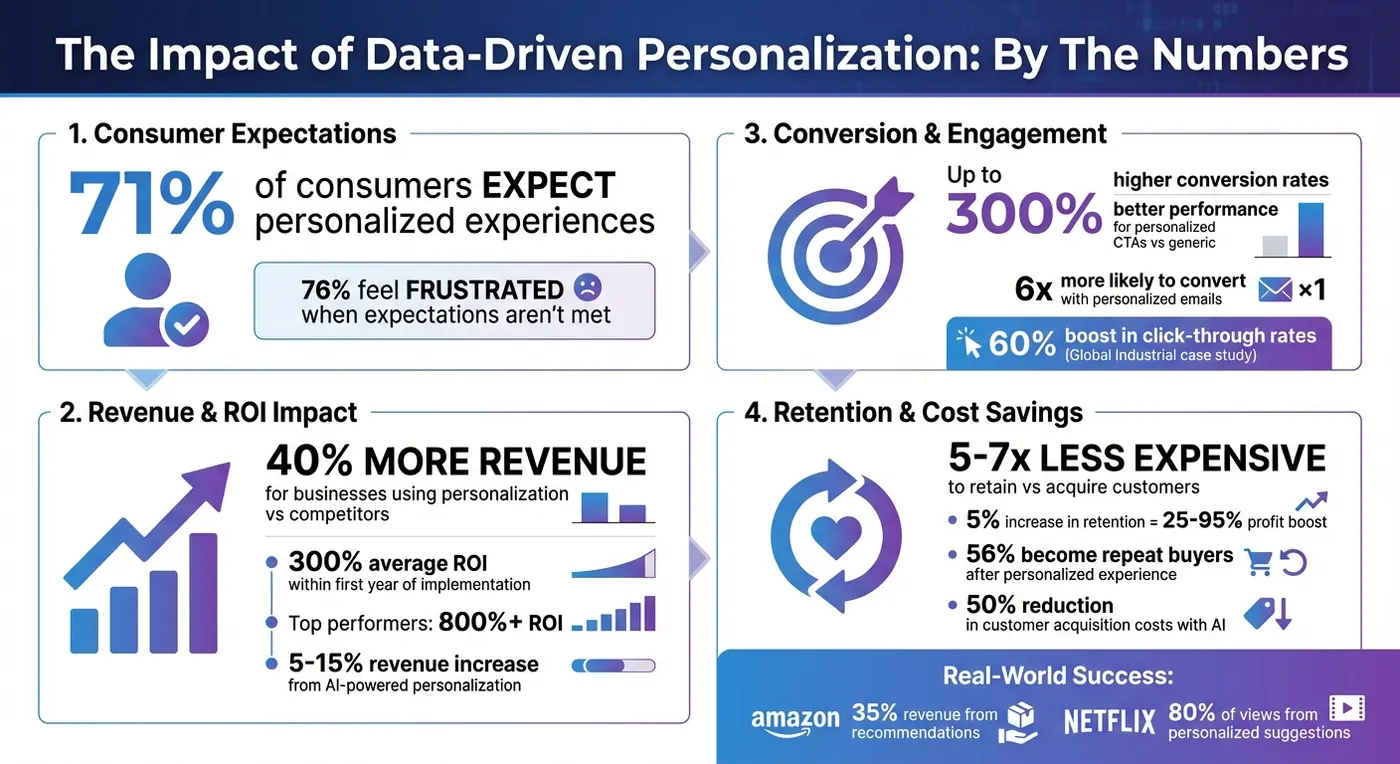
Data-driven personalization is about using customer data - like browsing habits, purchase history, and real-time actions - to deliver tailored marketing experiences. It’s no longer optional; 71% of consumers expect it, and businesses using it report 40% more revenue compared to competitors.
Here’s how it works:
- Key Components: Use a Customer Data Platform (CDP), AI-powered decision engines, and omnichannel delivery systems to create personalized experiences.
- Benefits: Higher engagement, conversion rates (up to 300%), and retention. Examples include Amazon (35% revenue from recommendations) and Netflix (80% of views from personalized suggestions).
- Implementation: Focus on AI for real-time insights, unify messaging across channels, and collect privacy-compliant first-party and zero-party data.
- Challenges: Overcome data silos, ensure privacy compliance, and integrate systems for real-time synchronization.
Start small with tools like Klaviyo or Dynamic Yield, test campaigns, and scale gradually. Personalization isn’t just about data - it’s about creating meaningful customer experiences that drive results.
Mastering AI: The Future of Data-Driven Personalization in Marketing
Benefits of Data-Driven Personalization
Personalization, when powered by data, delivers measurable results in engagement, conversions, and loyalty. These outcomes are tied to three key advantages: better customer engagement, higher conversion rates, and stronger retention and loyalty.
Better Customer Engagement
Personalization transforms how businesses interact with customers by cutting through irrelevant content and providing exactly what they’re looking for. With a unified view of the customer, businesses can send timely, relevant messages that make people feel seen as individuals, not just as another transaction.
The statistics are hard to ignore. 76% of consumers focus more on ads aligned with their interests, and 79% feel more favorable toward brands that customize content to their preferences. In B2B settings, personalization can even accelerate the sales process by offering tailored content, like industry-specific case studies, that help decision-makers reach agreements faster.
"Data-driven personalization represents the evolution from basic demographic segmentation to a more nuanced approach that connects customer interactions across various channels."Chris Baldwin, VP Marketing, Brand and Communications, Insider
Real-world examples highlight the impact. Global Industrial teamed up with Vallo Media in February 2026, using StackAdapt's Dynamic Creative Optimization to re-engage shoppers who abandoned their carts. The result? A 60% boost in click-through rates. Similarly, the Hong Kong Tourism Board partnered with Dentsu to promote its Wine & Dine Festival. By using contextual targeting on platforms like Expedia and Tripadvisor, they slashed their cost-per-click by 80%.
When engagement improves, the path to conversion becomes much smoother.
Higher Conversion Rates
Stronger engagement naturally leads to better conversion rates. Personalized experiences simplify the customer journey, encouraging users to take action. For instance, personalized calls-to-action perform 202% better than generic ones, and personalized emails are 6 times more likely to convert. On top of that, tailored product recommendations contribute to 25% to 35% of e-commerce revenue.
Consider Maine Lobster Now, which adopted Shopify's dynamic checkout to replace its outdated system. This move led to a 69% increase in overall conversion rates and a 97% jump in mobile conversions. Another example is Mac Duggal, which used Shopify Audiences to optimize ad performance despite privacy regulation changes. The results? A 2.3x larger retargeting audience, 3.6x lower cost per purchase, and a 2x return on ad spend.
Beyond driving immediate actions, personalization lays the groundwork for lasting customer relationships.
Improved Customer Retention and Loyalty
Personalization isn’t just about initial conversions - it’s also a powerful tool for keeping customers around. Retaining existing customers is far more cost-effective than acquiring new ones, costing 5 to 7 times less. Plus, even a modest 5% increase in retention rates can boost profits by 25% to 95%.
When customers feel recognized and valued - something 84% of them report after personalized experiences - they’re more likely to stick with a brand. Personalized interactions build trust, making customers hesitant to switch. In fact, 56% of shoppers become repeat buyers after a personalized experience, and brands that excel in personalization see customers returning 5 times more often than those offering generic interactions.
Take Starbucks as an example. The company uses lifecycle personalization to send tailored offers for customer anniversaries and creates seasonal challenges based on individual buying habits. This approach keeps customers coming back. Chewy takes it a step further by identifying sensitive moments, such as the loss of a pet, and responding with hand-written condolence cards or flowers. These thoughtful gestures foster deep, long-term loyalty.
How to Implement Data-Driven Personalization
Putting data-driven personalization into action involves three essential strategies: using AI to understand customer behavior, ensuring consistency across all touchpoints, and building a system for collecting privacy-compliant data. Each piece contributes to creating a more tailored customer experience.
Use AI and Machine Learning
AI takes personalization to the next level by shifting from static rules to dynamic, behavior-based systems. Unlike traditional methods, AI processes data from sources like web activity, CRM records, offline purchases, and connected devices to predict customer needs in real time. This approach has been shown to increase revenue by 5–15% while cutting customer acquisition costs by up to 50%.
Netflix is a prime example of this in action. As of March 2025, the platform uses AI to analyze watch history and genre preferences. Impressively, 80% of the content streamed on Netflix is driven by AI-powered recommendations, which adapt to user habits and play a key role in subscriber retention.
To get started, focus on high-value actions, such as when users revisit pricing or security pages. Follow the 10/20/70 rule: dedicate 10% of your effort to the AI model, 20% to setting up the necessary tools and infrastructure, and 70% to refining processes, involving people, and testing.
"AI-driven personalization isn't about guessing what people want; it's about using real behavior to make every interaction feel more intentional."Sarah Moss, Author, AI Digital
For first-time visitors, leverage contextual data like referral source, device type, and time of day to craft relevant experiences right away. At the same time, use guardrails - human-defined rules to maintain brand consistency, ensure compliance, and avoid overstepping into intrusive territory.
Once AI optimizes individual interactions, the next step is to ensure these insights are consistently applied across all channels.
Integrate Across All Channels
Personalization loses its impact when messaging is inconsistent across platforms like email, mobile, and web. A seamless, multi-channel approach ensures that actions - like abandoning a cart on mobile - trigger relevant follow-ups, such as a reminder email, rather than a generic promotion. Companies that provide consistent experiences often see 40% higher revenue from personalization efforts.
A strong technical foundation usually starts with a Customer Data Platform (CDP). This tool consolidates data from website activity, transaction history, and social media interactions into a unified customer profile. Achieving this "single customer view" requires effective identity resolution, which links anonymous visitors, email subscribers, and CRM data to ensure consistent messaging.
Netflix showcases the power of this approach. By analyzing user data, the platform ensures recommendations stay consistent whether someone is watching on their phone or TV.
Balance how you use data in real time versus batch processing. APIs can provide live updates for contextual data like weather or location, while static data like purchase history can be managed with batch processes, such as CSV uploads. Centralize decision-making with an engine that converts raw data into actionable insights - like "next-best-action" recommendations - and delivers them across all channels.
Breaking down silos between departments is critical. When marketing, sales, and customer service work from separate datasets, personalization efforts can become fragmented. Using a unified tagging system in your content management tools ensures that dynamic content remains relevant across platforms.
With consistent messaging in place, the focus shifts to collecting high-quality, consent-based data directly from customers.
Collect and Use First-Party Data
To sustain personalization long-term, gathering high-quality data directly from your audience is essential. With privacy regulations tightening and third-party cookies being phased out, first-party data - information willingly shared by customers - has become the backbone of personalization. It's worth noting that 85% of adults actively take steps to protect their online privacy.
Focus on collecting four key types of data:
- Identification Data: Basic details like name, location, and job title
- Behavioral Data: Insights from purchase history, search activity, and email engagement
- Contextual Data: Information such as device type or time of day
- Zero-Party Data: Preferences that customers voluntarily share, like style or budget
Zero-party data is particularly effective. For example, using strategies like interactive quizzes or assessments can boost engagement metrics by 217%. Additionally, 91% of consumers are more likely to shop with brands offering personalized recommendations.
To avoid overwhelming users, adopt progressive profiling - collecting data step by step rather than requiring lengthy forms upfront. Gamify the process with tools like skincare quizzes that recommend products based on skin type. Always make the value exchange clear, showing how their data will directly improve their experience.
Poor data quality is costly - U.S. businesses lose an estimated $3.1 trillion annually due to inefficiencies and inaccuracies. Before scaling, clean your data by standardizing event names and properties. For example, ensure events like "Demo Booked" are consistently tracked to prevent AI from amplifying errors.
| Data Category | Examples | Usage in Personalization |
|---|---|---|
| Identification | Name, Age, Job Title | Personalized greetings and targeting |
| Contextual | Device, Browser, Time of Day | Optimizing user experience and notifications |
| Behavioral | Search history, Cart adds | Triggering abandoned cart emails and ads |
| Zero-Party | Style preferences, Budget | Delivering tailored recommendations |
To measure the effectiveness of your efforts, use holdout groups and A/B testing. This ensures you're not just assuming personalization works but actually quantifying its impact through measurable results. A solid foundation of high-quality, consent-based data sets the stage for ongoing success.
Tools and Platforms for Personalization
Once you’ve developed a solid strategy, the next step is finding the right platforms to make it all happen. For startups and small businesses, the challenge lies in choosing tools that offer powerful capabilities without the need for a massive team or hefty budget. The aim? To unify scattered customer data, automate personalized content delivery, and grow alongside your business.
Customer Data Platforms (CDPs)
Customer Data Platforms (CDPs) act as the backbone of personalization efforts by consolidating fragmented data from different touchpoints into a single, real-time profile for every customer. This unified view allows businesses to act quickly, such as sending a personalized email after a cart abandonment instead of a generic promotion.
Older CDPs often required months to set up and sometimes created new data silos. However, newer "composable" CDPs can integrate with existing data warehouses in just a few weeks. These platforms go beyond basic profile matching by combining anonymous browsing data with known customer records using advanced identity resolution techniques.
Success stories abound. For example, Domino’s saw a 700% boost in ROAS and cut customer acquisition costs by 65% using Twilio Segment and Twilio Engage to create highly personalized campaigns. Similarly, 2xist reported a 56.1x ROI in just one quarter after adopting Klaviyo’s CDP for a unified customer view.
When choosing a CDP, look for platforms with extensive pre-built connectors - 300+ is a good benchmark - to ensure smooth integration with your CRM, ad platforms, and email tools. If your team lacks IT support, opt for platforms offering no-code data transformation features, enabling marketers to clean and format data without needing technical expertise. Many providers offer risk-free trials, such as Klaviyo’s 30-day Advanced KDP trial or Bird’s free starter tier.
"If we had to get rid of Hightouch, we'd riot. It underpins our entire marketing funnel and strategy. Marketing is all about personalization, and that's what Hightouch gives us."Trevor Luescher, Marketing Systems Architecture, Grammarly
AI-Powered Content Engines
AI-powered content engines take personalization to the next level by delivering tailored experiences at scale. These platforms enable true 1:1 individualization, offering features like personalized product recommendations, optimized send times, and real-time messaging adjustments based on user behavior across channels. The result? Higher engagement and conversion rates.
Businesses implementing AI-powered personalization often see an average ROI of 300% within a year, with top-performing companies achieving over 800% ROI. These tools also solve the "cold start" problem by using contextual signals - such as device type, location, and referral source - to provide relevant content even for first-time visitors. For instance, Calendly leveraged Optimizely Personalization to customize user experiences based on their position in the customer journey, leading to noticeable improvements in engagement and conversions.
For smaller businesses, email personalization is often the quickest way to see results. Tools like Klaviyo, starting at $45/month, specialize in e-commerce email and SMS with predictive analytics built in. Mid-sized companies might explore Dynamic Yield, starting at around $2,500/month, for a full suite of personalization tools, including product recommendation features.
Recent advancements, like multi-armed bandit algorithms, allow platforms to automatically direct traffic to the best-performing content variations in real time, eliminating the need for manual A/B testing monitoring. Some tools even offer "Generative UI", where AI creates user interface components on the fly based on user intent.
Consulting Services for Custom Solutions
While technology plays a huge role in personalization, expert consulting ensures your tools align with your business goals. Simply adopting advanced tech doesn’t guarantee success - having a clear implementation strategy is just as critical. Many startups struggle with choosing the right platforms, integrating them seamlessly, and rolling them out in a way that delivers quick wins while setting the stage for long-term success.
For tailored advice, Patrick Frank offers 1-on-1 strategy sessions for $150/hour. These sessions help businesses evaluate their data infrastructure, uncover high-impact personalization opportunities, and select tools that fit their budget and needs. If you’re ready for a full-scale approach, the 90 Day Growth Plan ($10,000) provides hands-on support, from setup to campaign launch and optimization.
Common Challenges and Solutions
Even with the best tools at your disposal, putting data-driven personalization into practice isn't without its hurdles. The upside? Most of these challenges have straightforward solutions that don't require a complete system overhaul.
Breaking Down Data Silos
Fragmented customer data is a major roadblock to effective personalization. Customer details are often scattered across various platforms - your CRM might store contact information, your website tracks browsing habits, your support team logs service tickets, and social media platforms collect engagement metrics. When these systems don’t communicate, you risk promoting products customers already purchased or sending generic emails to your most loyal users.
This disconnection comes at a cost. Companies lose up to 30% of their annual revenue due to inefficiencies caused by siloed data. Additionally, only 25% of marketers report having access to the data they need for meaningful personalization.
The fix? Start with a data audit. Map out where customer data is stored, how it’s being used, and identify gaps. Then, implement a Customer Data Platform (CDP) equipped with strong identity resolution capabilities. This technology matches data points - like an email address from a newsletter and a device ID from a mobile app - to create a single, accurate customer profile.
Focus on standardizing critical data formats first. Adopt universal naming conventions and data structures across your systems. Establish clear data governance policies to define ownership and access rules. Finally, align your IT, marketing, and customer service teams around shared goals to avoid working in isolation.
Once your data is unified, the next challenge is ensuring customer privacy is protected.
Staying Compliant with Privacy Regulations
Privacy and personalization don’t have to be at odds. With third-party cookies being phased out by late 2025, businesses must shift to relying on first-party data (information collected directly from customers) and zero-party data (details customers willingly share, like their preferences). When done correctly, this transition can actually enhance personalization efforts.
The tricky part is finding the balance between what businesses want to know and what customers are comfortable sharing. 71% of consumers would stop doing business with a company that mishandles sensitive data, and penalties for non-compliance with regulations like GDPR can reach up to €20 million or 4% of global annual revenue. In 2024, European regulators issued €1.2 billion in fines alone.
Go beyond basic cookie banners. Offer users detailed consent options, allowing them to opt into specific data uses - like analytics, marketing, or personalization - individually. Use a Consent Management Platform (CMP) that respects Global Privacy Control (GPC) signals, which are now mandatory in California and over 20 other U.S. states. Additionally, implement server-side tracking to anonymize or hash sensitive data before sharing it with third-party platforms.
"Privacy-led personalization isn't about doing less with data. It's about doing better."Adelina Peltea, CMO at Usercentrics
Progressive profiling is another smart approach. Instead of requesting all customer information upfront, gather data gradually as the relationship develops. This method not only respects customer boundaries but also builds trust over time. Brands that have embraced privacy-first personalization have reported conversion rate increases of up to 27%.
Managing Integration Complexities
After addressing data silos and privacy concerns, the next challenge is integrating systems to work seamlessly in real time.
System integration is often easier said than done. Your CMS, CDP, email platform, analytics tools, and CRM all speak different "languages." Only 19% of marketers feel they have the right technology to execute their personalization strategies effectively, and 44% of executives cite fragmented data as their top challenge.
One of the biggest problems? Lack of real-time synchronization. For example, if a customer abandons their cart, updates their preferences, or makes a purchase, that information needs to update across all systems immediately. Yet, many businesses rely on batch processing, which updates data only once a day, leading to outdated and irrelevant messaging.
Adopt a headless architecture with real-time, API-driven synchronization. This ensures every customer action is instantly reflected across all systems. Implement a synchronized decision engine that translates data into actionable insights, like next-best-action recommendations, in real time. To streamline content delivery, create a robust taxonomy for tagging assets in your Digital Asset Manager and CMS, making it easier to serve dynamic content across channels.
Start small - don’t try to personalize every aspect of your website right away. Focus on specific customer segments or high-impact channels first. Companies that excel in personalization see 40% more revenue from these efforts compared to their peers, and personalization can cut customer acquisition costs by up to 50%.
Step-by-Step Implementation Guide
You've explored the challenges and solutions - now it’s time to take action. The difference between companies that achieve a 10-15% revenue boost from personalization and those that fall short often lies in execution. Here’s how to implement data-driven personalization effectively.
Step 1: Assess Your Data Infrastructure
Begin by auditing your customer data. Review all data sources - CRM, e-commerce platforms, app analytics, support systems, and third-party tools - to understand where customer information is stored and accessed. This isn’t just about meeting compliance standards; it’s about knowing what you’re working with.
First-party data is key. According to research, 73% of marketers say first-party data will be critical by 2025. Companies that leverage strong first-party data strategies report 3-4x higher ROI on marketing spend compared to outdated methods. However, many businesses struggle because their data is scattered across disconnected systems, making it hard to get a complete view of the customer.
A Customer Data Platform (CDP) can help consolidate this information into a Single Customer View (SCV). This unified profile allows for better insights and personalization. Pair this with a solid data governance framework to ensure data quality, traceability, and compliance with regulations like GDPR and CCPA.
"A robust governance framework is the very thing that gives you the confidence to innovate. It transforms governance from a defensive checkbox into a strategic enabler."Stravix
Real-time data pipelines are essential. Intent signals fade quickly, so transitioning from batch processing to real-time systems is critical. Use first-party identifiers for identity resolution to recognize customers across devices without relying on third-party cookies. This is especially important as only 25% of mobile users accept app tracking prompts after iOS updates.
Start with basic metrics like page views and conversions, then expand to more complex behavioral tracking. Build trust with progressive profiling, which collects data gradually while improving its quality.
With a unified data foundation in place, you can now focus on selecting tools that integrate seamlessly into your system.
Step 2: Select the Right Tools and Platforms
Choose tools that align with your business model, data volume, technical capabilities, and budget. A solid personalization stack typically includes three components:
- Data ingestion and unification (handled by your CDP)
- A decisioning engine that turns data into actionable insights
- Delivery systems to execute personalization across channels
CDP costs vary based on company size. For example, startups with less than $5 million in revenue might spend $500–$2,000 per month, while mid-market companies ($5M–$100M) pay $5,000–$20,000 per month. Enterprises exceeding $100 million in revenue can expect costs of $25,000–$100,000+ monthly. Implementation timelines range from 3–6 months for basic setups to 9–12 months for full activation across all tools.
Establish a "Single Source of Truth" to ensure consistent customer experiences across channels. Your web tracking, marketing automation, and CRM systems must work in sync. Shared "state awareness" across your MarTech stack ensures every system responds to customer actions instantly.
Don’t forget compliance. Use a centralized consent management system to track permissions across all channels. Making opt-out as simple as opt-in builds trust and ensures you stay compliant with data residency requirements.
Step 3: Launch, Test, and Optimize Campaigns
With your data and tools aligned, it’s time to launch campaigns with a focus on continuous testing and improvement.
Treat personalization as an ongoing experiment. Think of each personalization idea as a hypothesis to test. Data-driven personalization has been shown to increase revenue by over 400% for companies that activate their data effectively. However, Gartner warns that by 2025, 75% of marketing programs using customer data for personalization will fail to justify their costs unless they find efficient ways to drive incremental revenue.
Follow a phased implementation roadmap:
- Foundation: Audit and set up tracking
- Quick Wins: Start with simple tactics like abandoned cart emails and send-time optimization
- Scale: Introduce AI-powered recommendations
- Optimize: Use continuous A/B testing to refine strategies
Start small, then scale. Amazon credits 35% of its revenue to its recommendation engine, while Netflix reports that 80% of content watched comes from personalized recommendations. Both started with basic personalization before expanding to more complex models.
Use modular content architecture to make updates easier. Instead of regenerating entire pages, swap out individual components like hero images or call-to-action buttons based on real-time behavior. For example, avoid showing a “Request a Demo” button to someone who hasn’t yet engaged with introductory content.
Set specific, time-bound goals and use attribution loops to feed performance data back into your AI systems for ongoing improvement. Personalization powered by AI can boost conversion rates by an average of 25%, and 89% of marketers report positive ROI from personalization efforts - but only when campaigns are consistently tested and optimized.
If you need help crafting a scalable personalization strategy, Patrick Frank offers tailored go-to-market plans and one-on-one sessions to help businesses build frameworks that align with their goals.
Conclusion
Summary of Benefits and Strategies
Data-driven personalization has become a game-changer for market success. Companies leading the way in personalization are seeing impressive results, generating 40% more revenue than their peers. Meanwhile, consumer expectations are clear: 71% want personalized experiences, and 76% express frustration when those expectations aren't met.
At the core of effective personalization lies a unified customer data platform (CDP) paired with AI-driven insights. By consolidating customer data into a Single Customer View, businesses can eliminate silos that cost them up to 30% of their annual revenue. AI and machine learning enable personalization at scale, across channels like email, web, mobile, and even offline interactions. Prioritizing first-party and zero-party data ensures privacy is respected while delivering tailored, relevant experiences. Success in personalization also hinges on continuous testing and refining strategies.
These tools and methods provide a clear path toward incremental, strategic implementation.
Next Steps for Personalization Success
To begin, focus on high-impact, manageable implementations. Start small - test a personalized homepage banner, an email recommendation, or a tailored call-to-action with one audience segment before expanding. For example, Bloom Botanicals saw their revenue triple in just six months by using predictive replenishment emails and upsell flows based on customer behavior data. You don’t need to overhaul everything at once.
Put customer needs first, even over short-term metrics. As Pratyusha Guha from VWO explains:
"Personalization isn't just about sending out random discounts or automated birthday greetings. It's about understanding the customer, their preferences, and behavior across different touchpoints and delivering a tailored experience".
Build trust by being transparent, making opt-outs as simple as opt-ins, and giving customers full control over their preferences.
For businesses seeking scalable personalization strategies, Patrick Frank offers tailored go-to-market plans and one-on-one sessions to help align your framework with your data infrastructure and business goals.
FAQs
What data should I collect first to personalize marketing?
To kick things off, gather first-party data directly from your audience through your website, email campaigns, and social media platforms. This can include details like preferences, behaviors, and how users interact with your content. You can also enhance your efforts by incorporating zero-party data, which comes from quizzes, surveys, or preference centers where users willingly share their information. Additionally, tracking behavioral data - such as website visits, purchase history, and email engagement - can offer valuable insights. These reliable, self-sourced data sets not only help you stay compliant but also lay the groundwork for creating highly effective, personalized marketing strategies.
How can I measure if personalization is increasing revenue?
To figure out if personalization is driving revenue, focus on tracking a few key metrics: conversion rates, revenue growth, and customer lifetime value (CLV). Start by comparing these metrics before and after rolling out personalization strategies. To get a clearer picture of its impact, use A/B testing - this helps you see how personalized experiences stack up against non-personalized ones.
Don’t stop there. Keep an eye on engagement metrics like click-through rates or time spent on site to gauge how well your efforts are resonating with your audience. By consistently analyzing these numbers, you can tie personalization efforts directly to financial outcomes and make sure they’re aligned with your business objectives.
How can I personalize without violating privacy laws?
To make personalization work while staying within privacy laws, focus on three key principles: transparency, consent, and data minimization. Be upfront with customers about what data you collect and how you plan to use it, and always get clear, explicit permission. Stick to using only the data that’s absolutely necessary for personalization, prioritizing first-party data collected with consent.
Take a privacy-focused approach by giving users control over their data. This could include compliant tracking options like server-side tracking or contextual targeting. These methods not only help you meet legal requirements but also build trust with your audience.