
Competitive mapping helps businesses visualize their position in the market against competitors by plotting brands on a 2D grid based on key attributes like price, quality, or innovation. This method identifies gaps in the market and highlights opportunities to differentiate your brand effectively. Here's a quick breakdown of the process:
- Define your axes: Choose factors that influence customer decisions (e.g., price vs. quality).
- Select competitors: Focus on 5-10 direct, indirect, and emerging competitors.
- Gather data: Collect insights on pricing, features, customer feedback, and marketing strategies.
- Create the map: Plot competitors on a grid, using logos and visual cues like bubble sizes for clarity.
- Analyze gaps: Identify underserved areas and evaluate their potential for your business.
- Develop a plan: Use insights to refine your value proposition and prioritize actions in phases.
Competitive mapping simplifies market analysis, turning complex data into actionable strategies. It’s an essential tool for spotting opportunities and staying ahead in the market.
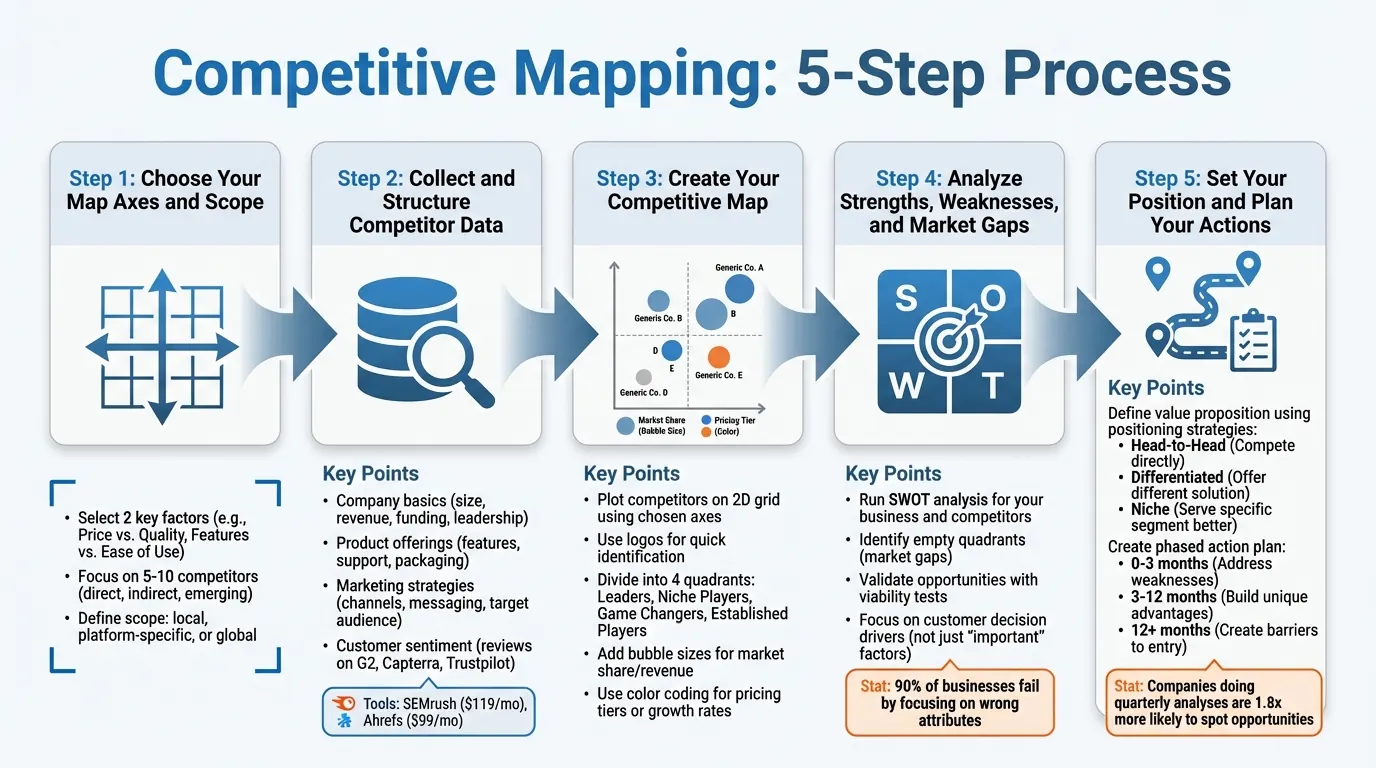
Step 1: Choose Your Map Axes and Scope
Selecting the Right Axes
The axes of your map should reflect the key factors that influence your target customer’s buying decisions - not just what you think matters, but what actually drives their choices. To figure this out, gather insights directly from your customers through interviews or surveys. This will help you pinpoint the features or attributes they prioritize most.
For example, if you’re in SaaS, Features vs. Ease of Use might be the most relevant axes. In retail, Price vs. Quality often highlights competitive positioning, while in food and beverage, Price vs. Nutritional Value can uncover opportunities.
Once you identify these key dimensions, define your grid using measurable metrics like brand reputation, product range, or customer retention. Assign weights to each factor (ensuring they add up to 1.0) and rate competitors on a scale from 1 (weak) to 4 (strong).
"You can't look at the competition and say you're going to do it better. You have to look at the competition and say you're going to do it differently." – Steve Jobs, Co-founder, Apple
For digital businesses, consider using axes like Total Traffic vs. Traffic Growth % to spot market leaders and rising competitors. The ultimate goal is to identify gaps - areas where no competitor is operating, such as offering high quality at a low price point. With these axes in place, you're ready to choose which competitors to analyze.
Deciding Which Competitors to Include
Focus on a manageable group of 5 to 10 competitors. This allows for a thorough comparison while keeping the analysis focused. Your list should include a mix of direct competitors (offering the same product to the same audience) and indirect ones (different products meeting the same needs).
To build this list, ask current and former customers which alternatives they considered. Use tools like Google’s "People also search for" feature or search for "alternatives to [your product]" to uncover competitors you might overlook. Platforms like SimilarWeb or SEMrush can also help identify who’s competing for your audience’s attention and search traffic.
Include a variety of competitors to cover all angles:
- Direct competitors: Companies offering similar products to the same audience.
- Indirect competitors: Businesses meeting the same needs with different solutions.
- Emerging competitors: Startups or players from adjacent industries entering your space.
- Aspirational competitors: Industry leaders you aim to emulate for long-term growth.
"The greater the insight into the competition, the greater the competitive gap." – Alina Wheeler, Author of Designing Brand Identity
Lastly, define the scope of your analysis - whether it’s local, platform-specific, or global. This ensures you stay focused and don’t waste resources. For fast-changing markets, update your analysis quarterly; for more stable industries, a semi-annual review works best.
Step 2: Collect and Structure Competitor Data
What Data to Collect
Start by gathering the basics: company size, revenue, funding status, leadership team, and geographic footprint. Dive deeper into their product offerings, including key features, support channels, and how they package their services. Take note of their sales tactics - pricing strategies, discount practices, free trials, and even their sales funnel performance.
Understanding their marketing and audience strategies is equally important. Look at who they’re targeting, which channels they emphasize (like SEO, social media, or paid ads), and the themes they use in their messaging. LinkedIn hiring trends can also give away potential product shifts or plans for market expansion.
Customer sentiment is where you’ll uncover insights competitors might not openly share. Reviews on platforms like G2, Capterra, and Trustpilot highlight genuine user experiences - the good, the bad, and the ugly. Companies that rely on structured competitive intelligence programs make smarter strategic decisions 76% of the time compared to those relying on informal observations. Focus your in-depth analysis on 3–5 direct competitors while keeping tabs on 10–15 secondary players. Once you’ve identified what to track, it’s time to find the right sources.
Where to Find Competitor Information
Start with publicly available resources. Company websites, pricing pages, product documentation, press releases, and investor databases offer insights into their official positioning. For marketing data, tools like SEMrush (starting at $119/month) and Ahrefs (starting at $99/month) can provide details on their organic rankings, keyword strategies, and backlink profiles. Platforms like the Meta Ads Library and TikTok Ads Library allow you to view their active ad campaigns for free.
To understand customer opinions, check feedback on G2, Capterra, app stores, and even Reddit. Sign up for competitors’ free trials to experience their onboarding process and customer support firsthand. Set up Google Alerts for competitor names and key executives to stay updated on new launches, partnerships, or leadership changes as they happen.
"Competitive analysis maintains market advantage by tracking what rivals do, how they position themselves, and where opportunities exist to win." – Sean O'Connor, Content Specialist, monday.com
Keep all your findings organized in a centralized tool like Google Sheets or Airtable to ensure your team has easy access to this information. Keep in mind that the competitive landscape changes quickly - new product launches and pricing adjustments can make your data outdated in just 90 days. Plan for regular updates to stay ahead.
Step 3: Create Your Competitive Map
Plotting Competitors on a 2D Grid
This step involves visually mapping your competitors on a 2D grid using the axes you defined earlier. Start by setting clear minimum and maximum values for your axes - for example, price could range from $0 to $500 or $0 to $5,000, depending on your market. These boundaries create a structured space where competitors can be accurately placed.
To plot competitors, identify where their data points intersect. For instance, if you're comparing price and quality, a company offering high-priced, high-quality products would sit in the top-right quadrant, while a budget-friendly, lower-quality option would fall in the bottom-left. To make your map more intuitive, use competitor logos for quick identification. Keep the map manageable by focusing on four to ten competitors - too many can overwhelm the visual and reduce its effectiveness.
Divide the grid into four quadrants to group competitors into categories like:
- Leaders: High on both axes, often dominating the market.
- Niche Players: Focused on specific, smaller segments.
- Game Changers: Emerging competitors with high growth potential.
- Established Players: Strong market presence but slower growth.
This setup highlights clusters of competitors and uncovers potential gaps in the market. It provides a clear framework for understanding where each competitor stands and how they compare to one another.
"A well-placed campaign can shift market perception, as seen when Apple's strategic positioning boosted its market share."
Adding Extra Information to the Map
You can make your 2D grid even more insightful by layering additional data. For example, use bubble sizes to represent a third metric, such as market share, revenue, or company size. A larger bubble instantly signals a major player, even if they’re in a less favorable quadrant. Add color coding to indicate pricing tiers (e.g., premium vs. budget), growth rates, or whether competitors are direct or indirect.
Consider creating multiple versions of your map, such as price vs. quality or innovation vs. reliability, to gain different perspectives. Basic scatter plots can be created using tools like Google Sheets or Microsoft Excel, while platforms like Canva and Creately offer more advanced visuals with automated data capabilities. Update your maps periodically - whether quarterly or annually - to track changes in competitor positioning. With these enriched visuals, you’ll be better equipped to analyze trends and refine your strategy.
Step 4: Analyze Strengths, Weaknesses, and Market Gaps
Running a SWOT Analysis
To get a clearer picture of your competitive landscape, use a SWOT analysis to evaluate Strengths, Weaknesses, Opportunities, and Threats for both your business and your main competitors. This can be done by leveraging your competitive map. For instance, if a competitor is positioned in a high-price, low-quality quadrant, it highlights a potential weakness you could take advantage of. On the other hand, being situated in a high-value, low-price area can showcase your ability to deliver strong value.
For Strengths, identify what sets competitors apart - this could be anything from intellectual property and advanced technology to strong brand recognition. Pinpoint where they excel based on the map’s axes. When it comes to Weaknesses, customer feedback is a treasure trove of insights. Platforms like G2, Trustpilot, and Reddit can reveal common complaints or recurring frustrations - often referred to as "pain language". To take this further, a Competitive Profile Matrix (CPM) can help you assign weighted scores to critical factors like product quality, pricing, and customer service.
For Opportunities, focus on the unoccupied areas of your map - these "white spaces" represent market segments that are currently underserved. For Threats, keep an eye on competitors moving into your quadrant or expanding into new segments that could challenge your position. By 2026, many companies are expected to use AI tools like ChatGPT and Claude to automate SWOT analyses and conduct real-time reviews of competitor sentiment, making the process faster and more efficient.
"The greater the insight into the competition, the greater the competitive gap." - Alina Wheeler, Author of Designing Brand Identity
Once you’ve completed your SWOT analysis, the next step is to zero in on actionable market opportunities.
Finding Opportunities in the Market
Using your SWOT analysis as a foundation, turn your attention to the competitive map to locate clear market gaps. Empty quadrants often indicate unmet needs, while crowded areas suggest tougher competition. Before jumping into an empty space, conduct a viability test to ensure it’s a real opportunity and not a failed market segment. For example, a quadrant that combines low pricing with high customization may seem appealing but could be financially unsustainable.
It’s also important to focus on what drives customer decisions rather than just what’s "important." Take airlines, for example. While safety is crucial, it’s typically assumed as a baseline. Instead, factors like legroom or route availability often influence customer choices. Research shows that 90% of businesses fail in competitive mapping because they focus on attributes that don’t actually drive purchasing decisions. Avoid defaulting to the overused "Price vs. Quality" framework, which often pushes brands along a predictable diagonal line. Instead, consider other dimensions like "Complex vs. Simple" or "Traditional vs. Avant-Garde" to uncover less obvious opportunities.
To validate these market gaps, analyze customer reviews and engage in social listening. Insights from these activities can help you position your brand strategically, potentially increasing client margins by an average of 35%. Keep your SWOT and market gap analyses up to date to account for competitor movements and maintain flexibility in your strategy.
Step 5: Set Your Position and Plan Your Actions
Creating Your Value Proposition
Once you've identified market gaps and analyzed your strengths through the SWOT framework, it's time to define your competitive edge. The key here is to align your strengths with the opportunities you've discovered in your competitive map. Your value proposition should answer the question: Why should customers choose you over others? Interestingly, research shows that 58% of companies rely more on intuition than formal analysis for strategic decisions, which often leads to poorly defined positioning.
You can choose from three main positioning strategies.
- Head-to-Head: Compete directly with a market leader by highlighting a specific advantage. A great example is how Figma took on Adobe XD and Sketch in 2020 by focusing on real-time collaboration - something their competitors overlooked.
- Differentiated: Offer a completely different way to solve the same problem. This works particularly well in mature markets where existing solutions leave customers frustrated.
- Niche: Zero in on a specific segment and serve them better than anyone else. Superhuman did this by targeting power email users, charging $30/month, and focusing on speed and keyboard shortcuts, which appealed to people managing over 100 emails daily.
A helpful structure for crafting your positioning statement is: "For [target customer] who [pain point], [product] is the [category] that [key differentiator]. Unlike [competitor], [product] [primary advantage]".
Your value proposition should focus on areas where competitors are weak and where you have a defensible advantage, like network effects, high switching costs, or proprietary data. A strong value proposition not only differentiates you but also shields you from being commoditized.
Building Your Action Plan
After refining your positioning, the next step is to turn insights into a structured action plan. Break this plan into three phases:
- Immediate actions (0-3 months): Address glaring weaknesses and match basic features that competitors already provide.
- Medium-term strategies (3-12 months): Build unique advantages, target new market segments, and roll out features that set you apart.
- Long-term initiatives (12+ months): Focus on creating barriers to entry, like high switching costs or exclusive offerings, to secure your market position.
For example, in 2025, a $350 million smart home company used this phased approach to target the North American SMB security market. They found a gap in the mid-price tier, offering remote installation assistance between low-cost DIY setups and expensive professional services. Within six months of launching their "Pro Remote" plan, priced 20-25% below traditional integrators, they filled the gap and hit their early acquisition goals.
Data supports the value of structured planning - companies that conduct quarterly competitive analyses are 1.8 times more likely to spot market opportunities before their rivals.
To execute effectively, consider working with strategic advisors who can help translate competitive insights into actionable plans. For instance, Patrick Frank's 1-on-1 strategy sessions offer tailored guidance on go-to-market strategies, refining value propositions, and creating scalable action plans. Assign clear ownership for each task and embed your competitive map into your regular planning processes to ensure follow-through.
Best Market Mapping Template (Map A Powerful Brand Position)
Conclusion
To effectively leverage competitive mapping, focus on these five steps: choosing the right axes, collecting competitor data, visualizing market dynamics, identifying gaps, and turning insights into action. Using a well-structured competitive mapping template simplifies complex market data, making it easier to identify actionable opportunities. This approach not only streamlines decision-making but also uncovers strategic areas that might otherwise go unnoticed.
The real strength of competitive mapping lies in its ability to reveal insights that spreadsheets and reports often miss. For instance, Alina Wheeler emphasizes that deeper competitive understanding can broaden your strategic advantage. A great example of this is Apple’s use of a design and ease-of-use matrix during their "Get a Mac" campaign in 2006. This strategy contributed to a 39% increase in Mac sales the following year.
To stay ahead, make it a habit to update your maps with input from your sales, product, and customer success teams. Instead of mimicking competitors, focus on capitalizing on market gaps by playing to your strengths. A well-maintained competitive map acts as a strategic guide, helping you cut through the noise and create a distinct, differentiated offering.
FAQs
How do I choose the best two axes for my market?
To pick the best two axes, zero in on the key market factors that set competitors apart and reveal potential opportunities. Popular choices include price vs. quality, innovation vs. cost-efficiency, or market share vs. growth potential. Make sure the axes align with your strategic objectives, can be measured, and expose gaps or strengths in the market. This approach helps you map out your position and identify areas where you can stand out.
What if competitor data is missing or unreliable?
If the competitor data you have is incomplete or unreliable, try presenting what you do have through charts, graphs, or maps. Visual tools like these can help uncover market gaps and potential opportunities that might not be obvious at first glance.
You can also use structured tools, such as competitive matrices or templates, to organize the partial data. These tools make it easier to spot patterns, evaluate competitors' strengths and weaknesses, and guide strategic decisions - even when you're working with limited information.
How do I turn a market gap on the map into a real plan?
To transform a market gap into a workable plan, start by understanding the gap and analyzing the opportunities it presents. Here's how you can approach it:
- Pinpoint the gap: Identify the specific area where customer needs aren't being met.
- Study competitors: Gather data on what others in the market are offering and where they fall short.
- Examine unmet needs: Dive deep into what your target audience is missing or looking for.
- Develop actionable steps: Create a plan that includes clear actions, such as introducing new products, adjusting pricing, or improving services.
By following these steps, you can address untapped needs and turn your insights into tangible growth strategies.