
Compliance is no longer optional for startups aiming to scale. Ignoring it can lead to lost revenue, reduced valuations, and delayed funding rounds. For instance, one startup missed out on $500,000 in annual recurring revenue in late 2025 due to a delayed SOC 2 report. Another faced a 15% valuation cut over unresolved tax and documentation issues.
Key challenges for startups include navigating complex regulations, safeguarding data, and managing limited resources. Automated compliance tools can save hundreds of hours, reduce audit times by up to 82%, and transform compliance from a burden into a growth enabler.
Here’s a quick breakdown of top compliance tools:
- Vanta: Best for startups needing speed and ease of use, with 400+ integrations and hourly automated tests.
- Drata: Ideal for scaling teams with deep technical needs, offering 270+ integrations and detailed configuration testing.
- Scrut: Focuses on risk management, perfect for startups with complex supply chains or multi-framework needs.
- Comp AI: Fast and budget-friendly, delivering SOC 2 readiness in 24 hours with AI-driven automation.
Each tool serves different needs based on your startup’s growth stage, resources, and compliance priorities. Investing in the right platform early can streamline processes, secure deals, and build trust with investors and customers.
Harmonizing & Scaling Compliance Part 1: Establishing the Foundation for Streamlined Controls
Common Compliance Challenges During Fast Growth
Rapid growth can make compliance feel like an uphill battle. Teams are stretched thin, tech stacks grow more complex, and new regulations seem to pop up overnight. The stats paint a clear picture: 29% of organizations have lost new business opportunities because they couldn’t provide the right compliance certification when it mattered most. The main hurdles? Navigating regulations, safeguarding data, and managing limited resources.
Understanding Complex Regulatory Frameworks
Early-stage startups often start with one framework - like SOC 2 for U.S. customers. But as you grow, the landscape shifts dramatically. Expanding into Europe? Now you’re dealing with GDPR. Land a healthcare client? HIPAA requirements come into play. Add AI to your offerings, and the EU AI Act becomes a factor.
The tricky part is managing these overlapping requirements without duplicating efforts. Many startups mistakenly run multiple audits, wasting time and money. For example, a single SOC 2 certification can fulfill 100% of SOC 1 requirements and cover 90% of HIPAA evidence needs. Without a strategic approach, you risk doing the same work over and over.
Protecting Data Security and Privacy
As your business scales, so does the volume of sensitive data flowing through your systems. That data spreads across CRMs, HR platforms, cloud storage, and countless SaaS tools, making it nearly impossible to track without automation.
The pressure is on: 85% of consumers say they care about a company’s data privacy policies before making a purchase. And by 2025, 60% of organizations are expected to prioritize cybersecurity risk when selecting vendors. Adding third-party integrations only complicates matters, introducing potential security vulnerabilities that you’re responsible for managing.
Limited Resources for Compliance Management
Most startups don’t even have a dedicated security team until they hit Series B. This leaves engineering leaders juggling compliance duties alongside product development. Manual processes eat up valuable time across engineering, legal, and operations teams.
"Complexity scales faster than teams. Your risk has outgrown your headcount." – DataGrail
Small businesses often pay 69% more per employee for regulatory compliance compared to larger companies. With a seed-stage budget of just $5,000–$15,000 annually for compliance, every hour spent on manual documentation is an hour not spent on innovation. This resource crunch pushes startups into reactive mode - treating compliance as a last-minute scramble instead of embedding it into their operations from the start.
Compliance Tools for Startups
Startups often face the dual challenge of rapid growth and navigating an ever-evolving regulatory landscape. Compliance tools can make this process much smoother by transforming what could take months of manual work into weeks of audit readiness. Modern platforms have moved beyond simple snapshots in time to continuous monitoring, catching security issues in real time instead of waiting for annual audits. With cybercrime projected to surpass $10.5 trillion by 2025, certifications like SOC 2 and ISO 27001 are now critical for securing deals.
Here’s a look at four platforms that cater to startups at various stages of growth. Vanta stands out for its broad capabilities, offering 400+ integrations and hourly automated tests across 35+ frameworks. Drata takes a deeper technical approach, with features like granular cloud checks and an "Audit Hub" for seamless auditor collaboration. Scrut focuses on risk management, making it ideal for startups with complex supply chains. Lastly, Comp AI uses AI to drastically shorten timelines, claiming SOC 2 Type I readiness in as little as 24 hours.
The benefits are clear. Vanta automates up to 90% of evidence collection, potentially saving over 50 hours of manual work, with customers reporting a 526% ROI over three years. Drata has been shown to cut SOC 2 audit durations by 75%. For example, in November 2025, Persona AI's CTO Daniel Rascon switched from Vanta to Comp AI after struggling to get past 30% of SOC 2 compliance over four months. Within two weeks, they were ready to begin their SOC 2 Type II observation period.
"Vanta has saved us hundreds of hours and well over six figures in potential lost deals or added headcount." – Everett Berry, GTM Engineering, Clay
Each of these platforms offers unique advantages, catering to different startup priorities, from speed and simplicity to advanced customization. Let’s take a closer look at what makes each one tick.
Drata: Automated Compliance Monitoring
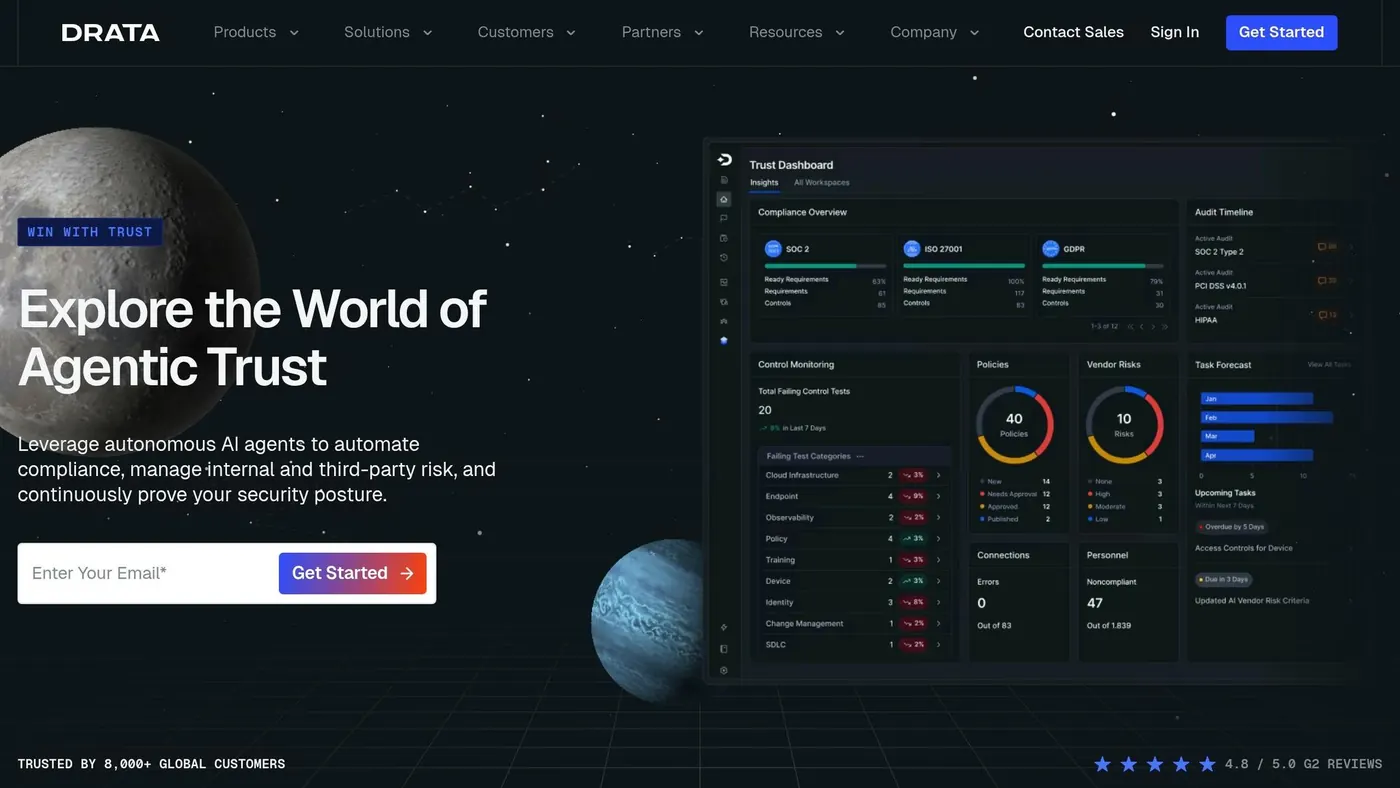
Drata specializes in enterprise-grade governance, risk, and compliance (GRC), making it a favorite for engineering-heavy teams. With 270+ integrations, it performs daily automated checks and offers highly detailed configuration testing. Its "Audit Hub" streamlines collaboration with auditors, cutting down on endless back-and-forth emails.
Drata’s AI-powered features handle vendor risk assessments and evidence collection, reducing the need for a dedicated security team. On G2, Drata scores 9.6/10 for Quality of Support, slightly ahead of Vanta’s 9.0/10, with users praising its real-time chat functionality for expert advice.
However, Drata’s setup process requires more engineering involvement, typically taking 6–12 weeks. It also relies on third-party MDM tools like Jamf or Kandji for device monitoring, which can add complexity for teams without existing IT infrastructure. Pricing starts at $7,500/year for the Essential plan and scales up to $100,000+ for custom enterprise solutions.
Vanta: Multi-Framework Compliance Solutions
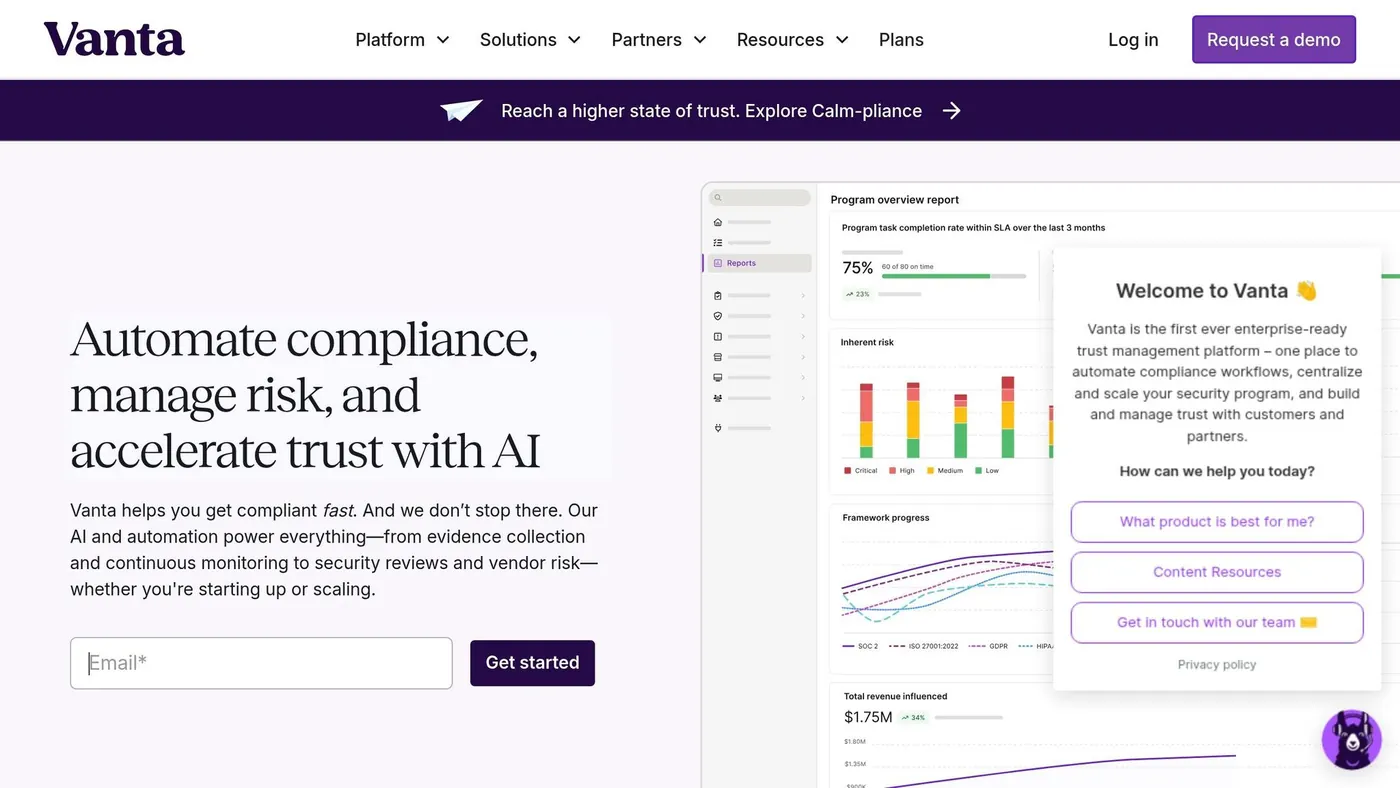
Vanta is designed for startups that need speed and ease of use. It supports 35+ frameworks, including SOC 2, ISO 27001, HIPAA, and GDPR, with the largest integration library in the market at 400+ connections. Unlike Drata, Vanta includes a built-in lightweight device agent for monitoring employee laptops, eliminating the need for additional MDM tools.
Vanta runs automated tests hourly, conducting approximately 1,200 tests per hour. Customers report a 129% increase in compliance team productivity, with many seeing the platform pay for itself in just three months. Its AI Agent also automates tasks like policy building and security questionnaire completion, which are traditionally time-consuming.
Manmit Shrimali, co-founder of Turing Labs Inc., switched from Drata to Vanta, citing superior customer support for navigating complex InfoSec documents and security questionnaires. Pricing starts at $12,000/year for the Core plan, with Growth and Scale plans ranging from $22,600/year to $80,000/year.
Scrut: SOC 2 and GDPR Compliance Automation
Scrut takes a risk-first approach, making it ideal for startups dealing with complex supply chains or third-party dependencies. It offers native vendor risk management and customizable workflows that extend beyond basic compliance automation. This makes it especially useful for businesses needing comprehensive compliance across 20+ frameworks.
Scrut’s strength lies in its unified risk visibility, providing a complete picture of your security posture rather than focusing solely on individual frameworks. While Vanta and Drata excel at automating evidence collection, Scrut prioritizes ongoing risk assessments. This approach is better suited for mid-market companies, as it requires more advanced security processes. The platform integrates with 180+ tools.
Although Scrut has a steeper learning curve compared to Vanta’s plug-and-play setup, its flexibility and built-in risk modules are highly praised. Pricing starts at $8,000/year and scales to $18,000+ with additional GRC modules and consulting hours. Audit readiness typically takes 1–2 months.
Comp AI: Minimal Viable Compliance Stacks
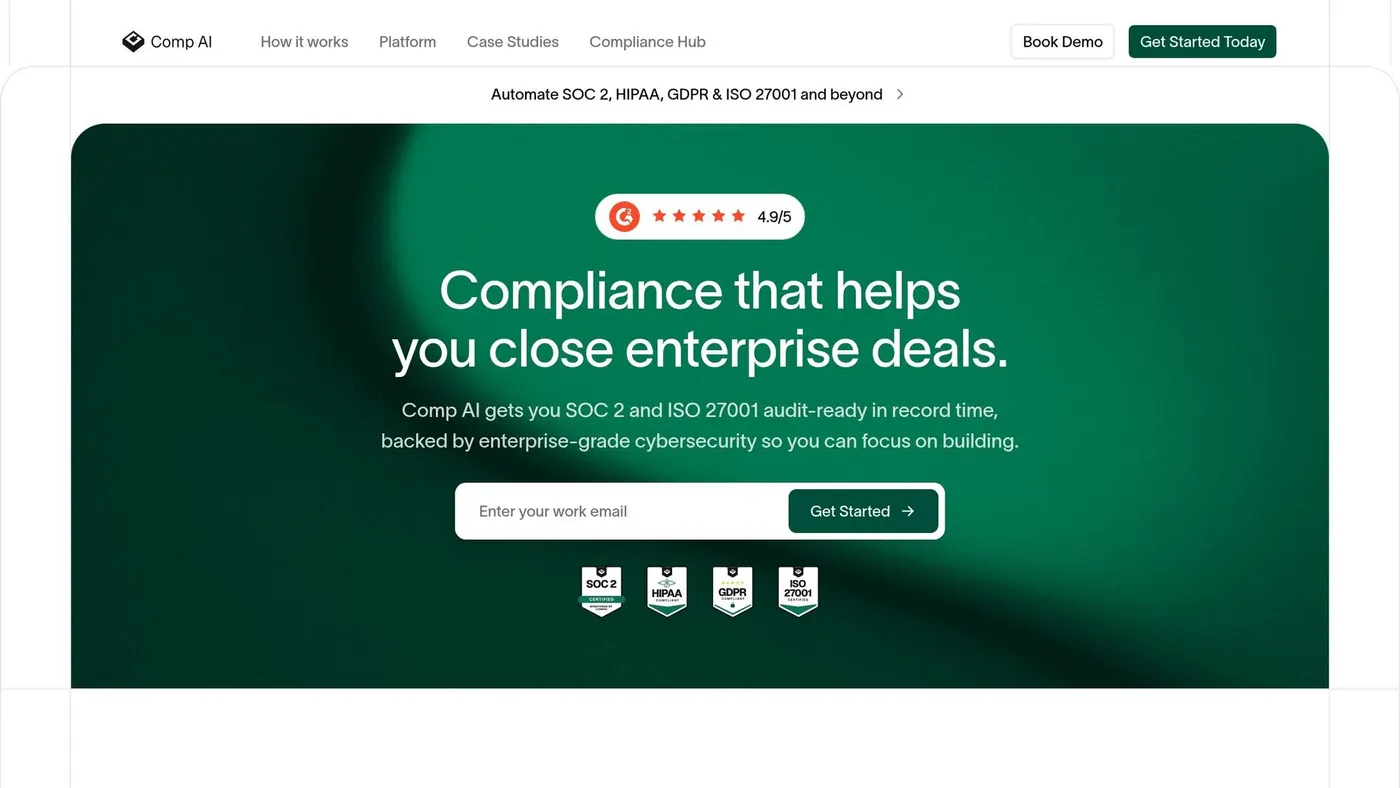
Comp AI is designed for startups that need to move fast. Its "agentic" platform approach allows for SOC 2 Type I readiness in just 24 hours, compared to the weeks or months required by traditional platforms. With 500+ integrations and open-source device agents, it replaces manual processes with continuous evidence collection.
One standout feature is its automated screenshot capture and open-source transparency. Teams can audit integrations and checks directly on GitHub, ensuring full visibility into how compliance evidence is gathered. Comp AI also offers 1:1 Slack support, providing hands-on guidance.
Pricing starts at $797/month, with total SOC 2 costs typically ranging from $5,000–$10,000, making it a cost-effective option for early-stage startups. While it lacks some enterprise-grade features, its speed and simplicity make it a great fit for seed-stage companies prioritizing quick audit readiness over comprehensive GRC functionality.
Feature Comparison of Compliance Tools
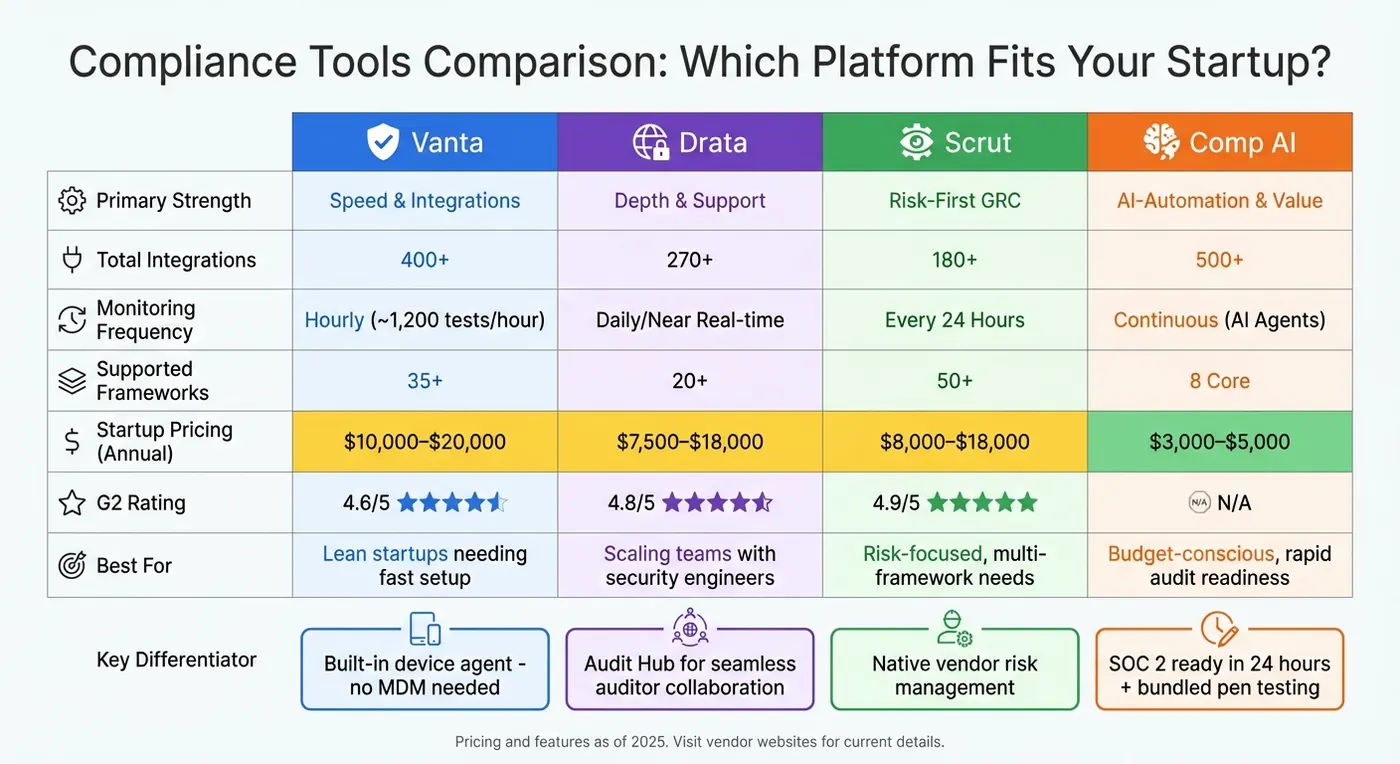
Comparison Table: Features and Benefits
When selecting a compliance tool, it's essential to align the tool's strengths with your business needs, especially during periods of rapid growth. Below is a quick comparison of key features to help you make an informed decision.
| Feature | Vanta | Drata | Scrut | Comp AI |
|---|---|---|---|---|
| Primary Strength | Speed & Integrations | Depth & Support | Risk-First GRC | AI-Automation & Value |
| Total Integrations | 400+ | 270+ | 180+ | 500+ |
| Monitoring Frequency | Hourly (~1,200 tests/hour) | Daily/Near Real-time | Every 24 Hours | Continuous (AI Agents) |
| Supported Frameworks | 35+ | 20+ | 50+ | 8 Core |
| Device Management | Built-in Lightweight Agent | Third-party MDM (Jamf, Kandji) | Third-party MDM | Open Source Agent |
| Audit/Pen Test Costs | Extra ($15,000–$45,000) | Extra ($15,000–$45,000) | Varies | Bundled in Price |
| Startup Pricing | $10,000–$20,000/year | $7,500–$18,000/year | $8,000–$18,000/year | $3,000–$5,000/year |
| Enterprise Pricing | $30,000–$100,000+/year | $45,000–$80,000+/year | Quote-based | Custom |
| G2 Rating | 4.6/5 | 4.8/5 | 4.9/5 | N/A |
| Support Quality (G2) | 9.0/10 | 9.6/10 | 24/7 with APAC focus | N/A |
| Best For | Lean startups needing fast setup | Scaling teams with security engineers | Risk-focused, multi-framework needs | Budget-conscious, rapid audit readiness |
Vanta is tailored for lean teams that need a fast and efficient compliance setup. With hourly automated testing and 400+ integrations, it simplifies the process for startups without a dedicated security team.
Drata is designed for teams that need robust automation and easy collaboration with auditors. Its "Audit Hub" and 270+ integrations make it a great choice for companies navigating increasingly complex compliance requirements.
Scrut takes a risk-first approach, making it a standout for industries with heavy regulatory demands or intricate supply chains. With support for over 50 frameworks and built-in vendor risk management, it’s a solid option for tackling multi-layered compliance needs.
Comp AI leverages AI-driven automation to deliver fast audit readiness, boasting SOC 2 Type I readiness in just 24 hours. Its bundled audit and penetration testing eliminates extra costs, saving businesses up to $45,000 in external fees.
Budgeting for Compliance Tools at Different Growth Stages
Seed-Stage Budgeting: Affordable Basics
When you're in the seed stage, compliance often takes a backseat until it's absolutely necessary - like when a customer demands it. At this point, sticking to free or low-cost tools is the way to go. Think password management, cloud workspaces, and policy documentation. Your budget can range from $0 to $500 per month, which translates to about $5,000 to $15,000 annually.
Some great tools to consider include Bitwarden (free), Google Workspace (around $6 per user per month), and Notion (free). These provide a strong starting point without eating up too much of your funding. SOC 2 certification, however, should be avoided at this stage. Early-stage products often lack the stability needed for certification, and the costs can be a major drain on your resources. For example, Luthor points out that with an annual compliance cost of $390,000, you could end up spending over 11% of a typical $3.5 million seed round.
Once you move into Series A funding, compliance becomes more than just a checkbox - it becomes a tool to help you grow and land bigger deals.
Series A and Beyond: Investing in Advanced Solutions
By the time you reach Series A, compliance shifts from being a low-priority task to a key business driver. Around 70% of enterprise deals require SOC 2 certification, and having it can help you close deals two to three times faster. At this stage, your budget should increase significantly - expect to spend between $500 and $6,000 per month, or $15,000 to $50,000 annually, to cover advanced tools like Vanta or Drata.
SOC 2 certification itself is a big-ticket item, costing anywhere from $50,000 to $82,000. This includes platform fees ($5,000–$12,000), auditor fees ($20,000–$30,000), and penetration testing (around $10,000–$15,000). If you're looking to save, boutique audit firms can often provide certification for about $25,000, which is far cheaper than the $60,000+ charged by "Big 4" firms. Additionally, platforms like Secureframe (around $5,000) can give you a competitive edge when negotiating prices with tools like Vanta or Drata.
Investing wisely in compliance at this stage not only helps you secure those critical enterprise deals but also lays the groundwork for scalable, long-term growth. For founders, this often requires a shift in mindset, which is where executive coaching services can help align leadership strategy with these new operational demands.
Conclusion
Compliance isn’t just about staying out of trouble - it’s about driving growth. As Compliagence AI puts it, "Compliance isn't a cost center, it's a revenue enabler. Mature operations shorten sales cycles, unlock enterprise contracts, and open new markets through trust and efficiency". By investing early in the right tools, businesses can build a strong foundation that speeds up deal closures and scales growth effectively.
When selecting compliance tools, it’s important to weigh your options carefully. Some may prefer specialized tools for specific needs, while others might opt for all-in-one platforms. Keep in mind, no single solution will fit every requirement. You’ll also need to decide between rigid templates for quicker results or flexible workflows for more complex scenarios. Above all, avoid falling into the trap of "compliance debt" - addressing issues later can be much costlier.
To stay ahead, follow the Six-Month Rule: revisit your compliance strategy at least six months before audits. This proactive approach prevents last-minute chaos, or as some call it, "Audit Scrambles." Automated platforms like Vanta can make a huge difference, cutting audit times by 82% and increasing attestations by 142%. Once your timing is optimized, focus on the compliance measures that will have the biggest impact.
Start by prioritizing KYC/AML and sanctions screening. Then, consider using cross-framework mapping tools to repurpose SOC 2 controls for ISO 27001. This approach not only keeps costs under control but also ensures you're prepared as your business grows.
FAQs
When should a startup start SOC 2?
Startups should aim to tackle SOC 2 compliance once they hit the Series A stage or land their first enterprise client that requires it. Why? It speeds up deal closures and matches the expectations of enterprise customers. Getting a head start on this process not only makes scaling operations easier but also strengthens trust with bigger clients.
How do I pick the right compliance tool for my stage?
Selecting the best compliance tool starts with understanding your current requirements and future growth ambitions. Focus on tools that offer features like automation, centralized policy management, and the ability to scale effortlessly as your business expands.
A good compliance tool should streamline workflows, provide support for multiple compliance frameworks, and adapt smoothly as your company transitions from a startup to a larger operation. Pay attention to ease of use and a proven track record with startups - this can help you avoid unnecessary disruptions as you scale.
How can one audit cover multiple frameworks?
To tackle audits across multiple frameworks, consider using compliance tools that bring everything together in one place - policies, controls, and evidence. These tools not only automate monitoring and audits but also map controls to different frameworks. This makes it much simpler to show compliance with various standards, cutting down on the manual work involved.