
If you want a cleaner view of dilution, a SAFE is usually easier to map. If you want debt-style terms and expect a priced round in 12 to 18 months, a convertible note may fit better.
When I compare the two, the cap table comes down to four things:
- SAFEs don’t accrue interest
- Convertible notes do accrue interest, often 4% to 8% per year
- Post-money SAFEs fix the investor’s target ownership at signing
- Notes can dilute more over time if the next priced round is delayed
That means your choice is not just about legal docs. It changes:
- founder ownership
- employee pool dilution
- investor leverage at maturity
- how easy it is to forecast a Series A
A simple example shows the difference. A $500,000 post-money SAFE at a $5,000,000 cap points to 10% ownership before the next priced round. A $500,000 note at 6% simple interest for 18 months converts as about $545,000, so the final share count grows before conversion.
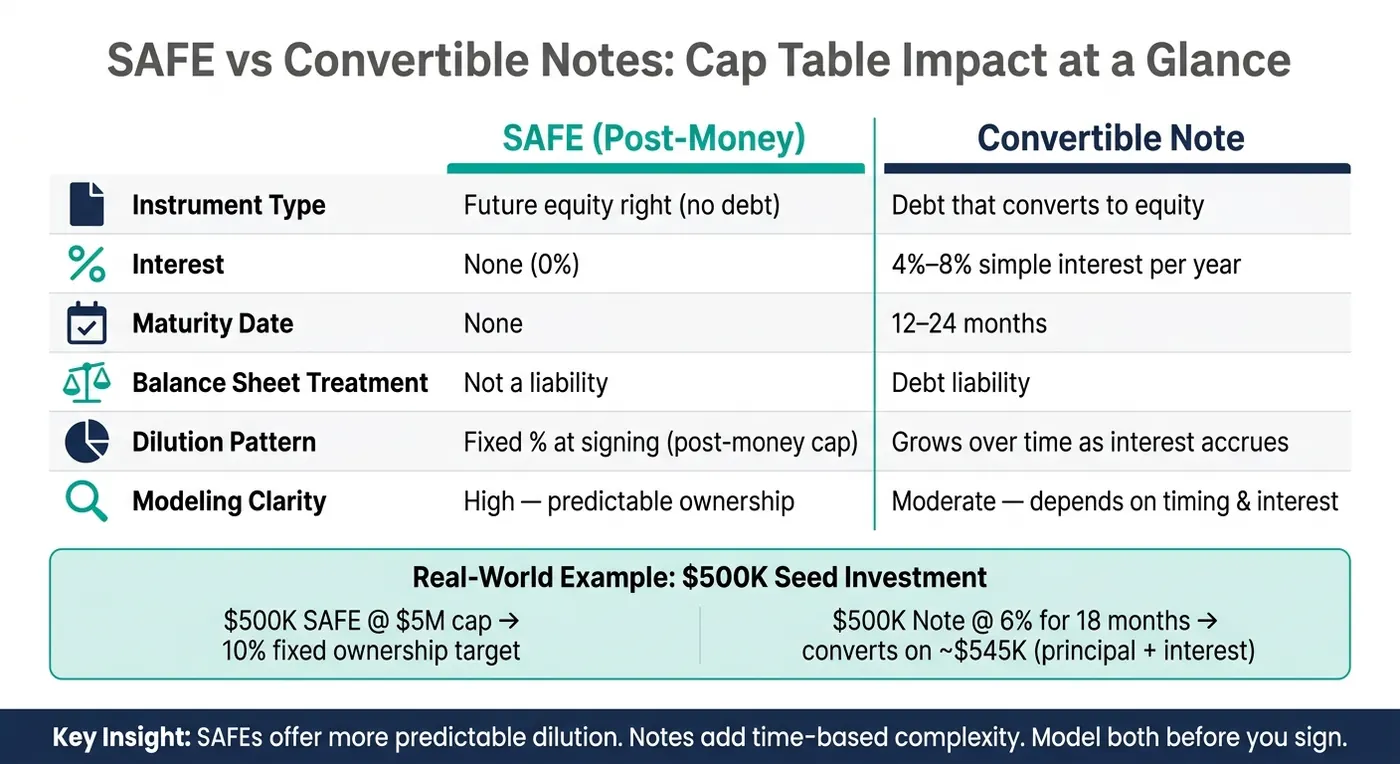
Startup Financing 101: How SAFEs and Convertible Notes Work | Equity funding explained
Quick Comparison
| Criteria | SAFE | Convertible Note |
|---|---|---|
| What it is | Future equity right | Debt that converts to equity |
| Interest | None | 4%–8% simple interest |
| Maturity date | No | Yes, often 12–24 months |
| Balance sheet treatment | Not debt | Debt liability |
| Dilution pattern | More fixed with post-money SAFEs | Grows with time and interest |
| Founder risk | Hidden dilution from stacked SAFEs and pool top-ups | More dilution if closing takes longer, plus repayment pressure |
| Modeling | Easier to forecast | Harder to forecast |
My short take: if you stack multiple SAFEs, founder dilution can pile up fast. If you use notes, interest and maturity can put pressure on both your cap table and your next fundraise. So before you sign, I’d model three cases: a Series A at the cap, above the cap, and below the cap.
That’s the core of this article: how each seed instrument changes ownership, where founders get surprised, and what to check before the round closes.
How SAFEs Affect Ownership and Dilution
A SAFE is a future equity claim, not debt. Before a priced round closes, it sits off the cap table, which can make dilution easy to miss until conversion. The cap-table effect shows up when the SAFE turns into shares.
Once a priced round closes, each SAFE converts into preferred shares. The total share count goes up, and founder ownership goes down as those once-hidden claims become actual equity.
SAFE Terms That Directly Change the Cap Table
The valuation cap is the term that matters most here. It sets the highest valuation at which the SAFE converts into equity. A lower cap gives the investor more shares at conversion, which means more dilution for founders and employees.
Discount rates - usually between 15% and 25% - let investors convert at a lower price than priced-round investors. If the round is priced below the cap, the SAFE converts at the lower of the cap-based price or the discounted round price.
MFN clauses let early investors match better terms, and pro-rata rights let them keep their ownership in later rounds. Both can make a Series A tougher to structure if they aren't scoped with care when signed.
Pre-Money vs. Post-Money SAFEs: Why the Difference Matters
The big issue is simple: who takes the dilution when several SAFEs stack in the same round?
With a pre-money SAFE, the investor's final ownership percentage isn't fixed until conversion. It changes based on how many other SAFEs are issued in the same round. Earlier investors get diluted by later ones, and the math stays uncertain until the priced round closes.
With a post-money SAFE, the investor's ownership is fixed at signing with a simple formula: Investment ÷ Post-Money Valuation Cap. That gives investors more certainty, but it puts more of the dilution on founders. Each new SAFE check added in the round increases founder dilution, not dilution for earlier investors.
"A post-money SAFE effectively locks in the investor's slice of the pie at the moment of conversion, whereas a pre-money SAFE's ultimate percentage is fluid until your Series A is priced." - Jason Acevedo, Partner, Klehr Harrison
Common SAFE Modeling Mistakes in Seed Rounds
Trouble starts when founders treat each SAFE like its own small deal instead of part of one shared dilution pool.
The biggest mistake is looking at each SAFE on its own. Founders often stack several SAFEs, sometimes with different caps, and assume the dilution will stay under control. A lot of the time, it doesn't.
"The most common founder mistake is 'raising multiple different SAFEs with different terms' rather than running a clean, structured pre-priced layer." - Healy Jones, Kruze Consulting
Another common miss is the option pool shuffle. Series A investors often want the employee option pool increased before the round closes. In post-money structures, that bigger option pool cuts directly into founder ownership.
A third mistake is assuming every SAFE in a round converts on the same economics. Different caps and MFN terms can create uneven conversion math, and that can snowball fast. Patrick Frank can help founders line up SAFE terms in a live cap table and forecast dilution before closing.
How Convertible Notes Affect Ownership and Dilution
A convertible note starts as debt. It stays debt until the company repays it or it converts into equity. That setup creates a timing issue: the longer the note sits out there, the more dilution it can cause later. That's a big reason notes are harder to predict than SAFEs.
Note Terms That Increase Dilution Over Time
Most notes use the same cap-and-discount setup as SAFEs. But they also add simple interest, often 4% to 8% per year. That interest usually isn't paid in cash. Instead, it builds up and converts into extra equity in the next priced round.
"That accrued interest converted into equity. You didn't pay it in cash; it compounded into your cap table." - Seth Girsky, Founder, Inflection CFO
Here's the part founders can miss at first glance: the note doesn't just convert based on the original investment amount. It converts based on the principal plus accrued interest. So at 6% for 18 months, a $1,000,000 note converts as about $1,090,000. That extra $90,000 buys more shares at conversion, which means more dilution than the original check size suggested.
What the Cap Table Looks Like Before Maturity and at Conversion
Before conversion, no new shares are issued. On paper, founder ownership can look unchanged. But that can be misleading. The dilution hasn't disappeared; it's just delayed.
When the note converts, the company takes the full principal plus accrued interest and divides it by the conversion price to get the final share count. That conversion price is the lower of the cap price or the discount price. Until that happens, notes sit on the cap table as liabilities. If the round closes, they convert under their terms, often at the same time as SAFEs.
Risks When the Next Priced Round Is Delayed
This is where notes can get tense. The maturity date is usually 12 to 24 months out. If the company hasn't closed a priced round by then, the investor may demand repayment. For most early-stage startups, that's not a check they can write.
"If the convertible note matures before your Series A closes, you might have to pay it back in cash. That changes everything." - Seth Girsky, Founder, Inflection CFO
And if the round takes longer than planned, the pressure builds from two sides. First, the note balance keeps growing as interest accrues. Second, the investor may gain more leverage if maturity hits before a financing event. At that point, they may push to renegotiate terms or agree to extend maturity on new terms. The longer fundraising drags on, the more interest stacks on top of the original principal, which increases dilution. Those tradeoffs stand out most when you put notes next to SAFEs and compare them directly.
SAFE vs. Convertible Notes: Side-by-Side Cap Table Comparison
Put them next to each other, and the main difference is predictability: SAFEs make future ownership easier to map out, while notes bring in time-based dilution.
SAFEs are cleaner. There’s no interest, no maturity clock, and post-money SAFEs lock in the investor’s target ownership when the deal is signed. Notes come with interest, a maturity date, and extra variables. You can see that gap in four areas: timing, dilution, liabilities, and modeling.
| Feature | SAFE (Post-Money) | Convertible Note |
|---|---|---|
| Instrument Type | Future-equity contract | Debt / loan |
| Interest | None | 4–8% simple annually |
| Maturity Date | None | 18–24 months |
| Balance Sheet Treatment | Not a liability | Debt liability |
| Dilution Pattern | Fixed % at signing; pool top-ups hit founders | Accrues over time; conversion math depends on timing |
| Modeling Clarity | High - fixed ownership target | Moderate - depends on timing and interest |
That’s why the next priced round is usually easier to model with SAFEs and harder to forecast with notes.
With post-money SAFEs, the final share count is more predictable. With notes, it turns on accrued interest and the moment of conversion. In a mixed round, even a small shift in conversion timing can change the final cap table.
"The instrument you choose impacts your dilution at Series A, your relationship with investors, your tax complexity, and even your ability to raise future rounds." - CapyTable
Option pool top-ups matter too. Series A investors often ask for an option pool expansion pre-money. With post-money SAFEs, that dilution lands almost entirely on founders - not SAFE holders - because the SAFE’s fixed percentage is calculated without those new shares.
A Hypothetical Dilution Example for a U.S. Seed Round
A $500,000 post-money SAFE at a $5,000,000 cap targets a fixed 10% ownership. At a $20,000,000 Series A, that investor keeps about 8.00% after dilution from the new round.
A $500,000 convertible note with 6% simple interest over 18 months converts on $545,000 in principal plus accrued interest. In that same Series A, the note investor ends up with about 7.08% ownership.
The main takeaway is simple: interest by itself doesn’t mean note holders get more equity. The conversion math matters more.
Choosing the Right Instrument for Cap Table Health
Decision Criteria to Review Before Signing
Once you've compared how each instrument converts, the next step is simple: pick the one that matches your timeline, investor mix, and hiring plan.
The choice usually comes down to five things: how long it may take to reach your next priced round, how many investors you're bringing in, how fast you plan to hire, whether debt pressure is something you can live with, and how clean you want your ownership forecast to look.
| Factor | Favor SAFE | Favor Convertible Note |
|---|---|---|
| Time to Series A | 24+ months or uncertain | 12–18 months with clear milestones |
| Investor count | 10+ small checks | Fewer, larger checks |
| Forecasting clarity | High priority | Comfortable with interest-based dilution |
| Option pool pressure | Low pre-Series A hiring | Hiring plan already scoped |
The hidden variable, more often than not, is the option pool. Model it before you sign anything. Why? Because post-money SAFEs shift that dilution to founders.
It also helps to keep the round simple. Use one cap and one discount across the round so you don't end up with messy conversion mismatches.
Using AI to Maintain a Live Cap Table and Forecast Dilution
After the round structure is in place, keep your cap table live instead of waiting for conversion. A static spreadsheet can work for a while, then fall apart once SAFEs or notes start stacking up.
Update the model every time you add a new instrument. Then use Patrick Frank to run what-if scenarios across Series A prices. That gives you a clearer view of dilution before it shows up on paper.
Conclusion: The Cheapest Instrument Is Not Always the Cleanest
A SAFE is cheaper and faster to close, but only a live model shows whether it stays cleaner.
FAQs
How do stacked SAFEs affect founder dilution?
Stacked SAFEs can create a compounding dilution effect that's often bigger than it looks when you sign each one. Here's why: post-money SAFEs lock in ownership at signing, so every new SAFE adds dilution that shows up on the cap table later, all at once, in a future priced round.
With staggered SAFEs, total dilution equals the combined ownership impact of each SAFE. If you want to avoid a nasty surprise, model all stacked instruments together on a fully diluted basis before your next financing round.
When does a convertible note become risky?
A convertible note gets risky when you don’t close a priced equity round before the maturity date. Since it’s a debt instrument, the company may have a legal duty to repay the principal plus accrued interest once that date passes.
That deadline can also shift power toward investors. They may use it to press for repayment, force conversion, or negotiate terms that work against the company. And while all of that is happening, interest keeps adding up, which means any later conversion can turn into more equity than you planned to give away.
How should I model option pool top-ups?
Run your fully diluted cap table through a few likely conversion scenarios before you sign anything. SAFE and convertible note conversions can change dilution in ways that aren’t obvious at first glance, so it helps to compare how pre-money, post-money, and dollars-invested methods change ownership.
The final share count can move around based on the terms of the priced round, especially if you adjust the option pool right before closing. That one change can hit founder ownership harder than people expect.
The main job here is simple: focus on the levers that most change later ownership. Then use cap table software to model those scenarios ahead of time, so you don’t get blindsided by surprise dilution.