
If I had to boil it down to one point: a valuation cap can dilute founders much more than a discount rate when the next priced round lands far above the cap.
Here’s the short version:
- A valuation cap sets a maximum valuation for SAFE or note conversion.
- A discount rate gives early investors a fixed cut on the next round’s share price, such as 20%.
- If a SAFE has both, the investor usually converts at the lower price.
- In a high-priced Series A, the cap often wins.
- In a lower-priced or near-cap round, the discount can win.
- The lower the conversion price, the more shares the investor gets.
- More investor shares means more founder dilution.
A simple example makes the gap clear. If I invest $500,000 on a SAFE with a $5 million cap and a 20% discount, and the company later prices its Series A at $20 million with 10,000,000 shares outstanding:
- Cap price = $0.50/share
- Discount price = $1.60/share
- The cap applies, and I get 1,000,000 shares
But if the Series A is only $6 million:
- Cap price = $0.50/share
- Discount price = $0.48/share
- The discount applies, and I get about 1,041,666 shares
That’s why founders shouldn’t just look at the headline terms. I’d always model at least 3 cases before signing:
- a round near the cap
- a round at 3x–5x the cap
- a much higher up-round
How discounts and caps work for convertible notes, Pre-money SAFEs and Post-money SAFEs
Quick Comparison
| Term | What it does | Best for investor when | Founder dilution |
|---|---|---|---|
| Valuation cap | Sets a ceiling on conversion pricing | Next round valuation is far above the cap | Often less predictable and can be higher |
| Discount rate | Cuts the next round share price by a set % | Next round valuation is near the cap or only modestly higher | Usually easier to forecast |
| Cap + discount | Uses the lower of the two prices | Investor wants the best available conversion price | Can be the heaviest if the cap is low |
Bottom line: if you want to know what these terms will cost, don’t stop at the SAFE language. Run the cap table math in actual dollars, shares, and ownership percentages.
What a valuation cap is and what a discount rate is
Both terms reward people who invest early. But they do it in different ways.
Valuation cap: a ceiling on conversion pricing
A valuation cap sets the highest valuation used when the SAFE turns into shares. If the company’s valuation goes above that cap in the next priced round, the investor converts as if the company were priced at the lower capped valuation.
Here’s the plain-English version: the cap can give the investor a better deal than the new round investors get.
At a $20 million Series A, a $5 million cap means the investor gets more shares than a new investor buying at the Series A price.
Discount rate: a percentage reduction on the next round price
A discount rate gives the investor a set percentage off the share price in the next priced round. So if the discount is 20% and new investors pay $1.00 per share, the SAFE investor converts as if the price were $0.80 per share.
Some SAFE templates phrase this a little differently. Instead of saying 20% discount, they say the investor pays 80% of the next-round price.
If a SAFE includes both terms, the investor converts at the lower price.
Next comes the actual conversion math at the priced round.
How conversion mechanics differ at the next financing round
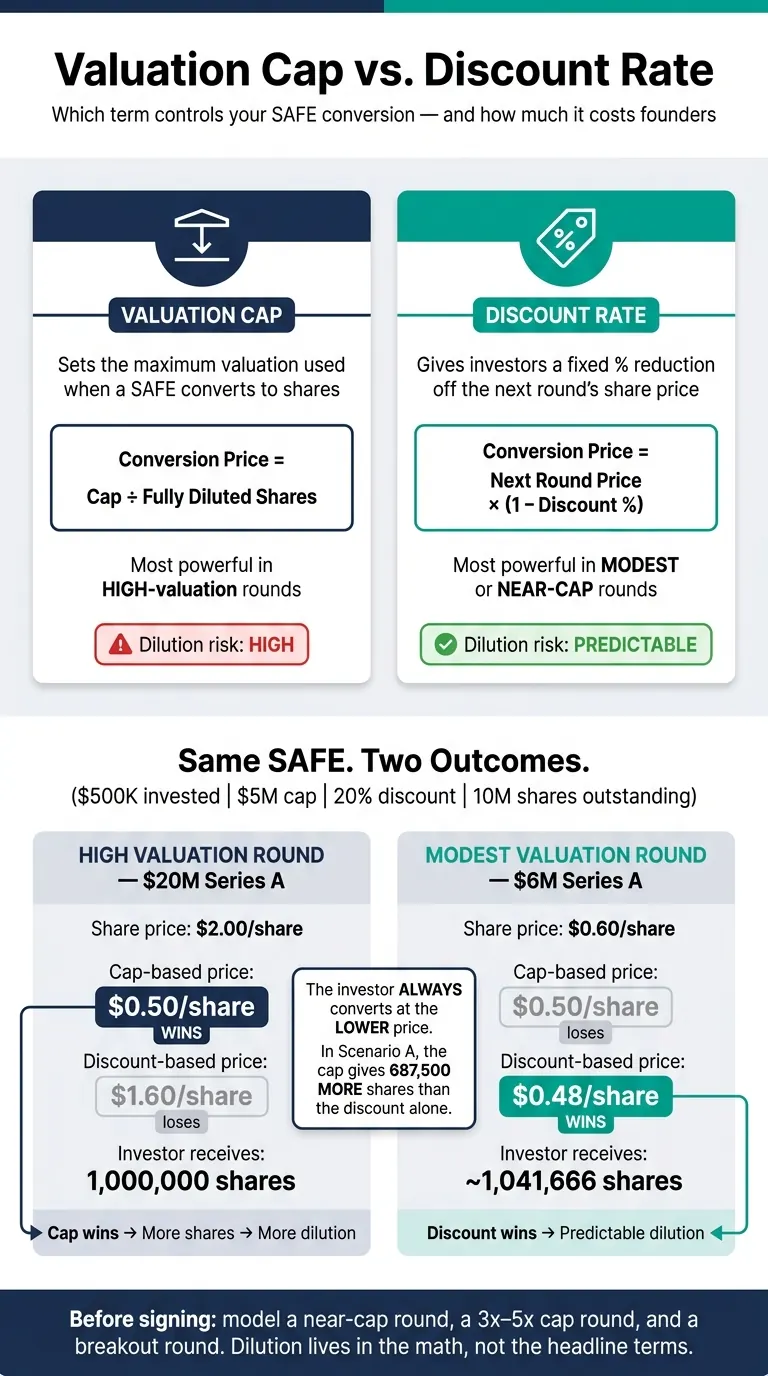
When a SAFE converts, the investor doesn't use both pricing terms at once. The SAFE converts at the lower of the two prices: the cap-based price or the discount-based price.
Here's the simple version:
- A valuation cap puts a ceiling on the conversion price. You calculate it by dividing the cap by the company's fully diluted shares.
- A discount rate gives the investor a set reduction from the next round's share price.
- If the SAFE includes both, the investor gets whichever price is lower.
That sounds abstract at first. It clicks much faster when you put the two formulas next to each other.
Side-by-side comparison table: cap vs. discount
| Feature | Valuation Cap | Discount Rate |
|---|---|---|
| Primary Purpose | Sets a ceiling on the conversion price | Rewards early risk with a fixed price reduction |
| Conversion Price Calculation | Cap ÷ fully diluted shares | Next round price × (1 − discount %) |
| Most Relevant When | When the next round valuation moves far above the cap | When the next round valuation is modest or near the cap |
| Investor Upside | Potentially outsized as valuation grows | Fixed percentage benefit |
| Founder Dilution Sensitivity | High; can surprise founders if the cap was set too low | More predictable; dilution is a fixed percentage of the round |
In a fast-growth round, the cap often produces the lower price. And when the price is lower, the investor gets more shares. That's where founder dilution can jump more than expected.
A hypothetical example using U.S. dollar amounts
Say an investor puts $500,000 into a SAFE with a $5 million cap and a 20% discount. Later, the company raises a Series A with 10,000,000 shares outstanding.
Scenario A - High valuation ($20 million Series A, $2.00/share):
- Cap-based price: $5,000,000 ÷ 10,000,000 = $0.50/share
- Discount-based price: $2.00 × 0.80 = $1.60/share
- Cap wins → investor receives 1,000,000 shares
In this case, the cap does all the work. The Series A price is high enough that the cap price lands far below the discounted price.
Scenario B - Modest valuation ($6 million Series A, $0.60/share):
- Cap-based price: $5,000,000 ÷ 10,000,000 = $0.50/share
- Discount-based price: $0.60 × 0.80 = $0.48/share
- Discount wins → investor receives 1,041,666 shares
This time, the discount produces the lower price, so the investor converts on that term instead.
One detail stands out: Scenario A gives the investor 687,500 more shares than the discount alone. That's the part founders need to watch. A lower conversion price leads to more investor shares, and more investor shares lead to more founder dilution.
So even a small-looking pricing term in a SAFE can change the cap table in a big way once the next round closes.
Founder dilution, investor protection, and when each term applies
Once the conversion math is clear, the next step is figuring out which term is less likely to hit founders with surprise dilution.
How valuation caps can increase dilution in fast-growth rounds
A lower cap can lead to more dilution when the next priced round lands far above that cap. The bigger the gap, the more shares the early investor gets when the SAFE or note converts.
In breakout rounds, the cap, not the discount, usually sets the conversion price and the dilution that follows. A $5 million cap converts at a very different price when the next round closes at $20 million. That happens because the investor’s conversion price stays tied to the cap, while the priced round has moved much higher.
When discounts are simpler and when notes use both terms
A discount-only SAFE is easier to forecast because its conversion price moves with the next-round price. For founders, that usually means dilution is easier to predict since it scales with the new-money price.
Most modern SAFEs and convertible notes use both a cap and a discount. In that setup, the investor converts at whichever price is lower.
That tradeoff is easiest to see when you line up investor protection, founder dilution, and complexity side by side.
| Structure | Investor Protection | Founder Dilution | Complexity |
|---|---|---|---|
| Cap only | Strongest in breakout scenarios | High if the cap is set too low | Moderate |
| Discount only | Fixed benefit that scales with round price | More predictable and proportional | Low |
| Cap + discount | Investor gets the lower conversion price | Highest dilution if the cap is low | High |
What founders should model before signing
Before signing, founders should test the term against a few realistic raise outcomes. A good starting point is to model:
- a near-cap round
- a round at 3x–5x the cap
- a breakout round
It also helps to model option-pool expansion, since that dilutes founders before new money comes in. And there’s another wrinkle: issuing SAFEs with different caps or discounts to different investors during the same period can turn the cap table into a headache. It can also create layered conversion waterfalls that make Series A diligence harder.
Model the cap table before signing. The dilution comes from the conversion math, not the headline terms.
Conclusion: Key differences founders should keep in mind
A valuation cap puts a ceiling on the conversion price. In a fast-growth round, that often means early investors get more shares. A discount rate cuts the next round’s price by a set percentage, often 20%. Both are there to protect investors, but they don’t hit dilution in the same way.
The split becomes clear when the next priced round happens. Caps tend to matter more in up-rounds. Discounts tend to matter more in flat rounds or rounds with only modest price growth.
If both terms show up in the same instrument, the math is straightforward: the investor converts at the lower conversion price. That sounds simple enough, but a low cap paired with a discount can dilute founders more than they first expect.
That’s why the cap table should lead the decision, not the headline term. Before you close a seed round, model the best-, base-, and worst-case outcomes in actual dollar amounts and ownership percentages. Also keep cap and discount terms aligned across investors in the same round. If terms vary too much, you can end up with dilution risk later and a messier next round. Seed-round terms may look small on paper, but dilution is where the cost shows up.
FAQs
How do I know if the cap or discount will apply?
If a convertible instrument includes both a valuation cap and a discount, you don’t pick one up front, and they don’t stack.
At conversion, the agreement applies whichever term gives the investor the lower price per share. Your legal counsel will calculate both prices, and the investor gets shares at the more favorable one.
Why can a low valuation cap dilute founders more?
A low valuation cap can dilute founders more. Why? Because it lets early investors convert into equity at a lower price.
If your next priced round values the company above the cap, those investors convert at the cap, not at the higher round valuation. That means they get more shares for the same investment.
The result is simple: investor ownership goes up, and the founders’ equity goes down. And when the agreement uses whichever term is better for the investor, a low cap often ends up being the main thing driving dilution.
What should founders model before signing a SAFE?
Before signing a SAFE, founders should model future funding rounds so they can see what happens to equity and dilution.
Run the numbers on how valuation caps and discount rates change ownership under a few different scenarios. A SAFE can look simple on the surface, but the conversion math can shift the cap table more than people expect.
It also helps to confirm whether the SAFE is pre-money or post-money. That detail matters a lot because it changes how ownership is calculated and how dilution gets spread across the cap table.