
If you test demand before launch, you cut the odds of building something nobody wants. I’d keep it simple: talk to the right buyers, test the problem first, ask for a paid commitment, and only then move to an MVP or beta.
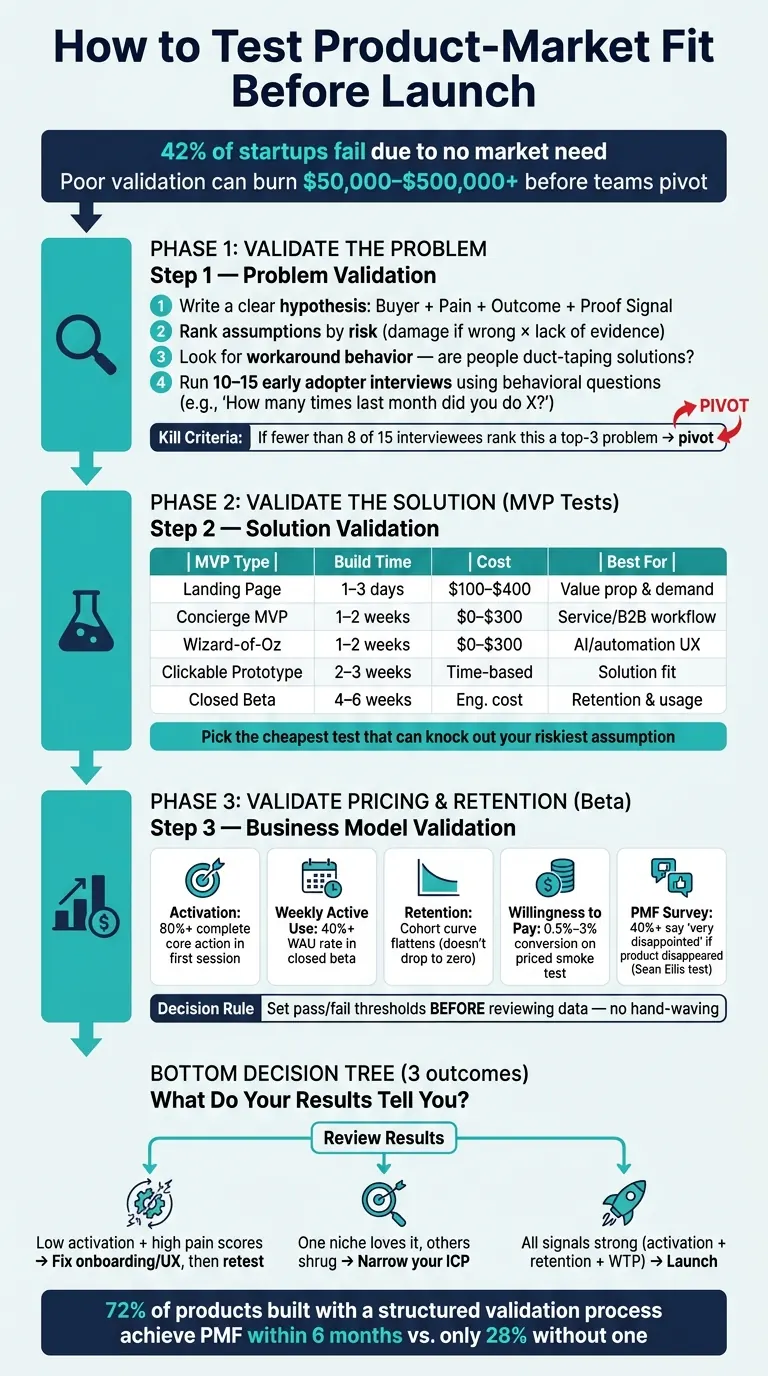
Here’s the core idea in plain English: product-market fit starts as a guess, not a fact. Before launch, I’d test four things: who the buyer is, how painful the problem is, whether people will use the solution, and whether they will pay. That matters because 42% of startups fail due to no market need, and bad validation can burn $50,000 to $500,000+ before the team admits the problem.
If I were doing this, I’d follow this order:
- Write one clear hypothesis about buyer, pain, outcome, and proof
- Rank assumptions by risk so the biggest failure point gets tested first
- Use the cheapest test possible before building much
- Look for action, not praise like deposits, paid pilots, pre-orders, or LOIs
- Run a short beta to check activation, repeat use, retention, and feature use
- Set pass/fail rules early so I don’t talk myself into weak results
A few numbers from the piece stand out:
- 40%+ “very disappointed” on the Sean Ellis survey is a strong PMF signal
- 40% weekly active use in a closed beta is one good usage marker
- 0.5% to 3% conversion on a priced smoke test can show buying intent
- 80%+ activation for the core first-session action can point to low friction
- 4 to 6 weeks is a common beta window
The article also makes one point I agree with: polite feedback is weak, payment is stronger. If people like the idea but won’t commit money, time, or repeat use, that’s a warning sign.
Here’s a fast view of the test options:
| Test | What I’d use it for | What it tells me |
|---|---|---|
| Early interviews | Problem check | Is the pain real and frequent? |
| Landing page | Demand check | Does the message get attention? |
| Concierge MVP | Manual delivery | Will buyers pay for the result? |
| Wizard-of-Oz MVP | Fake backend | Do users care about the experience? |
| Clickable prototype | Flow test | Do people understand and want the product? |
| Closed beta | Usage test | Do they come back and keep using it? |
Bottom line: before launch, I’d test problem, then solution, then pricing, and I’d let user behavior decide whether to iterate, narrow the target customer, or move ahead.
Achieve Product-Market Fit with the Sean Ellis Method and the 40% Test
Identify the assumptions you need to prove first
Start with the two or three beliefs that could sink the business if they turn out to be false. Those are the ones worth testing first.
Each assumption should connect to a clear pre-launch test. That test then tells you what to run next: an MVP, a beta, or an early-adopter test.
Write a clear product-market fit hypothesis
A testable hypothesis should spell out four things: the buyer, the pain, the outcome, and the proof signal.
One useful template from the Jobs to Be Done framework is: "When I am [situation], I want to [do job], so I can [reach outcome]." Pair that with an if-then rule before you run the test. For example: "If 10 qualified buyers are interviewed and at least 3 agree to a paid manual pilot, then we build the MVP".
| Element | What It Answers | Example |
|---|---|---|
| Buyer | Who exactly is this for? | "Seed-stage founders selling to HR leaders" |
| Pain | What specific moment hurts? | "Stop rewriting every investor update from scratch" |
| Outcome | What changes for them? | "Send a polished monthly update in under 20 minutes" |
| Test Signal | What behavior proves demand? | "Book a 20-minute pilot call" |
Once the hypothesis is clear, test assumptions by risk.
Rank your problem, demand, and pricing assumptions
After you write the hypothesis, sort your assumptions by what could fail first. Use two filters:
- How much damage it causes if you're wrong
- How little evidence you have right now
The assumptions that score high on both should go first.
A sequence that often works is problem risk first, solution risk second, pricing risk third. First, make sure the problem is urgent and happens often, not just something mildly irritating. One strong signal is workaround behavior: are people already patching together ways to deal with it? If yes, the problem is likely real. If they're just using an existing tool's built-in feature and saying it's "fine", the pain may not be strong enough.
Praise doesn't mean much. Money, a deposit, an LOI, or a paid pilot means more. Test commitment, not politeness: ask for a deposit, LOI, or paid pilot. And set kill criteria before you begin. For example: "If fewer than 8 of 15 interviewees rank this as a top-3 problem, we pivot". Pre-set kill criteria help cut sunk-cost bias.
Run lean pre-launch tests with MVPs, beta tests, and early adopters
Once you've ranked your assumptions, the next step is pretty simple: get proof fast without building the whole product.
Start with early adopter interviews to check whether the problem is real, painful, and urgent. Then move to MVP or smoke tests to find out if people will commit to your solution. After that, use a beta test to see whether people stick with the product once they’ve tried it. The rule of thumb is straightforward: pick the cheapest test that can knock out your riskiest assumption.
Choose the right MVP format for the signal you need
Not every MVP gives you the same kind of answer. A landing page can tell you whether your value proposition gets attention, but that’s all it tells you. It usually takes one to three days to build and costs about $100 to $400.
A concierge MVP works differently. You deliver the service by hand to three to five paying customers. That usually costs $0 to $300, and it helps you learn the workflow and unit economics.
If you're testing an AI or automation idea, a Wizard-of-Oz MVP can be a smart move. On the surface, it looks automated. Behind the scenes, a person is doing the work manually. That lets you test whether users care about the experience before you build the full engine.
| MVP Type | Speed to Build | Estimated Cost (USD) | Best Signal | Best Use Case |
|---|---|---|---|---|
| Landing Page | 1–3 days | $100–$400 | Interest in value prop | Testing value prop and demand |
| Concierge MVP | 1–2 weeks | $0–$300 | Workflow and unit economics | Service-heavy or complex B2B |
| Wizard-of-Oz | 1–2 weeks | $0–$300 | Whether users value the experience | AI tools, automated assistants |
| Clickable Prototype | 2–3 weeks | Time-based | Whether users want the solution | Testing solution fit |
| Closed Beta | 4–6 weeks | Engineering cost | Retention and usage patterns | Testing usage before scale |
The key is to match the format to the question you need answered, not just the one that feels easiest to ship.
Set up a beta test with early adopters
A beta test is only useful if the right people are in it. Don’t fill it with people who simply say the problem sounds interesting. Find users who are already duct-taping a fix together with spreadsheets, WhatsApp threads, or stitched-together tools. Those are the people already feeling the pain.
Use behavioral screener questions instead of opinion questions. Ask, "How many times last month did you do X?" instead of "Would you use a tool that does X?"
Keep the beta narrow and short, usually four to six weeks, with clear milestones. During that period, track:
- Time to first value
- Repeat usage
- Retention
- Feature adoption
A closed beta is often seen as working if it keeps a 40% weekly active user rate. If people disappear after the first session, don’t brush that off. That’s the kind of signal you want to catch before you scale anything. Then put user statements next to user behavior and see where they line up - and where they don’t.
Collect feedback that shows what users value most
After users try the product, pay attention to commitment behavior. Repeat usage, referrals, and feature adoption show what people care about most.
The Sean Ellis PMF survey gives you a second check. If 40% or more say they would be "very disappointed" if they could no longer use the product, treat that as confirmation rather than discovery.
Use both sets of signals to decide what stays, what needs work, and what should be cut next.
Read your results and decide whether to iterate, narrow, or move forward
Collecting data is only half the work. The other half is making a call: iterate, narrow your ICP, or move forward.
Weak numbers usually don’t mean “give up.” More often, they point to a problem with your segment, your message, or your onboarding. And each metric below ties back to one assumption - problem, demand, or pricing - so when something looks off, you know where to look.
Track a small set of pre-launch product-market fit metrics
Don’t track everything. That’s a fast way to drown in noise. Focus on five signals that can tell you something useful before launch.
| Metric | How to Measure Pre-Launch | Benchmark Range | What Weak Results Mean |
|---|---|---|---|
| Activation | % of beta users who complete the core action in the first session | 80%+ complete the core action | Onboarding friction |
| Engagement | Frequency of use during the beta period | Recurring usage pattern | Low-frequency use signals weak pull |
| Retention | Cohort curve shape over the beta window | Curve flattens rather than drops to zero | No ongoing value delivered |
| Willingness to Pay | Pre-orders, deposits, or signed letters of intent | 0.5%–3% conversion from cold traffic on a priced smoke test | Verbal interest is noise; count paid actions only: pre-orders, deposits, signed LOIs, or paid pilots |
| Pain Intensity | Emotional language in interviews; unprompted referrals | Users immediately name 2–3 peers when asked for introductions | Problem isn't painful enough to act on |
A small set like this keeps you honest. If activation is strong but retention falls off a cliff, that tells a very different story than low willingness to pay with high interview enthusiasm. One says people can get started but don’t stick around. The other says they like the idea in theory, but won’t open their wallet.
Set decision rules before you review the data
Set your cutoff before you look at the results. If you wait until after, it gets far too easy to explain away weak numbers and keep building anyway.
Write down your pass/fail criteria before each test. For example:
"We need at least 10 paying customers from outside our personal network"
"At least 60% of beta users must return within 7 days."
Specific numbers force honest calls. No hand-waving. No “maybe this is still promising.” Just a plain read on whether the signal is there.
Once the data comes in, most results land in one of three buckets:
- If activation is low but pain scores are high, the problem is likely onboarding or UX - not the idea itself.
- If one niche loves the product and everyone else shrugs, narrow your ICP instead of rebuilding the whole thing.
- If fewer than half of interviewees confirm the problem exists and no one has a workaround, your hypothesis likely needs to change.
When activation, retention, and willingness to pay all look strong, that’s a green light to move toward launch. Mixed results usually point to one fixable issue. The key is to let the signal choose the path: iterate, narrow, or move forward.
Build a repeatable testing process before launch
Once you can read the data, the next step is turning that work into a process you can run again and again. The goal is simple: test one assumption at a time with the smallest proof you can get. That approach isn't just tidy; it works. Research shows that 72% of products built with a structured validation process achieve some level of PMF within 6 months, compared with only 28% for those built without one.
A good flow moves from problem validation to solution validation to business model validation. At each stage, use the cheapest test that can prove you wrong. That's the point. You don't want to spend weeks building something just to learn a basic assumption was off.
Clear thresholds help too. 80+ means go. Under 60 means revise. Without that kind of line in the sand, teams tend to talk themselves into weak signals.
Use AI and automation to speed up testing and analysis
For small teams, the main bottleneck usually isn't getting feedback. It's sorting through it and figuring out what it means. That's where automation helps. A lean setup might use Otter.ai to transcribe discovery calls, Typeform to trigger surveys after certain user actions, and an LLM to tag pain points, spot sentiment shifts, and produce a weekly PMF summary. That keeps the loop fast enough to repeat without turning analysis into a full-time job.
AI can also help with the first version of the product. Clickable Figma prototypes made with AI-assisted tools let you test core workflows in days, before you build the full product. That's a big deal. Your beta cohort gets something they can click through and react to, instead of trying to picture a product from a pitch or mockup.
If you want to make this a system your team can keep using, Patrick Frank focuses on operational leverage - keeping feedback analysis fast and systematic as the team stays small.
Conclusion: The signals that matter before you launch
The best founders validate in a systematic way. When retention flattens at a stable level, engagement stays steady, and people begin paying without much pushing, those are the signals that matter. When those signals show up together, launch.
FAQs
How many interviews are enough before building?
It depends on your target market and business model.
A common starting point is at least 10 interviews. That’s often enough to spot repeated pain points and hear the same problems come up more than once.
Some teams use rough benchmarks like these:
- 20 interviews for B2C
- 30 interviews for B2B
- 50+ interviews for enterprise
The point isn’t to hit a magic number for the sake of it. The point is to find steady patterns and signs of real commitment from the people you want to serve.
If you’ve done 10 interviews and still aren’t hearing a shared, painful problem, that’s a signal. Your segment may be too broad, the wrong fit, or in need of a pivot.
What if users love the problem but won’t pay?
If users care about the problem but won’t pay, you’ve probably found a nice-to-have instead of a must-have pain point.
That can also point to a few other issues. The problem may not feel urgent. Your pricing may be off. Or the person you’re talking to may use the product but doesn’t control the budget.
Don’t build yet.
Go back to your assumptions. Separate the user from the buyer. Then tighten your value proposition or aim for a segment where the problem comes with clear financial or day-to-day business costs.
How do I choose between a landing page, MVP, and beta?
It depends on where you are in validation and what you need to learn.
- Landing page: use this to test early demand and interest in your core value proposition.
- MVP or manual version: use this to test whether your solution actually solves the user’s problem.
- Beta: use this when the product is feature-complete to validate reliability, retention, and real-world performance.