
AI can help me turn a rough idea into a working business plan in days, not weeks. But the output is only a draft. I still need to check the numbers, test demand, and get real buyer feedback before I trust it.
Here’s the short version:
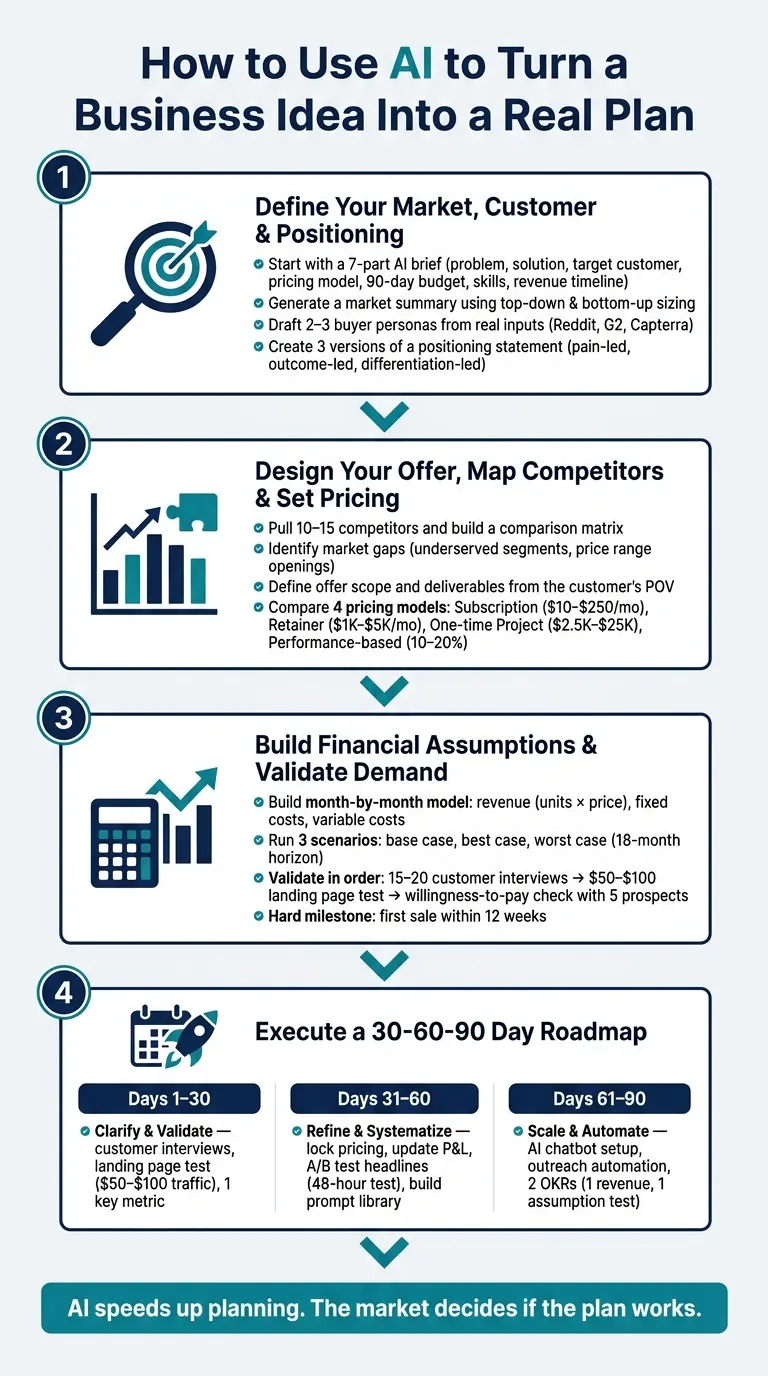
- I start with a 7-part brief: problem, solution, target customer, pricing model, 90-day budget, my skills, and revenue timeline.
- Then I use AI to draft:
- a market summary
- 2–3 buyer personas
- a positioning statement
- a competitor map
- offer and pricing options
- a simple 18-month financial model
- After that, I test the weak spots with:
- 15–20 customer interviews
- a landing page with $50–$100 in traffic
- a willingness-to-pay check with 5 real prospects
- Last, I turn it into a 30-, 60-, and 90-day plan focused on one goal: getting to the first sale.
The main idea is simple: AI speeds up planning, but the market decides if the plan works. The best use of AI here is to help me ask better questions, spot weak assumptions, and turn vague ideas into clear next steps.
| Step | What I use AI for | What I still have to do |
|---|---|---|
| Define the idea | Draft market, buyer, and positioning notes | Check sources and narrow the target |
| Shape the offer | Compare competitors, outline scope, test pricing ideas | Decide what to sell and at what price |
| Build the numbers | Draft revenue, cost, and break-even cases | Add real inputs and fix weak assumptions |
| Validate demand | Draft scripts, roleplay objections, review test results | Talk to buyers and ask for the sale |
| Plan the next 90 days | Turn tasks into a weekly roadmap | Execute and adjust |
If I use AI this way, I don’t get a polished fantasy plan. I get something better: a short plan I can test, fix, and use.
How to write a business plan using ChatGPT in 2025 (with a HUMAN touch!)
1. Use AI to define your market, customer, and positioning
With your AI brief in hand, build the plan one piece at a time. Ask for one output at a time: first a market summary, then personas, then positioning. That keeps the work tight and makes it easier to spot weak points. Start broad enough to understand the market, then narrow into the people you want to sell to.
Use AI to run a quick market research summary
Start with a focused market research prompt. Paste in your brief, then ask for a summary that covers demand drivers, key trends, major risks, and a market size estimate. For market size, ask the AI to use both a top-down and a bottom-up method so you have two ways to compare the numbers.
Use a live-search tool here. Then check every market-size, growth-rate, and trend claim against a source you can cite, such as Statista, IBISWorld, or the U.S. Census Bureau.
When the output comes back, push on it a little. Ask: "What is the source and year for that figure?" That simple follow-up can save you from building on shaky numbers. Take the strongest demand drivers and the exact words buyers use, and carry those into the persona work below.
Draft 2 to 3 customer personas from real inputs
Generic personas don't help much. A persona like "small business owner, 35–50, values efficiency" sounds fine on paper, but it tells you almost nothing about how to reach that person, what to say, or what might get them to buy.
To get sharper personas, give the AI real inputs. If you've done customer interviews, paste in raw notes or transcripts. If not, pull language from Reddit threads, G2 or Capterra reviews, or Quora discussions where your target buyer talks about pain points in plain English. Then ask the AI to extract buyer language and build personas around:
- Job title
- Main pain point
- Decision power
- Current workaround
- Buying trigger
- Likely objection
This keeps the plan grounded in what buyers are saying, not what you assume they mean.
Once you have two or three draft personas, run a skeptical buyer check. Ask the AI to act like a skeptical buyer and point out the five weakest assumptions in each profile. That tension tends to expose the gaps you still need to check through direct conversations.
Turn your research into a clear positioning statement
Once your market summary and draft personas are ready, use AI to turn them into one clear positioning statement. A solid framework to prompt against is: "For [target customer] who [need], our [product] provides [benefit] unlike [alternatives] because [differentiator]."
Ask the AI for three versions:
- A pain-led version
- An outcome-led version
- A differentiation-led version
This gives you a few angles to compare instead of locking into the first draft.
Then ask the AI to simulate how a skeptical CEO and an enthusiastic early adopter would react to each statement. That stress test often shows where the wording is too fuzzy or where the difference from other options isn't coming through.
Revise until the statement is specific, clearly differentiated, and easy to defend. You'll use that statement to shape the offer and pricing in the next section.
2. Use AI to design your offer, map competitors, and set pricing
Use your positioning statement to figure out which competitors matter and where your offer can be different. Then use that gap to shape the offer and set a price.
Map competitors and find gaps in the market
Start with live search to pull up 10–15 competitors. Then ask Claude or ChatGPT to turn that info into a comparison table. Have the AI compare each competitor by price range, target audience, key strength, and key weakness. Ask for the output as a table so you can scan it fast.
"Identify the competitive landscape for [your business]. For each competitor, list: direct vs. indirect, pricing model, target segment, main strength, and biggest weakness. Format as a comparison table."
Once you have the matrix, look for gaps in the market:
- underserved segments
- crowded audiences
- price ranges where buyers don’t have a good-fit option
That gap helps define what your offer needs to include and what it should leave out.
Here’s a simplified example of what that matrix might look like for an AI coaching platform:
| Competitor | Price Range | Audience Focus | Key Strength | Key Weakness |
|---|---|---|---|---|
| LinkedIn Learning | $30/user/mo | Enterprise | Massive content library | Generic, not AI-specific |
| Coursera for Business | $399/user/yr | Mid-market | University brand credibility | High barrier for SMBs |
| ChatGPT Team | $25/user/mo | General | Native AI tool | Lacks structured learning path |
| Your Startup | $15–$20/user/mo | SMBs | Workflow-specific training | Affordable & structured |
Ask the AI to sort must-haves from differentiators. That split shows what you need just to look credible and where you can stand out.
Turn your idea into a specific offer
Once you know where the gap is, use AI to turn that opening into a concrete offer. Give it your positioning statement, target persona, delivery constraints, and target margin. Then ask for two or three offer structures with clear deliverables, scope limits, and the outcome the buyer gets.
Write the offer from the customer’s point of view: the outcome, the timeline, and what it replaces. A small shift in wording helps a lot. Instead of asking, “What should I include in my service?” ask, “Describe this offer from the customer's point of view. What outcome do they get, by when, and what does it replace or eliminate for them?”
Then ask the AI to flag the three weakest assumptions in the offer. That step often surfaces scope issues, delivery risks, or value gaps that are easy to miss when you’re too close to the idea.
Draft pricing and monetization options in USD
Price should come after scope, not before. Once the offer is defined, compare pricing models. Paste in your offer details and any competitor pricing you found. Then ask the AI to map how similar products are priced and suggest where you fit in the market - premium, budget, or gap-filler - with three specific USD pricing tiers.
Compare these four models:
| Model | Pros | Cons | Cash flow | Example range (USD) |
|---|---|---|---|---|
| Subscription | Predictable revenue; high LTV | Requires constant value delivery | Steady monthly inflows | $10–$250/month |
| Retainer | Guaranteed capacity; deep client relationship | Hard to scale; trades hours for dollars | Regular, predictable payments | $1,000–$5,000/month |
| One-time Project | Fast upfront cash | No recurring revenue; constant sales pressure | Lumpy; large upfront sums | $2,500–$25,000/project |
| Performance-based pricing | Aligns incentives; easy to pitch | High risk; hard to track | Delayed; depends on results | 10%–20% of revenue or savings |
Each model creates a different cash flow pattern and a different kind of sales pressure. Subscription smooths revenue but means you need to keep delivering month after month. A retainer gives you steadier client income, but it can pin you to capacity. One-time projects bring cash in fast, though they can leave you chasing the next sale. Performance pricing can sound great in a pitch, but it comes with more risk and tougher tracking.
After you choose a primary model, stress-test it with this prompt:
"Model a pessimistic scenario where customer acquisition takes twice as long and churn is 50% higher. Does this pricing still work?"
That single prompt can save you from building around assumptions that fall apart under mild pressure.
Use the competitor matrix, offer, and price to build revenue and cost assumptions next.
3. Use AI to build simple financial assumptions and validation steps
Build a basic revenue and cost model
Once your offer and pricing are set, build a simple financial model, not an investor deck.
Start by asking AI to list the assumptions before it touches a single number. Use a prompt like: "List all the assumptions needed to estimate first-year revenue for [your business], including fill rate, ramp-up time, and seasonality." This pushes the model to show what it doesn’t know and what you still need to provide. AI gives you the structure; you bring the real numbers.
Then ask it to build a month-by-month model that covers revenue (units × price), fixed costs (rent, software, payroll), and variable costs (contractor fees, payment processing). Tell AI to mark any unverified number as [NEEDS DATA].
Use those assumptions to test the plan under three scenarios.
Run base, best-case, and worst-case scenarios
Run three scenarios by changing only two or three variables: customer acquisition rate, average deal size, and time to close. Your base case should use conservative estimates tied to competitor pricing and industry benchmarks for customer acquisition cost (CAC). Your best case shows what happens if referrals start early or CAC drops sooner than expected. Your worst case shows the failure threshold: the point where the business can’t hit break-even within 18 months.
Skip five-year forecasts. Stick to monthly detail for the first 18 months. Anything past 36 months is often treated as guesswork by lenders and investors.
Once you have all three scenarios, run this adversarial prompt: "Act as a skeptical bank loan officer. List the five weakest assumptions in this financial model and the three most likely reasons this business fails." That step often reveals the one variable that can break the whole model if it’s off.
The weak point in the worst case becomes your first validation target. In plain English: the worst case tells you what to test first.
Define the fastest ways to validate your plan
Before you build, test the riskiest assumption in the market. As Vincent, Founder, Preuve AI, puts it:
"The business plan is a hypothesis test, not a sales document."
Validate in this order, and tie each test to the assumption it checks:
- Customer interviews: Run 15–20 short interviews to hear how people describe the pain point and confirm the problem assumption.
- Landing page test: Set up a simple page and spend about $50 on traffic to measure click-throughs and sign-ups. This checks demand.
- Willingness-to-pay test: Quote a specific price to five potential customers and count the "yes" responses. This checks your pricing assumption.
Set a hard milestone: close your first sale within 12 weeks, at a specific price point, through one specific channel.
Then feed AI your offer, target persona, and price, and have it roleplay a skeptical buyer who pushes back on pricing and payback period. It won’t replace customer feedback, but it’s a fast way to rehearse before you go live.
Use those results to tighten the plan before you map the first 30 to 90 days.
4. Turn your plan into a 30- to 90-day execution roadmap
You’ve got your validation results. Now the job is to turn them into a weekly rhythm that keeps you moving toward revenue without getting pulled in ten directions at once. Start with the weakest assumption from Sections 1–3. That’s the first thing this roadmap should test.
Days 1 to 30: clarify, research, and validate
This first phase is about settling your riskiest assumption before you spend more money. Use what you learned in Sections 1–3 to pick one metric to test this month. Say your idea depends on freelancers paying $20/month for automated invoicing. In that case, your target might be five clear "yes" responses from 15 real conversations by the end of the month.
Set up a simple landing page and put $50 to $100 behind targeted traffic to see if people click and convert. That kind of early test can get you to revenue faster.
A simple habit helps here: every Monday, spend 10 minutes updating your key metrics and marking each goal as on track, at risk, or off track. Then, once a month, use AI to review what’s happening and spot what needs work. When that first test is settled, use the next 30 days to tighten your offer and pricing around what you found.
Days 31 to 60: refine the offer, pricing, and systems
Once your riskiest assumption checks out, shift your energy to tightening the offer and putting the money side in order. Use your validation results to lock in pricing and narrow the scope. Then update your financial model with the numbers you actually gathered, and build a simple 12-month P&L and cash flow outline.
Draft your landing page copy and run a 48-hour A/B test on headlines before you commit to a full ad budget. Also, save every prompt that gave you a useful result - your persona drafts, your competitor gap analysis, and your pricing rationale. Those turn into assets you can reuse later.
By day 60, you should have:
- A live landing page
- A refined P&L
- A short prompt library you can use again next quarter
It also helps to write a short "not doing" list. Pick three to five good-sounding ideas you will ignore for the rest of the 90 days. That protects your focus. Once the offer feels stable, move the rest of the work into simple repeatable systems.
Days 61 to 90: build repeatable AI workflows and get support
The last phase is about moving from one-off prompts to a system you can run again and again. Set up an AI-powered support workflow for routine questions - AI chatbots can handle many routine customer inquiries for new businesses. You can also use tools for outreach drafts and meeting summaries to cut down manual work.
Keep this quarter tight. Limit yourself to two objectives:
- One tied to revenue or growth
- One tied to testing your next riskiest assumption
Make sure your key results track outcomes, not activity. "Generate 1,000 organic sessions" is much better than "Write 10 blog posts".
If building these systems starts to feel messy or too heavy to do alone, that’s usually the moment to bring in outside help.
Use this 90-day sequence to move from proof to repeatable execution:
| Phase | Objectives | Key Activities | Expected Outputs |
|---|---|---|---|
| Days 1–30: Clarify & Validate | Finalize concept and prove demand | Customer interviews, market sizing, landing page test | Validated AI brief, 2–3 personas, conversion data from MVP |
| Days 31–60: Refine & Systematize | Tighten the offer and financial model | Landing page launch, finalizing pricing, updating financial assumptions, A/B testing copy, documenting prompts | Refined pricing tiers, updated P&L, documented prompt library |
| Days 61–90: Scale & Automate | Build repeatable workflows and get support | AI chatbot setup, outreach automation, weekly OKR reviews, 90-day growth audit | Repeatable AI workflows, automation audit, 90-day infrastructure |
Conclusion: Leave with a real plan, not just an idea
At the end of the 90-day roadmap, the goal isn't certainty. It's a plan you can actually use.
AI won't build the business for you. But it will speed up research and help you spot weak assumptions before they turn into bigger problems.
So the work moves in a clear sequence: from brief to research to positioning to pricing, and then through a reality check at each step. Every assumption needs support from data or direct customer input. Let AI handle the draft. Let your research guide the decision. A plan only matters if customers respond to it.
Run the 90-day cycle, update the plan, and repeat. For now, the plan is finished. After that, the market gets its say.
FAQs
What should I include in my AI brief?
To get better results, keep your brief specific and short - ideally under 100 words. Include your business type, target customer, the problem you solve, your solution, revenue model, stage, location, team, and funding goal.
Think of it like onboarding a new team member. Give the AI the core details that define your model, so it can test your assumptions instead of spitting out generic output.
How do I verify AI-generated market research?
AI can help organize research. But it can also make up stats, market sizes, or trends that look convincing at first glance.
That’s why it helps to treat AI-generated research like a roadmap, not a fact sheet.
Check every claim against primary sources, such as industry association reports, government census data, IBISWorld, or Statista. If you can’t verify a number on your own, cut it from the plan.
Use source citations to check data fast and keep your research grounded in facts.
What if customer validation contradicts the plan?
Treat your business plan like a hypothesis, not a promise. It’s your best guess at the start, not something you have to defend no matter what.
If customer validation shows your assumptions are off, listen to that feedback and adjust fast. Don’t try to force the plan to work just because you wrote it down.
Think of the plan as a living document. Update your Lean Canvas or strategy as you learn more. Even evidence that goes against your idea is useful, because it can save you from pouring time into a business that doesn’t have real market demand.