
AI agents are transforming how startups scale after raising seed funding. Instead of hiring more staff, startups are automating repetitive tasks like lead qualification, customer onboarding, and billing. This shift reduces costs, speeds up workflows, and allows founders to focus on growth.
Key insights:
- 70% of founders' time is often spent on operations, not strategy.
- Companies using AI agents have cut 40% of operational costs in a year.
- AI agents can deploy in 1–7 days, compared to 30–60 days for onboarding new hires.
- Example: A 12-person agency saved 110 hours/month and increased margins by 24% using AI agents.
AI agents handle tasks autonomously, operate 24/7, and scale affordably. They’re not here to replace teams but to amplify their capabilities. Startups using these tools are achieving faster revenue growth without increasing headcount, giving them a competitive edge in securing Series A funding.
Post-Seed Scaling Problems
What the Post-Seed Stage Looks Like
The post-seed phase is a pivotal moment for startups. At this point, you've likely raised between $500,000 and $3 million, confirmed product-market fit, and are now laser-focused on hitting the metrics needed for a Series A round. Your team has grown to somewhere between 8 and 25 people, and your annual revenue sits in the range of $600,000 to $3 million. The challenge? Scale quickly enough to secure your next round of funding before your runway dries up.
During this stage, you might find yourself juggling everything from crafting sales decks to handling customer support issues or onboarding new clients. The systems and processes that worked with five customers often buckle under the weight of fifty. Tasks that were manageable manually now require constant attention, and onboarding new hires - who need time to ramp up - can slow things down even more. This operational strain often tempts founders to increase headcount, but that approach can create more problems than it solves.
Why Traditional Scaling Methods Fail
A common response to operational bottlenecks is hiring more people. On the surface, it seems like a logical solution: more revenue means you bring on more team members to handle the workload. But this strategy often amplifies inefficiencies instead of resolving them. For instance, as sales grow, you might hire another salesperson. When support tickets pile up, you bring in a customer success manager. And when marketing feels stretched, you add a coordinator. The result? "Operational drag" - an increase in meetings, additional layers of management, and slower decision-making. Instead of speeding up, you find yourself bogged down in endless status updates and coordination.
The financial costs of this approach are steep. Scaling this way means your expenses grow almost as fast as your revenue. For example, hiring a junior employee in a major city can cost around $8,500 a month when you factor in salary, benefits, and overhead. Multiply that across multiple hires, and suddenly, your seed funding is being drained by payroll instead of fueling growth initiatives.
But the real issue runs deeper. A staggering 60% of organizational leaders cite legacy system integration as their biggest scaling hurdle. Your CRM might not sync with your billing system, or your marketing tools might fail to integrate with your sales pipeline. These disconnects create inefficiencies - like team members spending 15–25 minutes manually updating spreadsheets or transferring data across dashboards. These aren't problems you can solve just by hiring more people; they require a fundamental shift in how your operations are designed.
"What got you to $1M ARR is what will slow you down at $10M - unless you shift from doing the work to designing the machine." - Patrick Salyer, Startup CEO Field Guide
The traditional approach of hiring, training, and managing worked well in an era when scaling relied heavily on labor. But for post-seed startups, this method often leaves you stuck between two tough choices: grow too slowly and miss your Series A window, or hire aggressively and burn through capital before achieving sustainable unit economics.
Implementing and scaling AI agents in business
How AI Agents Fix Operational Bottlenecks
By addressing repetitive tasks, AI agents can help founders eliminate operational delays that often slow down post-seed scaling.
Automating Repetitive Tasks
AI agents are designed to handle the kind of repetitive work that can overwhelm post-seed teams. Instead of hiring additional staff to manage these workflows, AI agents can autonomously take over. For example, in 2024, Ramp introduced an internal finance agent that automated 83% of expense categorization tasks with an impressive 96% accuracy rate. This innovation saved their finance team 12 hours of work per week and cut the time spent on monthly close reports from 4–6 hours down to just 10 minutes.
While basic automation is limited to straightforward "if-this-then-that" tasks, AI agents go a step further by making judgment calls. For instance, they can score leads based on their fit with an ideal customer profile (ICP) or prioritize support tickets by urgency. Mercury, a banking startup, implemented a support triage agent in late 2024 that resolved 71% of tier-1 tickets (like password resets and balance inquiries) automatically. This reduced their median response time from 4.2 hours to just 8 minutes. These advancements in automation lay the groundwork for faster, more data-driven decision-making.
Faster Decision-Making with AI
Once repetitive tasks are automated, AI agents can shift their focus to speeding up data-driven decisions. In a competitive landscape, the ability to analyze data in real time and provide actionable insights becomes a game-changer. Take Glean, for example. They used a multi-agent system to automate 68% of inbound lead qualification by enriching data through LinkedIn and Crunchbase APIs. The results? They booked 340 qualified meetings per month and reduced the time-to-first-meeting from 3.2 days to just 4 hours. Achieving this level of speed would be nearly impossible with manual processes or traditional hiring.
"Speed is the ultimate moat. An AI agent that responds in 60 seconds will always beat a human team that takes 60 minutes." - Rowan Cheung, Founder, The Rundown AI
AI agents also operate around the clock without the need for coordination. There’s no scheduling of meetings, no handoffs between team members in different time zones, and no waiting for someone to finish their current task. For busy founders juggling multiple responsibilities, this means critical workflows keep moving forward, even when other priorities demand attention.
Cutting Operational Costs
By automating tasks and accelerating decision-making, AI agents naturally drive down operational costs. The cost of running agent tasks ranges from just $0.06 to $0.35, which is significantly lower than human labor. To put it into perspective, hiring a junior developer costs about $8,500 per month, while API fees for an agent group average around $1,200 monthly. This represents a 40% cost reduction over a year.
The takeaway is clear: AI agents allow businesses to scale their output without increasing payroll at the same rate. This shift fundamentally transforms unit economics, setting the stage for sustainable growth as companies progress toward their Series A funding rounds.
Using AI Agents to Grow Revenue
Cutting costs is just the beginning. The real game-changer is using AI agents to supercharge revenue growth. Beyond trimming expenses, these tools can revolutionize prospecting and pipeline management, speeding up sales cycles and closing deals faster. Post-seed startups are proving that the same systems reducing operational drag can also ramp up pipeline velocity.
AI-Powered Sales and Marketing
AI agents are reshaping how startups handle prospecting by working around the clock. They scan for buying signals - like funding announcements or leadership changes - conduct deep research across platforms like LinkedIn and SEC filings, and even execute tailored outreach campaigns, all without human input. This shift from "Linear Scaling" (hiring more sales reps) to "Agentic Scaling" (leveraging computing power) allows startups to grow revenue without expanding payroll.
Between late 2024 and early 2025, SaaStr’s Founder Jason Lemkin introduced over 20 specialized AI agents. Their AI-powered SDR sent out 15,000 messages in just 100 days, achieving response rates of 5–7%, far above the industry average of 2–4%. The result? $1.5 million in revenue within two months of deployment - all while maintaining eight-figure revenue with a small team.
"The future of B2B operations isn't about replacing humans with AI – it's about creating human-AI teams that dramatically outperform purely human operations."Jason Lemkin, Founder, SaaStr
AI agents also shine at converting inbound leads. They qualify prospects in real time on revenue-generating pages, sync seamlessly with CRMs like Salesforce, and automatically schedule meetings - ensuring sales reps start their day with fully booked, qualified calendars. In the middle of the sales funnel, these agents can generate highly customized sales collateral (like 20-page industry-specific decks) in minutes, transcribe calls, flag objections, and update deal stages based on the context of conversations.
In February 2026, Flowtivity experimented with its autonomous growth agent "Flowbee", which managed the entire sales pipeline in just one week. Flowbee identified and qualified 67 leads in 4 days, created over 25 personalized interactive prototypes, and sent 74 outreach emails. The results? A 3.8% warm reply rate from cold leads and the discovery of high-performing verticals in trades and childcare. This experiment highlighted how AI can drive revenue growth without increasing headcount.
Growing Revenue Without Hiring More People
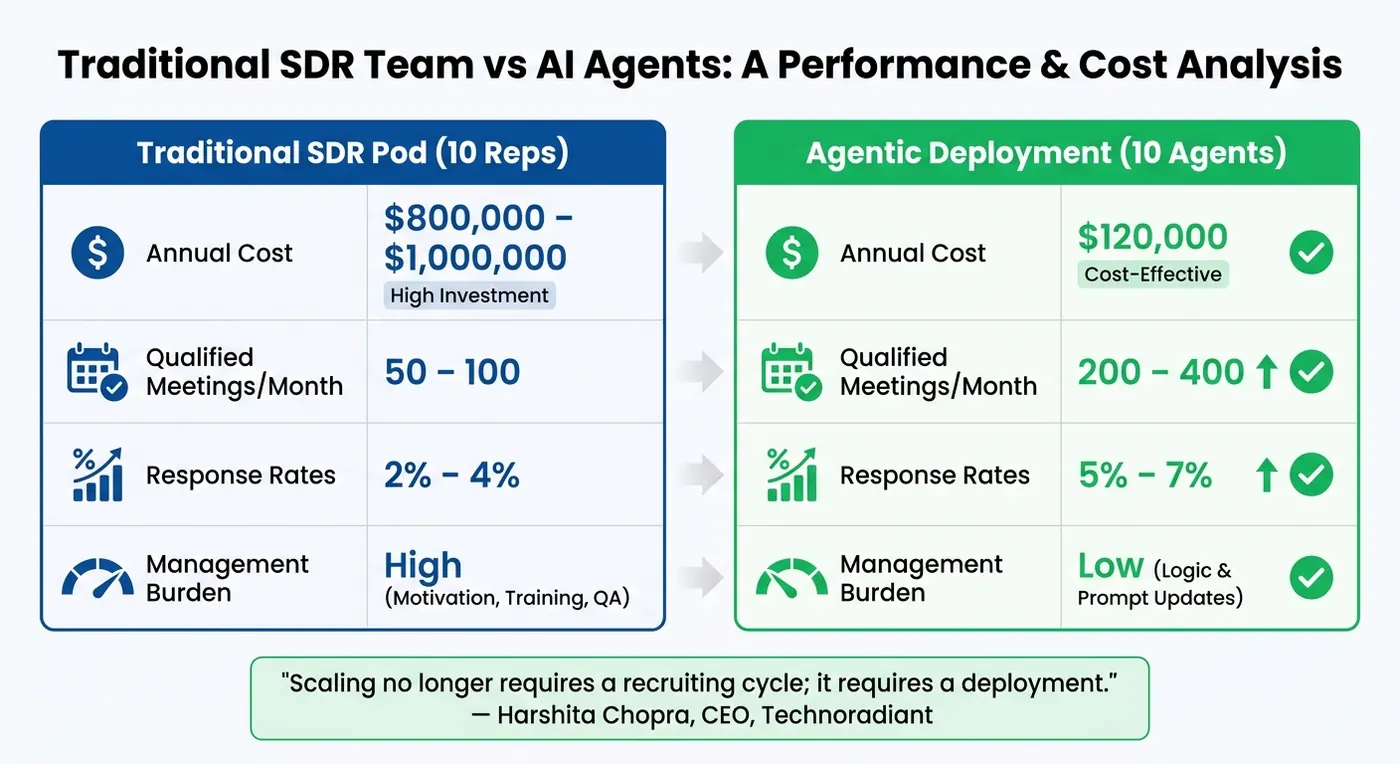
The financial advantage of AI agents is hard to ignore. A traditional team of 10 SDRs costs $800,000–$1,000,000 annually, while deploying 10 AI agents costs roughly $120,000. And the performance gap is significant: while traditional SDR pods generate 50–100 qualified meetings per month, AI agents can deliver 200–400 within the same timeframe.
Here’s a side-by-side comparison:
| Metric | Traditional SDR Pod (10 Reps) | Agentic Deployment (10 Agents) |
|---|---|---|
| Annual Cost | $800,000 – $1,000,000 | $120,000 |
| Qualified Meetings/Mo | 50 – 100 | 200 – 400 |
| Response Rates | 2% – 4% | 5% – 7% |
| Management Burden | High (Motivation, Training, QA) | Low (Logic & Prompt Updates) |
For example, a SaaS founder achieved $1.2M ARR in just 14 months with the help of 7 AI agents. The monthly infrastructure cost? Only $1,450, compared to $102,000 in revenue.
"Scaling no longer requires a recruiting cycle; it requires a deployment."Harshita Chopra, CEO, Technoradiant
This approach to scaling redefines how startups grow. Once an agentic system is in place, doubling outreach volume costs almost nothing compared to the expense of doubling a human team. Investors are taking note, increasingly favoring lean, AI-driven startups and prioritizing Revenue Per Employee (RPE) as a key metric over traditional team size.
How to Implement AI Agents in Your Startup
The success of AI agents in startups often hinges on how well they are deployed. Surprisingly, around 40% of AI agent projects fail to deliver measurable results - not because the technology is flawed, but because startups often implement agents without clearly identifying the problems they aim to solve.
Finding Automation Opportunities
Start by auditing your team's recurring tasks over a week. Classify these tasks as either repeatable (following consistent steps each time) or reactive (triggered by external events). This exercise will help you identify tasks that consume significant time and follow predictable patterns.
Not every task is worth automating. Use a simple scorecard to prioritize tasks, rating them on factors like frequency, time spent, error sensitivity, predictability, and cross-tool friction. Tasks scoring above 18 should be your top priorities. For example, if your team spends 8 hours a week manually qualifying inbound leads, that's a clear opportunity for automation.
Focus on automating processes that are performed at least 20 times manually. This ensures you fully understand the workflow, including any edge cases, before assigning it to an AI agent. Also, if a process cannot be documented in 10 steps or fewer, it's likely not ready for automation.
Start with straightforward, high-ROI tasks like lead qualification, support ticket triage, invoice extraction, or sales research. Once you've identified these tasks, implement automation gradually to ensure smooth integration.
Rolling Out AI Agents in Phases
Once you've pinpointed the tasks to automate, roll out your AI solutions in manageable phases. Avoid attempting to automate an entire department at once. Instead, focus on a single, narrow workflow - such as qualifying leads from one source or categorizing support tickets. This approach keeps the project contained and measurable.
Here’s a tiered approach to automation:
- Level 1: Task Automation – Tools like Zapier or Make ($20–$150/month) can handle single-step, rule-based tasks.
- Level 2: Workflow Automation – For more complex tasks, use tools with branching logic to connect multiple processes ($150–$1,000/month).
- Level 3: Agentic Automation – Deploy agents capable of making decisions and adapting autonomously ($1,000–$10,000+/month).
Most startups should start at Level 1, prove the concept, and then move to Level 2 as they gain confidence.
When deploying agents, start in shadow mode for the first 1–4 weeks. This means the agent operates in the background while a human reviews its outputs before they reach customers. This phase helps catch edge cases and builds trust. Begin with around 30% autonomy, gradually increasing to 60–80% by the third month as you validate the agent's quality.
Before writing prompts, develop 50–200 realistic test cases with expected outcomes. This allows safe iteration and ensures that upgrades to models won’t disrupt your workflow. Also, establish clear escalation paths - a “human-in-the-loop” process for handling low-confidence or high-stakes scenarios.
To avoid unexpected costs, set hard caps on daily and per-run token usage. This helps prevent scenarios where an agent might overuse API resources. For startups handling 10–20 automated tasks daily, a typical budget for AI API costs is around $50–$200 per month.
Working with Experts for Better Results
If your team has fewer than three engineers or lacks experience with large language models (LLMs), consider bringing in external expertise. Specialized agencies can compress a four-week DIY build into just 3–5 days. They can also handle ongoing tasks like model updates, security controls, and API integrations, freeing you to focus on strategy.
One of the main reasons AI projects fail is poor scoping - vague objectives, lack of human handoff processes, or trying to automate broken workflows. External experts can implement verification layers to avoid "silent failures", where agents confidently produce incorrect outputs that could corrupt your data.
"40% of AI agent projects fail before they deliver any value. Not because the technology doesn't work. Because companies deploy agents without defining what problem they're solving."Chirag Jakhariya, Founder & Lead Engineer, BinaryBits
Building a production-ready AI agent typically costs between $3,000 and $15,000, with ongoing monthly infrastructure and API costs ranging from $50 to $300.
For startups looking to streamline AI implementation, consultants like Patrick Frank offer services ranging from 1-on-1 strategy sessions to comprehensive 90-day AI integration plans. The right expert can help you avoid unnecessary complexity, set clear goals, and ensure your agents deliver measurable results.
When hiring consultants, prioritize those offering fixed-scope builds rather than open-ended retainers to prevent budget overruns. Also, look for platforms with pre-built capabilities - like lead qualification or revenue recovery - rather than blank-slate frameworks that require extensive setup. Expert guidance can make all the difference as your startup scales its AI efforts.
Conclusion
As outlined earlier, tackling operational bottlenecks is crucial for scaling after the seed stage. Startups at this stage face a choice: either expand their teams in a linear fashion, which often leads to increased operational burdens, or embrace AI agents to achieve lean growth with lower costs. Recent data shows that 74% of executives who implement AI agents report a positive return on investment within the first year.
AI agents provide founders with a significant advantage, saving 10–20 hours per week by offering around-the-clock execution and delivering instant, data-driven insights that streamline decision-making and reduce the need for lengthy meetings.
"The gap between using AI as a tool and running AI agents as part of your business infrastructure is the gap between someone who uses a calculator and someone who has built a financial system. Both involve numbers, but only one scales."Iniobong Uyah, Content Strategist
This distinction highlights why lean, AI-driven teams are consistently outperforming larger, more traditional organizations. Early adopters are securing a competitive edge by integrating proprietary workflows and leveraging data in ways that latecomers struggle to replicate. By 2026, 88% of executives plan to increase their investment in AI agents, signaling a shift toward these tools becoming the standard for scalable growth.
If you're ready to take the leap and integrate AI agents into your operations, experts like Patrick Frank offer tailored 90-day plans to help avoid common challenges and deliver measurable results. The real question isn't if you should adopt AI agents - it's how fast you can implement them to maintain your edge in an increasingly competitive market.
FAQs
Which workflows should I automate first with AI agents post-seed?
Startups that have moved past the seed stage should focus on automating routine, time-consuming tasks that follow clear rules and patterns. Some prime areas to tackle include:
- Customer support triage: Quickly sorting and directing inquiries to the right teams or resources.
- Sales pipeline management: Keeping leads organized and moving smoothly through the sales process.
- Finance reconciliation: Matching transactions and balancing accounts without manual effort.
- Lead enrichment: Automatically gathering and updating information about potential customers.
By automating these tasks, teams can save time and work more efficiently. Additionally, multi-agent systems can take on workflows such as onboarding, email sorting, and expense categorization. This allows startups to scale their operations while reducing the need for constant human intervention.
How can I prevent AI agents from making costly mistakes in production?
To minimize expensive errors during production, prioritize reliability and oversight in your processes. Here are some key practices to consider:
- Validation layers: These act as checkpoints to verify outputs and catch issues early.
- Token limits and timeouts: Set boundaries to prevent excessive resource consumption.
- Real-time monitoring: Keep a close eye on agent behavior to identify anomalies as they happen.
When deploying agents, take an incremental approach and validate outputs at each stage. For tasks that carry higher risks, implement a human-in-the-loop escalation process. This allows errors to be detected and corrected before they escalate. By combining these strategies, you can achieve safer, more dependable AI agent performance.
What does it typically cost to deploy and run AI agents for a small startup?
In 2026, small startups can expect to spend between $50 and $150 per month to deploy and operate AI agents. The exact cost depends on factors like how much API usage is required and the complexity of the tasks these agents handle. Specific business needs and scale also play a role in determining expenses.