
Want to grow your business effectively? Focus on the right KPIs. Many startups fail because they track too many metrics or the wrong ones. A well-structured KPI framework can help you measure progress, predict trends, and make better decisions. Here's a quick summary:
- Choose 5–10 KPIs: Focus on the metrics that align with your business goals.
- Use the SMART framework: Make KPIs Specific, Measurable, Achievable, Relevant, and Time-bound.
- Track with AI: Automate data collection and gain real-time insights.
- Review regularly: Run quarterly reviews to ensure KPIs stay relevant.
Adora Cheung - How to Set KPIs and Goals
Align KPIs with Business Objectives
It’s tempting for founders to pick KPIs that are simple to measure rather than those that truly matter. But here’s the thing: you need to focus on strategy first, not just the data. Start by defining your business goals. Once you’ve nailed those down, work backward to identify the metrics that will help you track progress toward those goals. This ensures that your KPIs are tightly connected to what your business actually needs to achieve.
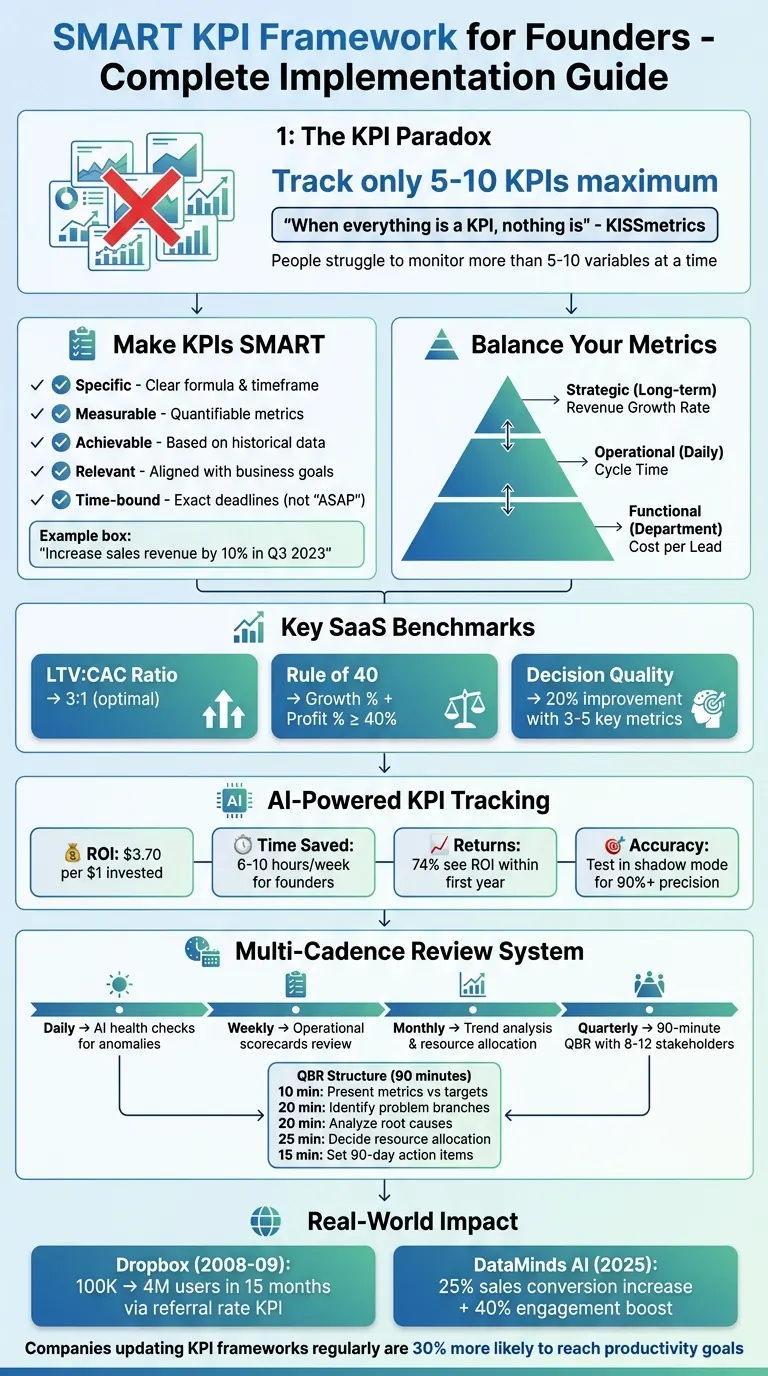
Here’s why this matters: tracking too many metrics can create the illusion that you have all the insights you need, but it often leads to confusion instead of clarity. This is known as the "KPI paradox." As KISSmetrics puts it:
"When everything is a KPI, nothing is. A KPI, by definition, is a key indicator".
Studies show that people struggle to monitor and act on more than 5 to 10 variables at a time. So, it’s crucial to focus only on the metrics that truly drive results.
Define Your Core Business Goals
Before diving into KPIs, take a step back and ask: What are the three most important outcomes my business needs to achieve in the next year? These goals must be specific and measurable. For example, a goal like "Increase Net Revenue Retention from 100% to 110%" is clear and actionable. On the other hand, something vague like "improve customer loyalty" doesn’t give you much to work with.
Once you’ve identified your goals, trace the value chain that leads to each outcome. Let’s say revenue growth is your main objective. You’ll want to track metrics along the entire journey - starting with product engagement, moving through feature adoption, and ending with upsell conversions that boost revenue. This process helps you identify predictive metrics that can guide future actions, instead of just confirming past results.
Connect KPIs to Your Priorities
With your goals clearly defined, the next step is to choose KPIs that align with your current priorities. Here’s an example: back in 2008-2009, Dropbox prioritized rapid user acquisition. Their key metric? Referral rates. By launching a referral program that rewarded users with extra storage for inviting friends, they skyrocketed from 100,000 to 4,000,000 users in just 15 months.
Another example is Slack. In 2015, they honed in on team workflow engagement as their primary focus. This strategy paid off, driving 110% MRR growth and helping them hit $200 million ARR by 2017. Both companies succeeded because they chose KPIs that directly aligned with their strategic goals, rather than settling for what was easiest to measure.
When selecting KPIs, it’s also important to maintain balance across different levels of your business. For instance:
- Strategic metrics: Long-term indicators like Revenue Growth Rate.
- Operational metrics: Daily performance measures like Cycle Time.
- Functional metrics: Department-specific KPIs, such as Cost per Lead.
Don’t forget to pair volume metrics with quality checks. For example, if you’re tracking lead volume, also monitor lead-to-customer conversion rates to ensure you’re not sacrificing quality for quantity. This balanced approach keeps your business moving in the right direction.
Select KPIs Using the SMART Framework
Once you've aligned your KPIs with your business objectives, applying the SMART framework ensures they're both clear and actionable. SMART stands for Specific, Measurable, Achievable, Relevant, and Time-bound - a structured approach that transforms vague goals into precise targets. The distinction between a KPI and a SMART goal lies in their focus: a KPI measures performance (e.g., website conversion rate), while a SMART goal defines the desired outcome. For instance, instead of saying "improve sales", a SMART KPI goal might be: "Increase sales revenue by 10% in Q3 2023." This example pinpoints the metric (sales revenue), the objective (10% growth), and the timeframe (Q3 2023). Such clarity eliminates ambiguity and fosters accountability across your team.
Make KPIs Specific and Measurable
To track KPIs effectively, each one needs a clear formula, a defined time frame (monthly or quarterly), and a consistent basis for comparison. Without this level of precision, you risk falling into the "decompression problem", where raw numbers fail to explain the underlying reasons behind the data. To counter this, supplement quantitative metrics with qualitative insights. For example, when tracking customer satisfaction scores, include a field for context, such as: "What factors influenced this score?" This added layer of detail keeps your data actionable.
Humans aren't equipped to manage an overload of metrics. Research suggests monitoring no more than 5 to 10 KPIs at an organizational level, with individual teams managing just 2–4. Once defined, these metrics should be paired with realistic benchmarks to ensure they're both achievable and meaningful.
Set Achievable and Relevant Targets
Your targets should be grounded in historical data, available resources, and team input [15, 17]. If you lack historical data - such as in the case of a startup - industry benchmarks can provide a foundation. For example, a successful SaaS business often aims for an LTV:CAC ratio of 3:1. Similarly, the "Rule of 40" suggests that the combined percentage of your revenue growth rate and profit margin should reach or exceed 40%.
Collaborate with team members responsible for the outcomes to set challenging yet realistic goals [15, 17]. Additionally, establish "investigation thresholds" based on historical variability to prevent unnecessary concern over minor fluctuations. This strategy ensures your team focuses on meaningful issues rather than insignificant changes. Once you’ve set achievable targets, anchor them with deadlines to drive action.
Add Time-Bound Deadlines
A KPI without a deadline is just an ambition. As Intrafocus aptly states:
"The time element transforms the KPI from a distant star to a destination on the horizon, one that's approachable and achievable within the foreseeable future".
Deadlines create urgency, define strategic windows, and allow for timely celebrations or adjustments.
Avoid ambiguous timeframes like "as soon as possible." Instead, specify exact dates, months, or fiscal quarters. Align your data collection frequency with your decision-making cycle. For example, if your team makes weekly operational decisions, you need weekly data. Reporting a SMART metric quarterly in such a scenario would leave you, as Sopact describes it, "operationally blind". Lastly, ensure KPI definitions remain consistent for at least 6 to 8 weeks before revising them, so that trends over time are clear and reliable.
Build a Data-Driven KPI Framework
To make SMART KPIs effective, you need more than just good intentions. A strong framework requires baseline data to understand your starting point, clear ownership to ensure accountability, and accessible dashboards to keep everyone on the same page. Without these elements, KPIs risk becoming static reports instead of tools that guide daily decisions. Together, these components link strategy to execution, turning KPIs into actionable insights.
Set Baselines and Targets
Start by establishing baselines to create measurable targets. This means auditing all data sources - like CRM systems, billing software, product analytics, or even manual trackers - to figure out where you currently stand. If your business has been around for a while, historical performance data can help set realistic baselines. For example, if your consultation-to-conversion rate is 20%, that figure becomes your starting point for future improvements.
For newer companies without historical data, industry benchmarks can serve as a helpful reference. Once baselines are set, link your metrics to live data sources. This ensures that each KPI reflects real-time values and trends, transforming your framework into a tool for everyday decision-making.
Accuracy is key. Train your teams and automate data entry whenever possible to minimize errors. Faulty data leads to misleading metrics and poor decisions. Before building strategies around assumptions, validate them using historical data. For instance, if you think onboarding completion impacts 30-day retention, test that correlation first to avoid misguided efforts.
Assign Ownership and Accountability
Every KPI needs a specific owner - not a team, but one person - who is responsible for monitoring changes and taking action. Research shows that when responsibility is shared broadly, action becomes less likely. A dashboard visible to 50 people won’t spark the same urgency as an alert sent to one accountable individual.
"The difference between organisations that act on data and organisations that merely report it almost always comes down to one thing: whether there is a named person whose job it is to care about each number." - KPI Tree
Use the RACI model to clarify roles. Identify who is "Responsible" for the work and who is "Accountable" for the results. Align ownership with your organizational hierarchy: executives handle top-level metrics, department heads manage branch-level data, and individual contributors focus on operational details. Keep it manageable - no one should oversee more than 3 to 5 metrics to stay effective.
Ownership also requires authority. The person responsible for a metric needs the resources, decision-making power, and influence to drive results. Set clear response protocols for when metrics exceed or fall below thresholds, ensuring the team knows exactly how to react.
Create Visibility Through Dashboards
With ownership assigned, dashboards make metrics actionable by turning data into clear visuals. But not all dashboards are created equal. Avoid trying to please everyone with a single, overloaded dashboard. Instead, tailor dashboards to specific audiences: executives focus on strategic overviews, department leaders track branch-level performance, and individual contributors monitor their own metrics.
Every metric should pass the "Action Test." If a metric doesn’t prompt a clear next step, it doesn’t belong on the main dashboard. Keep dashboards concise, limiting them to 5-7 key metrics to avoid overwhelming users.
Numbers alone can be misleading. Always pair KPIs with context - targets, trend lines, or comparisons to past performance. This immediately answers the question, "Is this good or bad?". Place your most critical metric, like a North Star indicator, in the top-left corner of the dashboard. Research shows this is where viewers naturally focus first.
Automated alerts are another essential feature. They ensure quick action when metrics deviate from expected ranges, preventing small problems from escalating into major issues. Finally, integrate dashboards into your team’s daily workflow. Use them in weekly stand-ups, sprint reviews, or other recurring meetings to keep KPIs front and center, rather than letting them collect dust as monthly reports.
Use AI for KPI Automation and Optimization
Using AI to automate and refine your KPI framework can transform how you monitor and act on critical business metrics. By integrating real-time dashboards and assigning clear ownership, AI shifts KPI tracking from a manual task to an intelligent system. This means founders can make quicker, more informed decisions based on up-to-the-minute insights.
Automate KPI Tracking with AI Agents
AI agents can seamlessly gather data from platforms like Google Analytics, Stripe, CRMs, and project management tools, then organize it into a consistent format for analysis. This eliminates tedious manual tasks like exporting data, updating spreadsheets, or copying information across systems. A multi-agent setup pairs basic data collection with advanced analysis, offering deeper insights.
To ensure accuracy, test AI agents in "shadow mode" for 20-30 cycles, aiming for at least 90% precision. Start by automating tasks you've performed manually at least 20 times - this ensures you understand potential edge cases. For basic automation, tools like Zapier or ChatGPT are effective and cost between $20 and $150 monthly. For more advanced workflows requiring custom logic, options like n8n or Make are available, costing $150 to $1,000 per month. Whether you're tracking weekly revenue or monitoring customer sign-ups, AI agents can simplify data collection and analysis.
Apply Predictive Analytics for Better Decisions
AI isn't just about analyzing the past - it can predict future trends. Predictive analytics transforms lagging indicators into leading ones, allowing businesses to act before issues arise. For example, AI can identify customer behavior patterns, flagging those at risk of churn weeks in advance. In October 2025, HealthSync Innovations used a predictive dashboard to pinpoint patient drop-off points, reducing churn by 15% and boosting satisfaction scores.
Predictive KPIs also enhance planning. AI can forecast sales, project timelines, or hiring needs by analyzing historical data and current trends. The process starts with identifying the business challenge - whether it’s lowering customer acquisition costs or improving retention - before selecting the right AI tool. Gartner estimates that by 2028, 33% of enterprise software will feature agentic AI, a significant jump from less than 1% in 2024. Integrating these capabilities into daily operations can streamline decision-making and improve outcomes.
Improve Workflows with AI Integration
AI workflow automation bridges your KPI framework with daily operations. For example, AI agents can send formatted insights via Slack, Telegram, or email at scheduled times - like every Monday morning at 9 AM. This ensures teams stay updated without logging into multiple dashboards.
Founders who automate routine workflows gain back an average of 6 to 10 hours each week. A great example is DataMinds AI, which implemented a system in October 2025 to track customer retention and model accuracy in real time. Within six months, they achieved a 25% increase in sales conversions and a 40% boost in engagement. For those looking to integrate similar systems, Patrick Frank provides consulting on AI agent implementation, workflow automation, and 90-day roadmaps.
"The gap between startups that automate early and those that don't isn't just operational efficiency - it's how much of your runway survives to product-market fit." - Nakshatra, Founder, Novara Labs
AI automation delivers an impressive ROI, averaging $3.70 for every dollar invested, with 74% of executives seeing returns within the first year.
Review and Update Your KPI Framework
Your KPI framework isn’t something you can set up once and forget about. Businesses evolve quickly, and sticking to outdated metrics can leave you tracking numbers that look good but don’t actually help improve revenue, retention, or efficiency.
Once you’ve automated and fine-tuned KPI tracking using AI, it’s essential to review your framework regularly. These reviews ensure that your metrics stay aligned with your business goals and drive meaningful performance improvements.
Run Quarterly KPI Reviews
A quarterly review is your chance to take a step back and evaluate whether your strategy is working. Schedule a 90-minute quarterly business review (QBR) with 8 to 12 key stakeholders. This typically includes leaders from Marketing, Sales, Product, and Finance. Unlike routine number-crunching, these sessions focus on assessing strategic effectiveness.
To keep the meeting focused, structure it around a metric tree that covers acquisition, retention, and monetization. Share the metric tree, trend data, and any root cause hypotheses with attendees 48 hours in advance. This way, the meeting is about decision-making, not catching up on data. Limit pre-read materials to a single page per department to ensure clarity and avoid distractions.
Break the review into five key phases:
- Present top-level metrics vs. targets (10 minutes)
- Pinpoint the branch causing any misses (20 minutes)
- Analyze root causes (20 minutes)
- Decide on resource allocation or strategic shifts (25 minutes)
- Set clear 90-day action items (15 minutes)
Each decision should lead to action: stop what’s not working, improve what has potential, or expand what’s delivering results. For example, a $5M ARR SaaS startup replaced "calls made" with "pipeline value" as a KPI. This shift eliminated low-quality activity metrics and boosted conversion rates by 27% within 90 days.
"A QBR without a planning follow-through is a diagnosis without a treatment. The value of the quarterly review is not the insight it produces but the change it creates in the next ninety days." - KPI Tree
Use AI for Dynamic Adjustments
AI doesn’t just collect data - it enables you to adjust KPIs dynamically between your quarterly reviews. Instead of waiting three months to catch issues, AI provides real-time monitoring. It can flag anomalies, such as a sudden 15% rise in customer acquisition costs or a drop in conversion rates, and trigger automatic alerts or interventions based on predefined thresholds.
For example, in 2025, the platform v0.report used Opinly to automate tracking of SEO and content metrics. By monitoring audit scores and AI-driven visibility in real time, the site increased monthly visitors by 2,397% (from a baseline of 1,498) and backlinks by 1,017%. One key query, "ai report generator", jumped from position 67 to 4 in the U.S. search rankings - all thanks to AI-driven adjustments.
To maintain a steady rhythm, adopt a multi-cadence review system:
- Daily AI health checks for anomalies
- Weekly huddles to review operational scorecards
- Monthly trend analysis to assess content clusters and resource allocation
AI also ensures data accuracy through a "measurement confidence layer", which tracks the completeness and reliability of your data. Monitor the "rework rate" - how often AI outputs require significant human edits - as an indicator of areas needing improvement. For clarity, use the 1-3-3 reporting model: one headline outcome (e.g., revenue per booking), three operational drivers (e.g., response time), and three control metrics (e.g., lead quality). This keeps dashboards focused on what matters most.
By combining structured quarterly reviews with real-time AI adjustments, you create a KPI framework that’s both agile and effective.
If you’re a founder interested in integrating AI-driven KPI systems, Patrick Frank provides consulting on AI workflow automation and 90-day integration roadmaps.
Conclusion
Aligning KPIs with business goals and using AI for real-time tracking creates a solid structure for growth.
A well-designed KPI framework transforms decision-making from guesswork to data-driven precision. As Peter Drucker wisely put it:
"What gets measured gets managed".
However, simply measuring isn’t enough. Your KPIs need to reflect your business’s core objectives, adhere to SMART criteria, and adapt as your organization evolves. Zero in on 3–5 key metrics to improve decision-making quality by 20%. Incorporating AI automation for real-time tracking can drive a 20% higher ROI on AI projects. Without disciplined metric management, businesses risk scaling too soon. Regular reviews, like quarterly strategy sessions, help keep your framework relevant and prevent unnoticed inefficiencies. Companies that consistently update their KPI frameworks are 30% more likely to reach their productivity goals.
Adopting a "stop-fix-scale" mindset is crucial. Eliminate efforts that don’t deliver results and redirect resources to initiatives that do. This focus on outcomes, rather than just activity, is a hallmark of high-growth organizations.
Looking to scale with an AI-powered KPI system? Patrick Frank provides consulting services, including AI workflow automation and tailored 90-day integration plans for founders.
FAQs
What are the best 5–10 KPIs for my startup?
For startups, keeping an eye on the right metrics can make all the difference. Some of the most important KPIs include:
- Monthly Recurring Revenue (MRR): A clear indicator of predictable income, helping you understand growth and revenue trends.
- Customer Acquisition Cost (CAC): This shows how much you're spending to acquire each customer, which is crucial for managing budgets and scaling effectively.
- Customer Lifetime Value (LTV): A measure of the total revenue you can expect from a customer over their entire relationship with your business.
- Retention Rate: Tracks how well you’re keeping customers, which directly impacts growth and profitability.
- Activation Rate: Looks at how quickly and effectively new users are engaging with your product or service.
- Engagement Metrics: These provide insights into how actively customers are using your product, signaling satisfaction and value.
- Operational Efficiency: Measures how well resources are being utilized to achieve business goals.
- Cohort Analysis: Breaks down customer data into groups to better understand behaviors and trends over time.
These metrics don’t just offer insights - they guide decision-making and help align your efforts with your long-term goals. For founders, staying on top of these numbers is essential for steering the business in the right direction.
How do I turn a KPI into a SMART target?
To turn a KPI into a SMART target, make sure it’s:
- Specific: Clearly outline the goal (e.g., "boost monthly sales revenue for product X").
- Measurable: Include a way to track progress (e.g., "achieve a 10% revenue increase").
- Achievable: Ensure the target is realistic given your resources.
- Relevant: Tie it directly to your business priorities.
- Time-bound: Set a clear deadline (e.g., "by the end of Q2 2026").
How can AI automate KPI tracking end-to-end?
AI takes the hassle out of KPI tracking by automating the entire process - from data collection to reporting. It handles the tedious work of gathering and organizing data, ensuring everything stays consistent and up-to-date in real time. With AI, you get dynamic dashboards that visualize performance metrics, automated alerts to highlight trends, and even predictive insights to improve forecasting accuracy. Plus, it creates customized reports tailored to your team's needs, making KPI management smoother and more effective.