
Team alignment is the key to turning startup chaos into focused growth. When everyone understands the mission, priorities, and their role in achieving success, teams work smarter, not harder. But as startups scale, communication gaps and misaligned goals can lead to wasted time, duplicated work, and frustrated employees.
Here’s what you’ll learn in this guide:
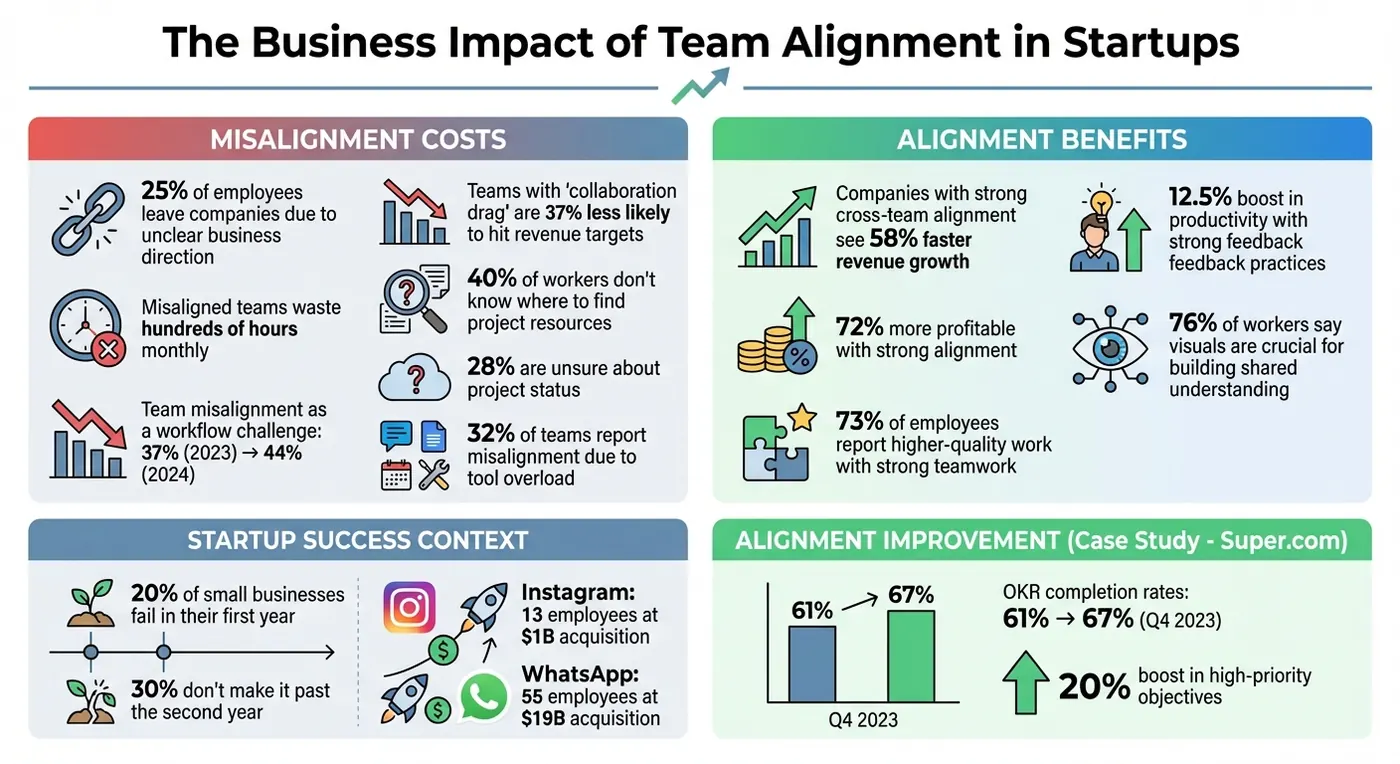
- Why alignment matters: Misaligned teams waste hundreds of hours monthly, with 25% of employees leaving companies due to unclear business direction.
- Core elements of alignment: Structure (clear roles and decision-making), strategy (shared goals), and culture (values and psychological safety) keep teams on track.
- Actionable steps: Use OKRs, clear communication tools, and regular check-ins to set and maintain alignment.
- Tools and metrics: From OKR software to tracking shared metrics, you’ll see how to measure and sustain alignment as your team grows.
Alignment isn’t just a buzzword - it’s measurable, actionable, and critical to avoiding wasted effort. Let’s dive into how to make it work for your startup.
How to Align Your Team to Scale
Core Elements of Team Alignment
Team alignment relies on three key areas: structure, strategy, and culture. Nail these, and your startup is primed for growth. Miss one, and progress can grind to a halt.
Aligning Your Organization Structure
Your organizational structure defines roles, decision-making processes, and how information flows. Matt Hoffman, Partner and Head of Talent at M13, explains it well: "Organizational structure: The roles and decision rights that help you achieve your company's vision, mission, and objectives".
In early-stage startups (0–30 employees), a flat structure works because it allows for fast decisions and open communication. But as you grow beyond 30 people, shifting to a functional structure - grouping teams by expertise like engineering, sales, or marketing - can improve efficiency. However, this transition needs careful handling to avoid silos.
Clarity in decision-making is critical to prevent bottlenecks. The DACI model helps here by assigning clear roles:
- Driver: Responsible for execution.
- Approver: Gives final sign-off.
- Consultants: Provide input.
- Informed: Kept in the loop.
Authority matrices are another tool, outlining spending limits and decision-making power for each role.
"A well-defined company structure ensures everyone understands their role and how it contributes to the bigger picture. This clarity minimizes miscommunication, prevents duplicated efforts, and empowers team members." – Lomit Patel, CMO, TYB
Planning ahead is essential. Work backward from where you want to be in 12–24 months - considering revenue, headcount, and expansion plans - and identify the roles and skills you'll need. Since hiring often takes three months or more, early planning prevents gaps that could slow your momentum.
Once your structure is in place, aligning your strategy keeps everyone focused on shared goals.
Aligning Your Strategy
Strategic alignment ensures your team is pulling in the same direction. When priorities are clear, teams can make decisions independently, without constantly escalating issues to leadership.
The challenge? Many leaders think their strategy is clear when it’s not. Tareef Jafferi from Happily.ai calls this the "alignment illusion": "Most leaders operate under the 'alignment illusion' - the assumption that because goals were communicated, they were understood".
To combat this, remember that people typically need to hear something 7–10 times before it sticks. Use multiple formats - like all-hands meetings, written updates, and one-on-ones - to reinforce priorities.
Break high-level objectives into SMART goals and audit them regularly to ensure clarity. Cascading goals create a "golden thread" that ties strategic priorities to daily tasks. Test alignment by asking 10 random employees to name the company’s top three priorities without checking any documents.
Another helpful practice is the "stop doing" exercise. Identify and eliminate work that no longer aligns with current goals to free up resources for what matters most.
With strategy in place, your culture must support and sustain these priorities.
Aligning Your Culture
Culture shapes behavior, especially in situations where rules don’t exist. Core values act as a compass, keeping actions aligned with your mission as your company scales. Define 3–5 core values early on by reflecting on your founders’ beliefs and your startup’s purpose.
Hiring for cultural fit is just as important as technical skills. Use behavioral interviews to gauge whether a candidate’s values align with your company’s environment. In high-growth settings, traits like resilience, adaptability, ownership, and a strong drive to learn are crucial.
Set cultural norms from the start. Share your company’s story and mission during pre-boarding to create a sense of belonging before an employee’s first day. Reinforce values through rituals like "Friday Wins" to celebrate achievements or skip-level meetings to ensure the vision is shared across all levels.
Psychological safety is another cornerstone of a strong culture. When team members feel safe to take risks and share honest feedback, innovation flourishes. Build feedback loops through regular one-on-ones and anonymous suggestion channels to address issues before they escalate.
A cohesive culture not only attracts great talent but also reduces turnover and helps your team adapt to the fast-paced startup world.
How to Achieve Team Alignment
Turning the concepts of structure, strategy, and culture into actionable steps requires a mix of clear goal-setting, effective communication, and the right tools. These practices ensure everyone stays on the same page and moves in the same direction.
Setting Clear Goals and Objectives
Once your foundation is in place, clear goals help translate your vision into actionable steps. Using OKRs (Objectives and Key Results) is a proven way to align individual actions with company priorities. As Steven Macdonald, Founder of OKRs Tool, explains:
"OKRs aren't just about setting goals. They're about connecting those goals - across teams, levels, and functions - so your entire company is working toward the same outcomes, not just individual wins".
To avoid spreading your focus too thin, limit company-wide OKRs to 2–3 per cycle (typically 6–12 weeks). Leadership defines the "what" - the big-picture goals - while teams determine the "how" by creating their own supporting objectives. This approach balances direction with team ownership.
Anchor each goal to the SMART framework: Specific, Measurable, Achievable, Relevant, and Time-bound. Always explain the reasoning behind each objective. For instance, instead of saying "improve response times", clarify how quicker responses boost customer retention and revenue.
Ensure visibility by sharing OKRs across the organization using collaborative tools. This transparency helps teams identify overlaps or dependencies early. To further clarify roles, use RACI matrices (Responsible, Accountable, Consulted, Informed) to eliminate ambiguity.
Regular check-ins are essential. Hold monthly 30-minute strategy syncs to address misalignment and focus on progress toward goals rather than just status updates. After each cycle, review outcomes to refine coordination.
| Strategy Component | Purpose | Implementation Method |
|---|---|---|
| Company OKRs | Strategic Direction | Leadership sets 2–3 high-level, outcome-driven goals |
| Team OKRs | Tactical Execution | Teams align their objectives with company priorities |
| SMART Criteria | Goal Quality | Ensure goals are clear and actionable |
| Strategy Syncs | Ongoing Alignment | Monthly 30-minute meetings to focus on priorities |
Improving Communication and Collaboration
Strong communication systems are critical to maintaining alignment. Miscommunication is one of the fastest ways to derail progress, but it can be avoided with the right strategies.
Start by creating a single source of truth (SSOT) where all project-related information - resources, roles, timelines - can be accessed in one place. This reduces confusion and eliminates time wasted searching for documents. According to research, nearly 40% of workers don’t know where to find project resources, and 28% are unsure about project status.
Visual tools are also invaluable. Use diagrams and virtual whiteboards to simplify complex ideas and ensure everyone has the same understanding. In fact, 76% of workers say visuals are crucial for building shared understanding. When teams can see workflows and timelines visually, alignment happens faster.
Leverage asynchronous communication methods like video recordings and shared document comments. These tools reduce the need for constant meetings, especially for teams spread across time zones. A "digital-first" mindset ensures that brainstorming and decision-making are documented naturally as they occur.
Monthly check-ins should shift from task updates to strategic discussions. Use these sessions to uncover shared dependencies and address potential misalignment. Encourage cross-functional collaboration by involving different departments in shared projects. This breaks down silos and brings fresh perspectives.
Fostering psychological safety is equally important. When team members feel comfortable raising concerns, issues can be addressed early. As Lucid points out:
"Team alignment isn't the same as team agreement. In fact, well-aligned teams often have disagreements - it's a key part of innovation".
Finally, standardize your communication tools. Define clear purposes for each platform - such as Slack for quick updates and visual tools for planning. Using too many applications can create confusion, with 32% of teams reporting misalignment because of tool overload.
Using Tools to Support Alignment
The right tools can simplify alignment, but only if used thoughtfully. Too many applications can lead to inefficiency, so keep your tech stack streamlined.
OKR software like OKRs Tool, Perdoo, and Profit.co connects individual and team objectives to broader company goals. These platforms make goals visible across departments, fostering accountability and focus.
Visual collaboration tools like Lucidchart and Lucidspark help teams map out workflows and dependencies. These tools are particularly effective when paired with asynchronous platforms like Loom or Zight, which allow teams to share context without scheduling live meetings.
Project management platforms such as Asana, Jira, and Trello help organize tasks, track deadlines, and ensure alignment with overall strategy. These systems help teams stay on top of dependencies and ensure accountability.
For real-time communication, tools like Slack and Microsoft Teams keep everyone connected. When face-to-face interaction is necessary, Zoom is an excellent option for productive discussions.
| Tool Category | Recommended Technologies | Function |
|---|---|---|
| Goal Tracking | OKRs Tool, Perdoo, Profit.co | Align individual and team objectives with company priorities |
| Visual Collaboration | Lucidchart, Lucidspark | Create shared models for complex projects |
| Communication | Slack, Microsoft Teams | Real-time updates and team collaboration |
| Project Management | Jira, Asana, Trello | Manage tasks and track progress |
| Asynchronous Context | Loom, Zight | Share video updates without live meetings |
To avoid app-switching fatigue, establish clear "team agreements" on which tools to use for specific tasks. Centralize all key information in your SSOT so no one is left out of the loop. Regularly scheduled syncs ensure that priorities remain clear and progress stays on track. As Steven Macdonald notes:
"When alignment is weak, even strong execution can fall flat. But when alignment is strong, progress compounds".
Tracking and Maintaining Alignment
Once you’ve set clear goals and established solid communication practices, the next step is ensuring your startup stays on track. Keeping alignment as your company grows requires consistent monitoring and proactive adjustments.
Metrics to Track Alignment
Metrics turn alignment into something you can measure and act on. Start with your North Star Metric (NSM) - a single, defining number that reflects the core value your business delivers to customers. This gives every team a shared focus point.
Beyond the NSM, differentiate between "owned" metrics (e.g., email open rates) and "shared" metrics (like Win Rate or Net Revenue Retention). Why? Companies with strong alignment across teams see 58% faster revenue growth and are 72% more profitable.
To dig deeper, consider using a metric tree. This model breaks down overarching goals like profit into smaller, actionable inputs, showing how each team’s work contributes to the bigger picture. As KPI Tree notes:
"The most common source of inter-team conflict is not disagreement about strategy. It is the absence of a shared model that makes the consequences of each team's optimisation decisions visible to everyone else".
It’s also crucial to track team dynamics, not just business outcomes. Tools like the Alignment Discrepancy Index (ADI) can highlight gaps between perceived and actual goals. Similarly, monitoring your employee Net Promoter Score (eNPS) can reveal whether your team feels connected to the company’s mission. Collaboration matters - a whopping 73% of employees report higher-quality work when teamwork is strong.
But misalignment is becoming a bigger issue. In fact, team misalignment as a workflow challenge rose from 37% in 2023 to 44% in 2024. And teams bogged down by "collaboration drag" are 37% less likely to hit revenue targets. Weekly pulse checks - quick, anonymous surveys - can help you catch morale or alignment issues early, preventing bigger problems down the road.
Conducting Regular Alignment Reviews
Forget the old-school annual reviews. Startups thrive on agility, so aim for quarterly check-ins paired with two-week planning cycles. Use a "Past-Present-Future" framework during these reviews: reflect on past performance, connect it to current business outcomes, and collaboratively map out the next steps.
Take Super.com as an example. In 2022, the company faced alignment challenges while scaling to 250 employees. Co-founder Henry Shi and Chief of Staff Michael Abramovich introduced "Mission-Aligned Teams" (MATs) with two-week planning cycles and quarterly OKR reviews. The result? OKR completion rates climbed from 61% to 67% by Q4 2023, with a 20% boost in high-priority objectives.
To make these reviews effective, require team members to complete self-assessments beforehand. This helps surface any perception gaps early on. End every review with 2–3 clear, measurable goals for the next cycle, and follow up to ensure accountability. Calibration sessions, where managers compare and discuss ratings, can also help maintain fairness and consistency.
Don’t overlook the value of post-mortems after major projects. These sessions help identify alignment gaps and capture lessons for the future. Companies with strong feedback practices see a 12.5% boost in productivity.
Keeping Alignment During Growth
Growth can quickly disrupt alignment, making it essential to reinforce your frameworks as your team expands. Misalignment often starts at the top - if leadership isn’t on the same page, confusion trickles down. To prevent this, hold strategy workshops to ensure leaders develop a unified vision and shared language.
One effective approach is to create a "golden thread" by cascading SMART goals from the company level down to teams and individuals. As you grow, middle managers play a critical role in bridging executive strategy with day-to-day operations. Equip them with tools like RACI matrices (Responsible, Accountable, Consulted, Informed) to clarify roles and eliminate ambiguity.
Breaking down silos is another priority. Encourage cross-functional projects that require collaboration across departments. Use real-time dashboards to make KPIs visible to everyone, fostering a sense of shared accountability. Instead of focusing on one distant goal, set smaller, incremental milestones - this allows flexibility without losing direction.
Regularly review incentives to ensure they align with your current strategy. For instance, if your focus shifts to long-term retention, don’t reward short-term sales volume. Implement conflict resolution methods, like "radical candor" or structured mediation, to address disagreements before they escalate. Darren Wall from Fundz puts it well:
"Speed keeps a startup alive, but teamwork decides whether that speed endures".
Lastly, celebrate small wins. Recognizing individual and team contributions strengthens the connection between effort and success, especially during high-pressure growth phases.
Patrick Frank's Team Alignment Services
As startups grow, keeping everyone on the same page becomes more challenging. Patrick Frank's consulting services offer practical tools and strategies to help businesses stay aligned and thrive.
Custom Alignment Strategies
Patrick Frank provides systems designed to scale with your business. His 30-Day Execution Timeline helps founders turn ideas into action by setting clear goals, KPIs, timelines, and budgets. For longer-term planning, his 90-Day Operational Planning framework helps streamline scattered concepts into a focused growth strategy. This includes mapping out goals and KPIs so every team member knows how their work ties into the company’s bigger picture.
Tony P., Founder of Buff Boy Crops, shared his experience:
"I bet I saved over 200 hours that I would have spent trying to learn everything myself. Now I am moving forward faster than ever."
Patrick Frank has worked with hundreds of clients across industries like tech, product, and services, generating over $10 million in growth. His 1-on-1 Strategy Sessions ($150 per hour) offer tailored advice for alignment challenges, while his 90-Day Growth Plan ($10,000) turns ideas into market-ready products with a clear execution roadmap.
These foundational strategies pave the way for seamless integration with cutting-edge technology.
AI Workflow Automation for Alignment
To eliminate inefficiencies, Patrick Frank offers AI-driven workflow automation that reduces manual work and keeps teams aligned. His SaaS Software Stacking service builds a custom suite of tools to streamline operations and improve team productivity. Automated Weekly Business Reports pull data from platforms like Stripe, Google Analytics, and Notion, presenting a unified snapshot of revenue, traffic, and priorities. Additionally, Inbox Triage Agents use AI to sort communications into categories like URGENT and FOLLOW-UP, keeping teams focused on what matters most.
The cost savings are striking: an AI stack costs $50–$80 per month, compared to $800–$1,500 for a human virtual assistant. As the AI Shortcut Lab Editorial Team puts it:
"AI workflows handle the administrative layer of your business so you can spend every working hour on the two things only you can do: building and deciding."
Team Solutions That Scale
Patrick Frank also offers scalable team solutions tailored to growing startups. His virtual assistant team assembly service ($2,500) helps founders delegate tasks effectively, while his Brand Guide development service ($1,500) ensures consistent messaging across all platforms. To prevent decision-making bottlenecks, his Founder Roles Sheet assigns clear ownership of responsibilities - a system implemented with over 25 startup teams.
For startups looking for a comprehensive toolkit, the Business In A Box Course includes over 25 templates and 100 tools for launching and scaling. The course even features a startup agreement drafted by Wilson Sonsini, valued at $2,500. Nathan R., Founder of Conscious Body, praised the approach:
"Patrick helped transform my creative chaos into a tangible plan... he made the process fun, but with the right amount of seriousness that pushed me to learn and think fast."
These solutions free up your team to focus on execution while ensuring the foundational work is handled.
Conclusion
Why Team Alignment Matters
Team alignment turns disjointed efforts into a unified strategy. Startups with a clear focus avoid wasting countless hours on uncoordinated tasks, which can be a game-changer in a competitive environment. Misalignment, on the other hand, drains resources and slows down critical decisions. The numbers speak for themselves: nearly 20% of small businesses fail in their first year, and 30% don’t make it past the second year.
Aligned teams thrive in fast-changing markets because every member knows how to adapt their work to fit the overall strategy. This becomes even more important as startups grow. Take Instagram and WhatsApp as examples. Instagram had just 13 employees when it was acquired for $1 billion, and WhatsApp had only 55 employees at the time of its $19 billion acquisition. These examples highlight how small, well-aligned teams can achieve extraordinary outcomes. As John Lafleur, Co-Founder of Airbyte, aptly explains:
"Alignment is the number one priority for high-growth startups where chaos necessarily emerges".
Your Next Steps
Alignment isn’t just an abstract concept - it’s something you can measure and improve, as outlined earlier.
Start with an alignment audit. If fewer than half of your team members can name the same top three priorities, it’s a sign of a clarity gap. Addressing this issue is the first step toward better alignment.
Next, implement quarterly planning cycles. A 90-day framework allows for regular check-ins to refine priorities and focus on actionable goals. During these cycles, include a "stop doing" exercise to identify and eliminate low-value projects, freeing up resources for what truly matters.
If you notice alignment issues worsening as your company grows or if departments seem to be working at cross-purposes, consider seeking outside help. Patrick Frank offers expert guidance to help teams refine their focus and align their goals. Using proven methods, you can turn scattered efforts into a cohesive strategy that drives meaningful results.
FAQs
How do I know if my team is misaligned?
If you want to spot misalignment within your team, start by seeing if everyone has the same understanding of your company’s top priorities. Ask team members about current goals. If their answers differ or don’t match your strategic objectives, there’s probably a disconnect. Misalignment often stems from unclear communication or mismatched expectations. To tackle this, conduct regular check-ins on alignment and promote open conversations. These steps can help resolve issues before they affect overall performance.
When should a startup switch from flat to functional teams?
When a startup begins to grow and its operations become more complex, a flat structure can start to fall apart. You might notice things like unclear responsibilities, slower decision-making, or a lack of clarity around ownership. These are all signs that the team has outgrown informal communication, and coordination costs are piling up.
At this point, switching to a functional team structure can make a big difference. By clearly defining roles and responsibilities, this approach helps streamline operations and keeps the organization running efficiently as it scales.
What’s the fastest way to fix misalignment without adding meetings?
Clear communication and focused actions are your best bet for fixing misalignment quickly. Here's how to tackle it:
- Set and share clear goals: Make sure everyone knows what they're working toward and how their role fits into the bigger picture.
- Leverage tools for transparency: Use platforms or frameworks that keep information flowing smoothly and accessible to everyone.
- Address conflicts head-on: Skip the endless meetings. Instead, have direct, purposeful conversations to resolve issues efficiently.
By keeping things straightforward and prioritizing alignment, you can get your team back on track without bogging them down with unnecessary meetings.