
Most AI founder content fails for one simple reason: it sounds polished, but says nothing. By 2026, trust in founder content on LinkedIn had dropped from 60% to 26%, and one big reason is that too many people use AI to fill space instead of sharpening a clear point of view.
Here’s the short version:
- I use AI to sharpen my message, not invent it
- I pick AI use cases tied to one buyer, one problem, and one result
- I define my voice before I ask AI to write anything
- I cut vague phrases like “AI-powered” when they don’t explain the offer
- I review every draft for specificity, tone, and factual accuracy
The article’s main idea is simple: AI should help me say my view better, not water it down. That means I need clear beliefs, clear wording, clear tradeoffs, and a review process before anything goes live.
A few facts make the point fast:
- One fintech firm changed a vague homepage line and saw inbound demos double
- One founder cut weekly writing time from 90 minutes to 38 minutes
- A company scaled from $1 million to $100 million ARR by building repeatable workflow functions into delivery
If I can explain my offer without saying “AI,” I’m usually on the right track. If I can’t, my message still needs work.
Choose AI Use Cases That Reinforce Your Brand
Start With Repeated Customer Problems and Internal Bottlenecks
Once your point of view is clear, the next step is simple: pick AI use cases that make that point of view easy to see.
Start where your team keeps hitting the same wall week after week. Maybe it’s a sales objection that won’t go away. Maybe onboarding drags and new customers feel the pain. Or maybe your team burns hours on research-heavy work like scanning reports or summarizing competitors.
Those repeated friction points matter more than big, fuzzy innovation goals. When you connect AI to one specific bottleneck, people can actually understand what it does. And when customers can see that change, it stops being just an internal shortcut and starts acting like a brand signal.
Pick Use Cases Customers Can Understand and Value
Internal efficiency only matters if customers feel the result.
That’s the key idea here. Some efficiency gains stay hidden behind the scenes, and that’s fine. But the use cases worth talking about are the ones that show up in your offer, like faster onboarding or sharper lead qualification.
A good rule of thumb is to tie AI to a clear workflow, not a vague productivity claim. One company used standardized workflow functions to grow from $1M to $100M in ARR. The lesson for founders is pretty direct: if a customer can see the difference, talk about it. If they can’t, don’t lead with it.
Table: Generic AI Use Case vs. Brand-Aligned AI Use Case
| Generic AI Use Case | Brand-Aligned AI Use Case | Why It's Stronger |
|---|---|---|
| AI-powered productivity | AI-assisted sales research that identifies hidden buyer intent for a specific buyer | Names the buyer and the bottleneck |
| AI-driven insights | Founder-led insight extraction from customer interviews | Positions the founder as the expert, not the tool |
| Automated workflows | AI-native delivery steps that standardize a specific offer | Turns a manual service into a repeatable, scalable product |
| AI-assisted QA for a specific workflow | We catch the errors your current model misses | Names the workflow and picks a fight with the status quo |
The pattern in every brand-aligned example is the same: you name the buyer, name the bottleneck, and point to a measurable result. Generic use cases leave all of that out.
How to Build a Remarkable Brand in the Age of AI | Seth Godin
Define Your Founder Voice Before You Automate It
Once your AI use cases support the brand, the next step is to define the voice that explains them, often with the help of brand consulting. AI can draft, summarize, organize, and rewrite. But if your founder voice isn't clear, AI tends to smooth your language into generic patterns and make you sound like everyone else.
That’s why voice comes before automation, not after. And this isn’t some side note. It shows up in the places people see first and remember most: homepage copy, sales emails, product explanations, and LinkedIn posts.
Separate Founder Voice, Brand Voice, and Core Messaging
A lot of teams lump these together. That’s a mistake.
As Ken Marshall explains, founder voice is not the same thing as brand voice or mission language:
"Your verbal identity is the specific way you speak, the words you always reach for, your tone, your cadence and the beliefs you communicate through every interaction. It is not the same as brand voice or mission and vision statements." - Ken Marshall, Co-Founder, Meet Sona
| Layer | What It Covers | When to Define It |
|---|---|---|
| Founder Voice | Your natural tone, cadence, phrases, and point of view | First - it's the raw material everything else builds on |
| Brand Voice | How your company sounds across all channels | After you have clarity on what the brand stands for |
| Core Messaging | 3–5 repeatable themes about audience, problem, solution, and outcome | After voice is defined and you're ready to scale content |
If you skip straight to brand voice or core messaging without grounding it in your actual founder voice, AI-assisted content starts to sound interchangeable. That’s what AI does by default: it moves toward the average.
Write Down the Beliefs, Phrases, and Tradeoffs That Make You Specific
Before you start prompting AI, make a short document that spells out what makes your point of view yours.
Include your contrarian market beliefs: the three to five positions you hold that go against what most people in your space say. Then list your vocabulary signature - the words you naturally reach for, like “ship” instead of “launch,” or “founder” instead of “entrepreneur,” along with the words you’d never use.
Just as important, document your tradeoffs. What won’t you promise? Who are you not for? Those choices shape what your AI says, what it leaves out, and how it frames your market. That level of specificity gives AI something to amplify instead of something to flatten.
From there, turn those guardrails into a prompt-ready style sheet. Write down the words, phrases, and tones that don’t belong in your content - “leverage,” “cutting-edge,” “dive deep” - and keep that list nearby when you prompt AI. You can also turn those preferences into a simple brand rules file that AI reads before it writes. Then use those rules as a filter for every AI prompt that will reach customers.
Replace Generic AI Language With Market-Specific Messaging
Once you’ve nailed your founder voice, the next step is simple: rewrite the claims buyers actually see.
By 2026, "AI-powered" doesn’t mean much on its own. Buyers see it on every other site, and they skim AI homepages in seconds.
Name the Buyer, the Bottleneck, and the Measurable Outcome
The answer isn’t clever copy. It’s specificity.
Most weak AI claims get sharper when you answer three basic questions: Who is this for? What exact problem does it fix? What changes, and by how much?
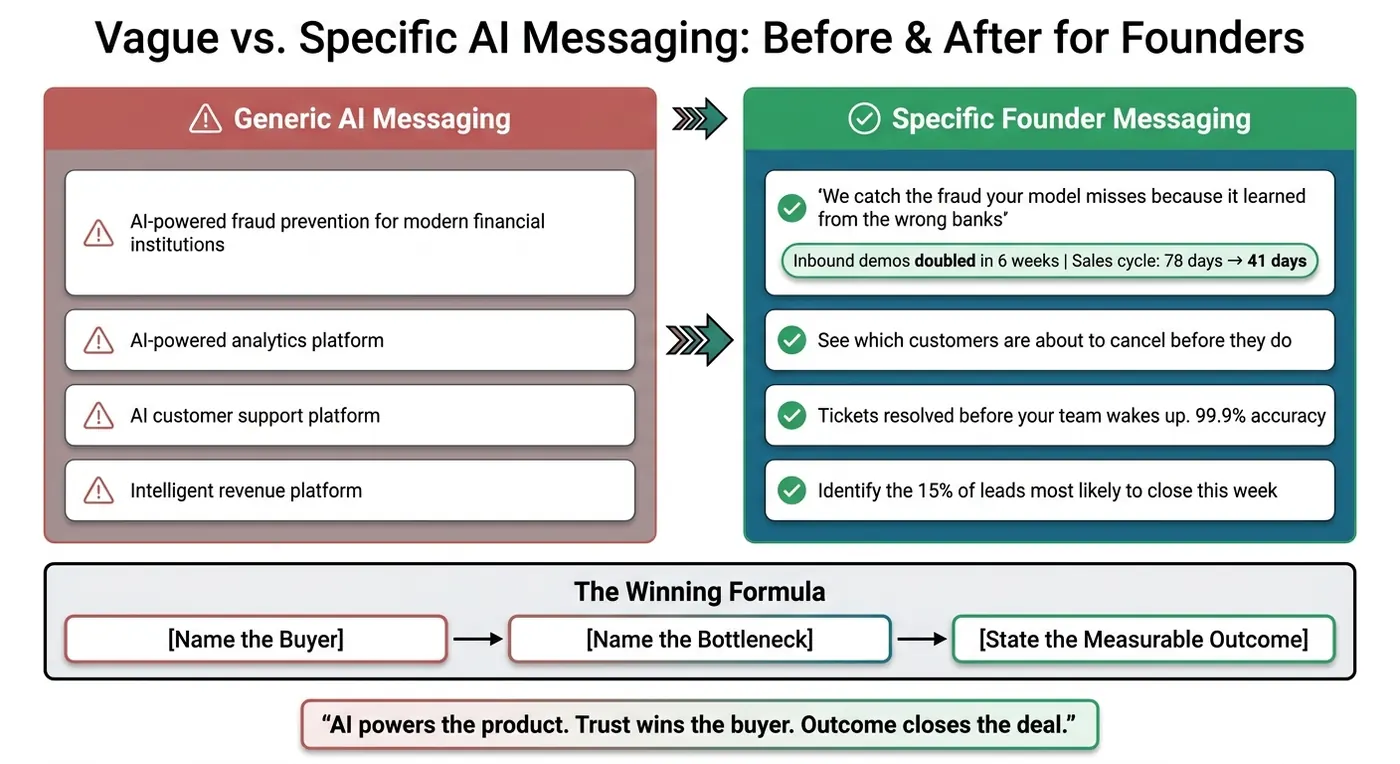
Here’s a good example. A fintech company with $9M ARR changed its homepage headline from "AI-powered fraud prevention for modern financial institutions" to "We catch the fraud your model misses because it learned from the wrong banks." In six weeks, inbound demos doubled, and the sales cycle dropped from 78 days to 41 days.
"AI powers the product. Trust wins the buyer. Outcome closes the deal." - Mike Molinet & Govind Kavaturi, The Builder Weekly
Why did that line work? Because it shows the buyer, the bottleneck, and the result in plain English.
Use Real Process Details Instead of Trend Language
Generic AI copy leans on labels like AI-powered or AI-enabled because they sound safe. But safe copy often says almost nothing. It doesn’t show how the product works or where it fits into a buyer’s day.
Process-level language does that job better.
Instead of "AI-powered analytics," say "See which customers are about to cancel before they do". Instead of "AI-native editor," say "automation that fits your product's real workflow." The goal is to narrow the message: one buyer, one job, one result.
A simple gut check helps here. Try to explain your product’s result in one sentence without using the word "AI." If you can’t, there’s a good chance you still haven’t pinned down what you’re selling.
Table: Vague vs. Specific AI Positioning
Use this test on your homepage, pitch deck, and outbound copy.
| Vague AI Messaging | Specific Founder Messaging |
|---|---|
| "AI-powered fraud prevention for modern financial institutions" | "We catch the fraud your model misses because it learned from the wrong banks" |
| "AI-powered analytics platform" | "See which customers are about to cancel before they do" |
| "AI customer support platform" | "Tickets resolved before your team wakes up. 99.9% accuracy" |
| "Intelligent revenue platform" | "Identify the 15% of leads most likely to close this week" |
That’s the split in plain terms: can the buyer see their own problem in a single sentence, or not?
Once the claim gets specific, building it into the offer becomes much easier.
Build AI Into Your Offers and Workflows
Once your positioning is clear, the next move is to make AI part of what the customer actually receives.
Build AI Into the Offer, Not Just the Back Office
Most founders begin by using AI behind the scenes for research, outlining, and faster iteration. That helps. But customers usually can't see it, which means they won't pay extra for it. The stronger play is to bake AI into the thing the customer is buying: faster audits, automated reporting, or a custom AI workflow that takes a repeat task off their plate.
A generic AI tool is easy to swap out. An AI system built around dental billing or freight dispatch is much harder to copy. That kind of workflow is easier to price because the value is plain. It solves a narrow problem, in a clear way.
Create a Human-Plus-AI Workflow for Content and Operations
One of the biggest mistakes founders make with AI content is simple: they give it a blank prompt and publish whatever comes back. The output usually sounds generic and flat, like it came from no one in particular. That's why every draft still needs a human pass.
A human-plus-AI workflow fixes that. You bring the strategy and judgment, often through a voice memo, rough outline, or strong point of view. AI can then draft or structure the piece. After that, a human reviews it for accuracy, tone, and any opinions that got sanded down. Then you shape it for the channel and audience before it goes live.
In practice, this can save a lot of time without washing out your voice. One Denver coaching founder cut her weekly writing time from 90 minutes to 38 minutes: 8 minutes for AI drafting and 30 minutes for her own editing pass, while keeping her voice intact. AI handled the structure. She kept the judgment.
"The reason your output sounds generic is not the model... It's that you handed the model a question without handing it a business." - Justin McKelvey, Fractional CTO
There’s still one more step: check every output for specificity before it ships.
Audit Every AI Output for Specificity and Accuracy
Check Every Output for Clarity, Originality, and Consistency
Once AI gives you a draft, give it one last specificity check before it goes live. A simple way to do that is the Cover-the-Logo Test: take the logo off and read the copy cold. If it still works without the logo, the message is too generic.
Next, run the Specific-Use Test. Cut lines like "AI-powered insights" and "AI-enabled solutions." Those phrases sound polished, but they don't say much. Swap them for one named workflow and one measurable outcome, such as "AI that flags charting errors before a doctor signs off". As Greg Rosner, Founder of PitchKitchen, puts it:
"The model isn't your differentiator. What you train it on, what you build with it, and what you say about it is."
After that, check for consistency across channels. Put your homepage hero, a customer email, and a social post next to each other. They should show the same point of view and the same position in the market.
Then strip out common AI filler, including "Let's dive into", "In today's fast-paced world", "The importance of X cannot be overstated", and "Moving forward". If the piece still doesn't sound like you, do one more manual voice pass.
Key Takeaways for Founders Using AI
The main idea across this guide is simple: AI handles structure and speed; you bring judgment and specificity. In practice, that means:
- Choose AI use cases that support your positioning, and define your voice before you prompt anything. Your beliefs, vocabulary, and contrarian takes need to be written down before AI can mirror them well.
- Replace vague claims with customer-specific language. Name the buyer, the bottleneck, and the measurable outcome.
- Build AI into your offers and workflows in ways that fit your actual business model.
- Review every output with the Cover-the-Logo Test, the Specific-Use Test, and a read-aloud pass before anything goes live.
The founders who stand out aren't the ones using the most AI. They're the ones whose AI-assisted work still sounds unmistakably like them.
FAQs
How do I define my founder voice before using AI?
Define your founder voice before you use AI. Start with your ownable point of view.
That point of view should come from your lived experience, the hard lessons you’ve learned, and the sharp market insight you’ve picked up along the way, not the same industry story everyone else is repeating.
A simple way to find it: go back through voice memos or meeting transcripts. Listen for the words you use without thinking, the rhythm of your sentences, and how formal or casual you tend to sound. That’s often where your natural voice shows up.
Then pressure-test your positioning. Answer one plain question: Why did you build this for this specific customer?
If the answer feels fuzzy, fix that first. Get the thinking clear before you use AI to scale your output.
How can I tell if my AI messaging is too generic?
Use three quick checks:
- Cover-the-Logo Test: If someone hides your logo and your homepage could pass for another company's, your message doesn't stand out.
- Specific-Use Test: If you say "AI-powered insights" instead of pointing to a clear use case for a clear buyer, you're being too vague.
- Lived-Truth Test: If you can't explain why you built this tool for this customer, your marketing may be ahead of your strategy.
Which AI use cases should I talk about publicly?
Talk openly about AI use cases in terms of clear outcomes for a specific buyer, not vague claims about what the tech can do. Put AI in its proper place: the engine behind a clear solution. Keep the customer win front and center.
If your message says "AI-powered insights", it's too fuzzy. Say what the AI actually does, who it does it for, and what changes because of it. Focus on the task, the person, and the result - more time back, less stress, better decisions, or a faster path to the outcome they want.