
If people notice you but don’t contact you, your brand isn’t doing its job.
I’d sum up the article like this: a personal brand should make it easy for the right people to know who you help, what result you deliver, and why they should contact you. The article’s main point is simple: attention alone is not enough. You need clear positioning, an outcome-focused message, proof, a small set of repeat topics, and a way to track whether your posts lead to DMs, calls, referrals, or speaking invites.
Here’s the short version:
- Pick one clear space to own. If your one-line description could fit 10 other people, it’s too broad.
- Lead with outcomes, not services. People care more about results like “15% more win rate in 8 weeks” than a list of tasks.
- Back up claims with proof. Case studies, numbers, screenshots, and client stories do more work than vague praise.
- Repeat a few topic themes. Posting about the same 3 to 5 ideas helps people remember what you do.
- Use LinkedIn for discovery and your website for conversion. LinkedIn starts the conversation; your site helps turn that interest into action.
- Track demand, not vanity metrics. Saves, qualified DMs, booked calls, referrals, and media requests matter more than likes.
A few facts from the article stand out:
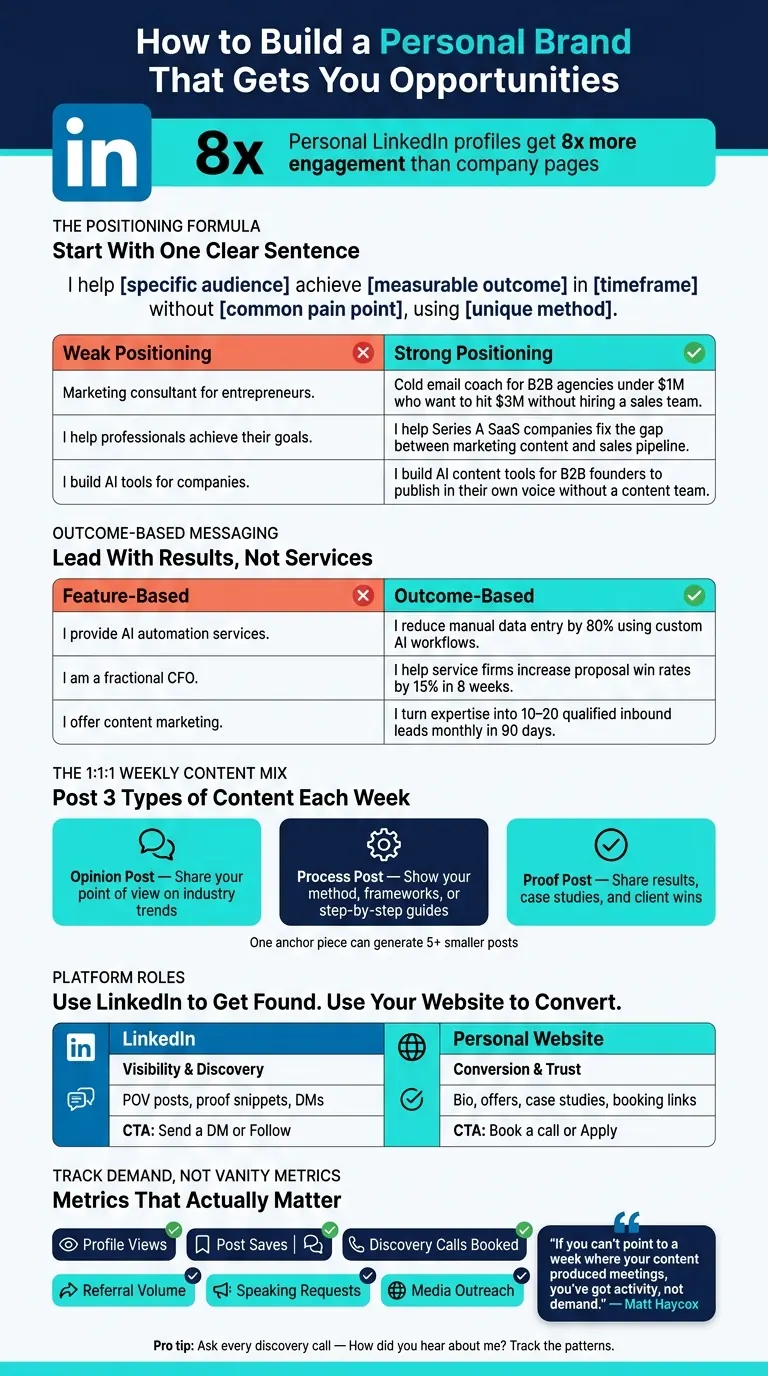
- Personal profiles on LinkedIn get 8x more engagement than company pages.
- A simple 1:1:1 posting mix works well: one opinion post, one process post, and one proof post each week.
- One anchor piece can turn into 5+ smaller posts, which cuts content effort without losing consistency.
If I were applying the advice today, on June 30, 2026, I’d start with one sentence: “I help [specific group] get [clear result] using [my way of doing it].” Then I’d put that message on my LinkedIn headline, website homepage, and outreach, and support it with numbers and short case studies.
That’s the whole game: clear promise, proof, repetition, and tracking what turns into opportunities.
Step 1: Define Your Positioning So the Right People Understand What You Do
Before you write content or touch your profile, get clear on what you want to be known for and who you want to be known by. If your positioning is fuzzy, people may notice you and still have no idea what to hire you for. Once that part is clear, writing posts, updating your profile, and sending outreach gets much easier.
"Positioning isn't about being the best. It's about being the only one who does what you do, for a specific person, in a specific way."
Write a Clear Positioning Statement
The fastest way to sort this out is with a simple formula: "I help [specific audience] achieve [measurable outcome] through [unique method], without [common pain point]". Here, "specific audience" could be something like "Series A SaaS founders" or "B2B agency owners under $1M in revenue", and the outcome should name a clear result.
Here’s the difference between positioning that fades into the background and positioning people can act on:
| Weak Positioning | Strong Positioning |
|---|---|
| "Marketing consultant for entrepreneurs." | "Cold email coach for B2B agencies doing under $1M who want to hit $3M without hiring a sales team." |
| "I help professionals achieve their goals." | "I help Series A SaaS companies fix the gap between marketing content and sales pipeline." |
| "I build AI tools for companies." | "I build AI content tools for B2B founders to help them publish in their own voice without a content team." |
| "I speak on leadership topics." | "I keynote for HR and People teams at mid-market tech companies navigating remote culture." |
A simple gut check helps here: if your positioning statement could fit ten other people in your space, it’s not a position. It’s just a description.
Once your position is clear, you can build a value proposition and proof that make your promise believable.
Pick the Audience and Outcome You Want to Target
Start with patterns in the work that fits you best. Look at your last 10 closed-won deals, your strongest client conversations, and the messages sitting in your inbox. Pay attention to the sector, the role, and the trigger behind the hire or inquiry. That’s usually where your niche starts to show up.
Then get more exact about who you want to attract: the people who can hire you, invite you, refer you, or feature you. Pair that audience with an outcome they already want, not one you think they should want. That part matters. When your positioning speaks to a pain they already feel, they spot themselves in your content much faster and are more likely to reach out.
"The paradox of personal brand positioning: the more specific you get, the fewer people your statement speaks to - and the more powerfully it speaks to those people." - Contentio.io
Narrowing your focus can feel like you’re making your reach smaller. In practice, the opposite tends to happen. The right people recognize themselves right away, and that recognition is what drives inbound. That clarity also sets up the value proposition you’ll build in the next step.
Step 2: Build a Value Proposition and Proof That Work Together
Your positioning needs to turn into a value proposition that makes the right person think, "This is exactly what I need." The job here is simple: name the outcome, then back it up with proof. The promise comes first. The evidence should support that promise right away.
Turn Your Expertise Into an Outcome-Based Value Proposition
Use this format:
"I help [specific audience] achieve [measurable outcome] in [timeframe] without [common pain point], using [unique method]."
That "without" part matters. It speaks to the trade-off people are trying to avoid.
Results matter more than features. People don’t buy a service list. They buy the change they want.
| Feature-Based Messaging | Outcome-Based Messaging |
|---|---|
| "I provide AI automation services." | "I reduce manual data entry by 80% using custom AI workflows." |
| "I am a fractional CFO." | "I help service firms increase proposal win rates by 15% in 8 weeks." |
| "I offer content marketing." | "I turn expertise into 10–20 qualified inbound leads monthly in 90 days." |
| "I help with business growth." | "I turn referral-dependent revenue into a repeatable pipeline." |
Once you have that statement, shrink it into three lines: who you help and what they get, how you do it in a different way, and one clear proof point. That short version can sit at the center of your LinkedIn headline, website hero section, and outreach.
Use Case Studies, Testimonials, and Founder Stories as Evidence
Once the promise is clear, you need proof. A strong format is Challenge, Action, Result. It reads like evidence, not hype. The challenge gives context, the action shows your method, and the result gives the reader something solid to latch onto.
Named case studies with real numbers tend to work best in high-stakes moments, like closing calls, proposals, or DMs from warm leads. Process posts and published frameworks help with cold audiences who haven’t heard of you yet. Testimonials can push a skeptical visitor over the line on a "Work With Me" page. Founder stories - like a sharp failure or turning point - build trust in a more human way than a stack of credentials ever could.
| Proof Type | What It Signals | When to Use It |
|---|---|---|
| Named Case Studies | Direct ROI and real-world application | High-ticket sales and closing calls |
| Process/Method Posts | Transparency and intellectual authority | Building trust with cold audiences |
| Artifacts (Screenshots/Templates) | Tangible evidence of work quality | Middle-of-funnel buyer enablement |
| Third-Party Validation | Consensus and industry recognition | Bios, featured sections, baseline credibility |
A practical way to do this: pull your top 10 closed-won deals in 90 minutes from your CRM or inbox. Then look at the business result each client got - maybe more cash runway, maybe more leads - and use those numbers in your case studies.
"Numbers are more convincing than adjectives." - Alex Berman
Use proof to make the promise believable. Next, turn that promise into repeatable content themes.
Step 3: Choose Content Themes That Reinforce Your Expertise
Once your value proposition is clear, pick 3–5 recurring content themes that keep reinforcing it. The goal isn’t to post more. It’s to make your work easier to recognize through repetition. Each pillar should reflect the audience, outcome, and proof you defined in the last step.
"The market no longer rewards presence alone. It rewards recognizable authority that people can place in a category and actually remember." - SocialRevver
Build Content Pillars Around Your Work and Point of View
Choose pillars that repeat your positioning, show how you work, and answer the problems your audience already wants solved. In practice, themes like client results, process, lessons learned, point of view, and work samples tend to do this well.
Each pillar should do at least one of three jobs:
- Build recognition so people know what you stand for
- Show competence so people can see you know your craft
- Create relationship so trust has room to grow
A simple weekly 1:1:1 mix works well: one point-of-view post, one process post, and one proof post. That gives your content enough consistency to be remembered without making it feel repetitive.
| Content pillar | Primary function | Example angles |
|---|---|---|
| Point of view | Filters audience and builds authority | Stances on industry trends, decision logs |
| Process | Makes expertise tangible | Frameworks, step-by-step guides, checklists |
| Proof | Reduces risk and validates claims | Before/after results, revenue metrics, timelines |
| Lessons learned | Builds relatability and trust | Post-mortems, "what I'd do differently" |
| Artifacts | Provides immediate evidence | Screenshots of work, templates, tool stacks |
Build a Simple Content Calendar You Can Stick To
Start with one main idea each week. Then turn that idea into three angles: a problem post, a method post, and a proof post. Set aside 3–4 hours once a week to script and record content.
From there, one anchor piece - a long-form LinkedIn post, a newsletter, or a short article - can turn into five or more shorter posts, an email section, and a short video script. That’s the same idea doing more than one job, which is exactly what you want.
Use Notion or Airtable to plan, schedule LinkedIn posts in Buffer, and keep a running proof bank with results, objections, metrics, and client language. Done right, this turns your calendar into a system for sending the same signal again and again - not just a place to track what you’ll post next.
Next, assign those pillars to the platforms that can turn attention into inquiries.
Step 4: Publish on LinkedIn and Your Website, Then Track What Drives Opportunities
Once your content themes are clear, put them where they can generate demand. For most founders, that means LinkedIn and your personal website. LinkedIn helps people find you and start conversations. Your website turns that interest into inquiries.
Give Each Platform a Specific Job
LinkedIn should do the heavy lifting for visibility and discovery. Personal profiles get 8x more engagement than company pages. So don’t treat your profile like a resume. Use your headline to say the outcome you deliver, not just your job title. And in your Featured section, link to specific frameworks or case studies instead of sending everyone to your homepage.
Your personal website plays a different role. It’s your lead-capture hub: a steady place for your bio, offers, and proof that social platforms can easily bury. It should make three things clear fast:
- what you offer
- why someone should trust you
- what to do next
That matters because LinkedIn reach shifts all the time. Your website is the asset you control.
| Platform | Primary Job | What Belongs Here |
|---|---|---|
| Visibility, discovery, and visibility in AI search results | POV posts, proof snippets, DMs | |
| Personal Website | Conversion, trust deepening, lead capture, and sales | Bio, offers, case studies, service pages, booking links |
| CTA Style | Different goals, different CTAs | "Send a DM" or "Follow" vs. "Book a call", "Download resource", or "Apply" |
Track Inbound Signals and Refine Your Brand Over Time
Publishing only helps if you can tell which posts lead to qualified interest. Watch signals like profile views, post saves, qualified DMs, discovery calls booked, referral volume, speaking requests, and media outreach. Those are the signs that your brand is creating actual opportunities, not just noise.
"If you can't point to a week where your content produced meetings, you've got activity, not demand." - Matt Haycox, Entrepreneur and Investor
This is the key shift: track what leads to DMs, calls, and referrals, not just likes. Pay attention to which topics, proof points, and offers keep showing up in inbound conversations.
One simple habit makes this much easier. During every discovery call, ask, "How did you hear about me?" Then write down the answer. After a while, patterns start to show. You’ll see which posts, topics, or proof points are driving real conversations.
FAQs
How do I choose a niche without limiting opportunities?
Choosing a narrow niche doesn’t shrink your opportunities. It helps you draw in the right ones. If you try to speak to everyone, your positioning usually gets fuzzy fast. And when that happens, people don’t know why they should pick you.
A niche gives people a clear reason to remember you.
Think of your niche as the place where you build authority first. You’re not throwing away the rest of your expertise. You’re simply picking a clear starting point, so people know exactly what to come to you for.
What proof should I use if I don’t have formal case studies yet?
Use other concrete evidence of your expertise: specific results, numbers, and before-and-after outcomes, even if they’re small.
You can also share artifacts of your work - templates, frameworks, checklists, and screenshots - and use your content to walk people through your thinking, methods, and decision-making. That gives potential clients proof they can actually see, even without a formal case study.
How long should I track content before judging results?
Give your content 90 days before you decide whether it’s working for your personal brand.
Yes, you can test messaging and positioning in 7 to 14 days with small, focused experiments. That part can move fast.
But trust and authority don’t show up overnight. The kind that leads to steady business results usually takes a full 90 days of consistent publishing.