
You do not need three ideas. You need one clear idea and three versions of it.
I’d sum up the process like this:
- as the main source
- for LinkedIn
- with your take
- , with email going out
later - - the thinking and research, which can take
of the total work
If I want to publish more without adding more work, this is the play: build one strong piece, mark the best parts while writing, and turn those parts into posts for other channels. The goal changes by format - search traffic for the blog, comments and views for LinkedIn, and opens and replies for email - but the main idea stays the same.
A simple way to think about it:
| Format | Main job | Best use |
|---|---|---|
| Blog post | Search traffic and authority | Full explanation |
| LinkedIn post | Attention and response | One hook, one point |
| Newsletter | Reader trust and clicks | Context, opinion, and link back |
I’d use this method any time I have one idea tied to a buyer question, a service I sell, or a lesson that keeps coming up in calls. It cuts wasted effort and makes publishing more steady.
How to Repurpose Content Across Platforms (Step-by-Step)
Pick a Pillar Idea Worth Repurposing
A strong pillar idea needs to do two jobs at once. It has to be specific enough to matter, but broad enough to work across three formats. It should solve a clear business problem and connect to a business goal. If the idea is too vague, it falls apart fast. If it’s too narrow, you’ll run out of room.
You probably already have good source material sitting in your day-to-day work. Think webinars, podcast episodes, articles, research, memos, calls, and transcripts. Pull the key points into one workspace so you’re building around one usable idea, not just piling up more content. Then strip that material down to its core message before you pick the format.
"One good idea deserves multiple formats, channels, and shots on goal." - Patrick Frank, Business In A Box
"One good idea deserves multiple formats, channels, and shots on goal." - Patrick Frank, Business In A Box
Run a Simple Test to Validate the Idea
Before you draft anything, ask:
- Is it relevant?
- Does it support a business goal?
- Does it answer a real audience need?
The strongest ideas tend to be evergreen, tied to a core service, or pulled from questions customers ask again and again.
Write the Core Message Before Choosing a Format
Before drafting, turn the idea into a source document with key takeaways, proof points, and reusable visuals. This gives you one input for your blog, LinkedIn post, and newsletter, so you’re not starting from scratch each time.
From there, the shape changes by channel. The blog goes deeper. The LinkedIn post gets tighter. The newsletter adds context. Start with the core message, then adjust the depth to fit the place where it will live.
Turn the Idea Into a Blog Post That Builds Authority
The blog post is the deepest version of the idea. It also becomes the main source for your LinkedIn post and newsletter.
Start with a structure that gives you parts you can reuse later. A strong pillar post doesn't just teach something. It shows how you think in a way people can spot again and again. And the way you shape that post affects how much material you'll have when it's time to repurpose it.
Use a Four-Part Structure That Is Easy to Repurpose
Use a simple four-part structure: problem, insight, steps, outcome.
Start with a pain point your audience will spot right away. Then bring in your main idea or framework as the answer. Walk through the steps in plain English. End with a real-world result that proves the idea holds up.
Each part can do double duty.
- The opening problem can become your LinkedIn hook.
- The framework can become a social post or carousel.
- The outcome can become the angle for your newsletter.
You're not writing four separate assets. You're writing one post with built-in pull quotes, angles, and starting points.
Mark Extraction Points While Drafting
As you draft, mark four things before you call it done.
Find one quote that can stand on its own as a graphic. Pick one contrarian point that pushes against common advice. Spot one short story or behind-the-scenes moment that gives the piece some texture. Then pull out one simple list or checklist readers can use right away.
This is what makes repurposing feel easy instead of annoying. When you open a blank doc for LinkedIn or email, you won't have to start from scratch. The best parts are already marked and ready to turn into a hook, a lead, or a stand-alone point.
| Blog Component | Repurposing Target | Repurpose As |
|---|---|---|
| Opening paragraph | LinkedIn hook or newsletter teaser | Use it as the lead to pull readers into the full post |
| Framework or steps | LinkedIn carousel | Turn each step into one slide with a short headline |
| Contrarian point | Social post | Share it as a stand-alone take and invite responses |
| Personal or client story | Newsletter angle | Lead with it to add context and commentary |
| Simple list or checklist | Social post | Turn it into a quick-win resource that points back to the blog |
Once you've flagged these parts, turning the idea into LinkedIn and email becomes a rewrite, not a restart.
Adapt the Same Idea for LinkedIn and a Newsletter
Once the blog draft is done, reuse the same core idea for LinkedIn and email. The message stays the same. What changes is the hook, the depth, and the tone based on the channel.
Start with what you already flagged in the blog draft: the opening line, the contrarian point, or the short story. That becomes your raw material.
Rewrite the Idea as a LinkedIn Post With One Hook and One Takeaway
LinkedIn tends to reward short, sharp posts. So don't turn your blog into a mini recap. Instead, pull out one angle and let it stand on its own.
Think of it like a teaser, not a transcript.
Open with a strong hook. That could be:
- a contrarian statement
- a surprising number
- a short story that drops the reader into the middle of a moment
Then keep the body easy to scan with short sentences and line breaks. Close with one clear takeaway or a simple prompt that invites a response.
Condense the Idea Into a Newsletter With Context and Commentary
A newsletter is more personal, so it should read like a note to someone who already knows you. Lead with why the topic matters right now, add your point of view, and link to the blog for the full breakdown.
Then stagger the send by 24–48 hours after the blog goes live so search engines index your original post first.
See How the Same Idea Changes by Channel
The goal isn't to change the idea. It's to shift the angle, depth, and voice.
| Feature | Blog Post | LinkedIn Post | Newsletter |
|---|---|---|---|
| Outcome | Traffic & SEO rankings | Engagement & impressions | Open rates & replies |
| Length | Long-form (800+ words) | Short/medium (150–300 words) | Medium, digestible summary |
| Tone | Educational & structured | Bold, punchy, social | Personal & conversational |
| Depth | Deep dive | One sharp takeaway | Context & commentary |
With the formats mapped, the next move is turning this into a fast workflow.
Build a Repeatable Repurposing Workflow
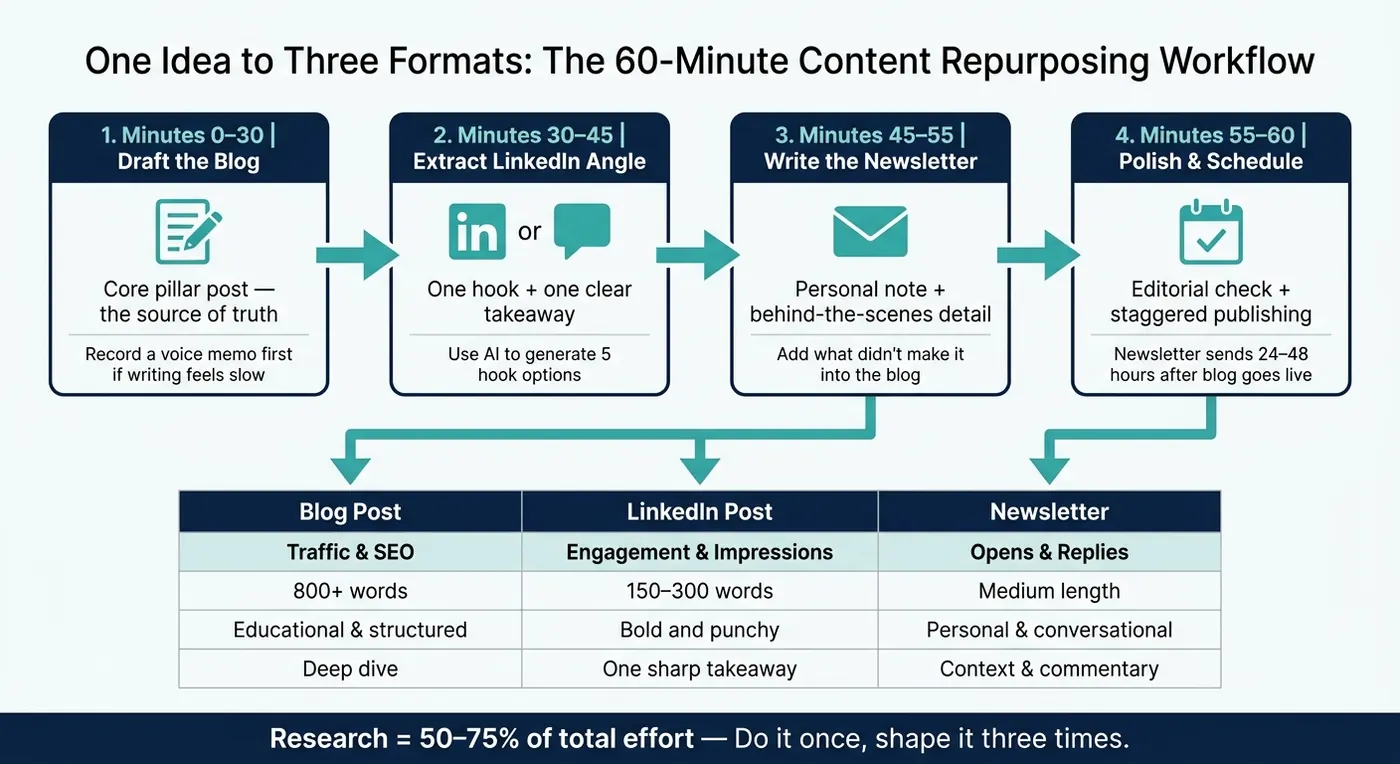
Now make the process fast enough to run every week.
Use a 60-Minute Workflow to Go From One Idea to Three Drafts
Once your core message is set, you can turn one source idea into three drafts in about an hour. Research takes roughly 50–75% of total effort, so the goal here is simple: do the thinking once, then shape it for each channel without restarting.
Here’s the flow:
- Write the main post around your pillar idea. If writing feels slow, record a voice memo first and draft from the transcript.
- Pull out one strong hook and one clear takeaway from the blog, then rewrite them for a professional audience. You can also use an AI tool to generate five hooks or sum up the main points.
- Add one personal note, a behind-the-scenes detail, or an extra tip that didn’t make it into the blog.
- Run through a quick editorial check, publish the blog, and queue the LinkedIn post and newsletter to go out after the post is live.
This works because you’re not coming up with three separate ideas. You’re taking one solid insight and giving it three different jobs.
Keep Voice and Positioning Consistent Across Formats
After the drafts are done, make sure the language and point of view line up so everything still sounds like one brand. The biggest risk here is drift. A blog that sounds sharp, a LinkedIn post that feels flat, and a newsletter that reads like someone else wrote it can weaken recognition.
Stick with the same specific terms, the same point of view, and the same business stance across all three formats. That kind of consistency matters. Consistent visuals can lift brand recall by 23%.
Keep your tool stack simple:
- for transcripts
- for visuals
- for staggered scheduling
Conclusion: One Idea, Three Formats, Less Wasted Effort
The system is simple: start with a strong pillar idea, turn it into a long-form blog post that acts as the source of truth, pull one sharp angle for LinkedIn, and reshape it into a more personal newsletter that builds trust with your current audience. Each format has a different role, but the idea only has to be built once.
If you’re a founder or operator who never seems to have enough time to publish on a steady basis, this workflow removes the biggest bottleneck: starting from scratch. One good insight can power three formats and keep your presence steady.
FAQs
How do I know if an idea is strong enough to repurpose?
A strong repurposing idea keeps paying off over time. The best picks are evergreen topics, high-performing pieces with proven traffic or engagement, and sharp insights tied to your main business goals.
Before you move ahead, pressure-test the idea. Does it solve a real audience need? Does it support a business goal? And does it have enough depth to work across more than one format without forcing you to rebuild it from scratch?
Should I always publish the blog before LinkedIn and email?
Yes, publish the blog on your website first.
That gives your site the best shot at being seen as the original source. It also helps search engines connect the content to your domain, which supports your SEO.
Once the post is live and indexed, turn it into LinkedIn content and a newsletter. A simple way to do this is to space those follow-up posts by two or three days.
Use LinkedIn and email as teasers or a place to share personal takes, then point readers back to the full blog post on your site.
What if I do not have time to create all three formats every week?
Focus on a repeatable system that puts quality ahead of volume. Batch your work by format, use scheduling tools to automate distribution, and repurpose one strong idea so you don't have to redo the research for every version.
It also helps to rotate the formats you focus on based on the time and energy you have right now. If your bandwidth is tight, lean on the formats that are easier to produce without letting standards slip.