
I’d write a brand positioning statement by naming who you serve, what they need, what you offer, and why they should believe your promise. Start with customer feedback and facts you can support - not words like best.
I’d use this guide to:
- Gather the facts and turn them into a short statement.
- Check the draft against examples from invented businesses.
- Ask target customers what they think it means, then fix repeated misunderstandings.
- Use the statement to guide your homepage, sales pitch, and product copy.
My rule: <u>make the promise no bigger than the proof.</u> Customer feedback can help you check the wording; it cannot prove demand or support a claim.
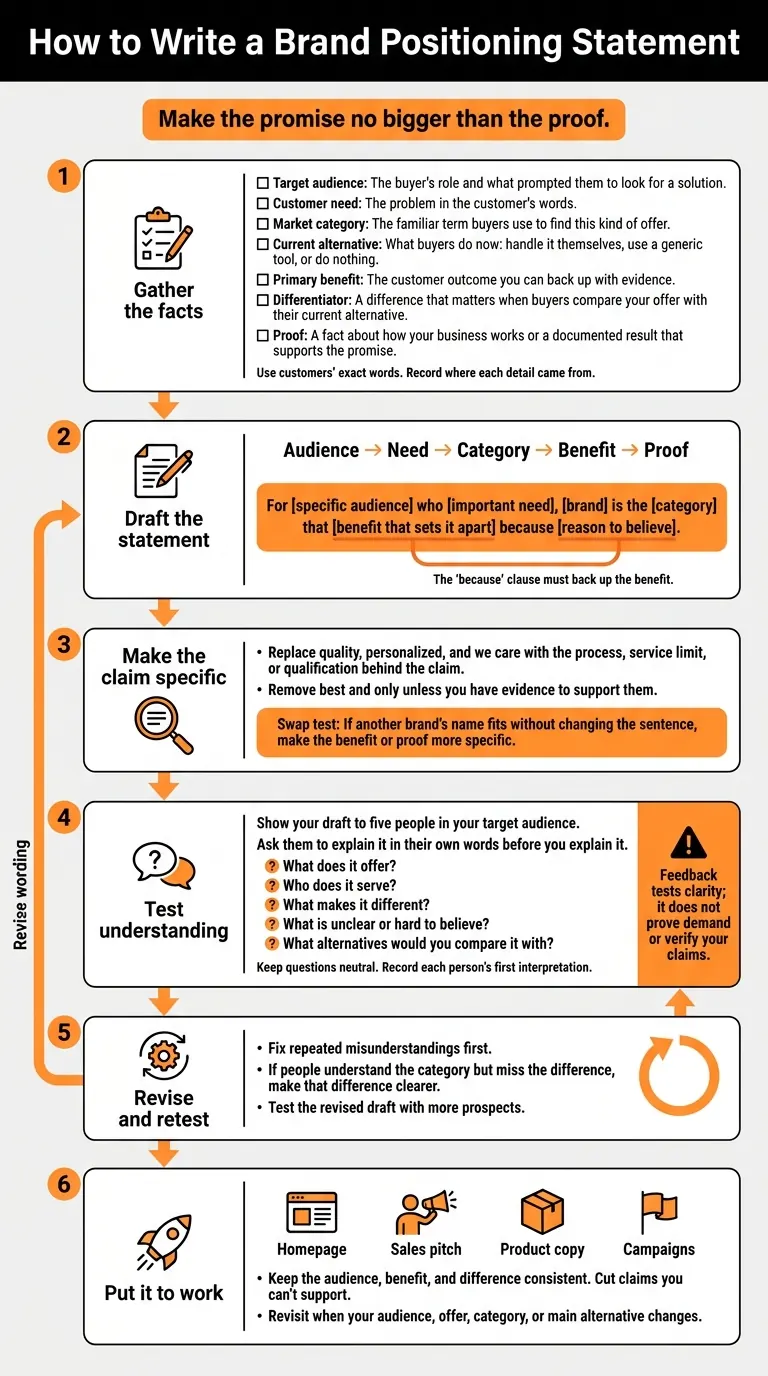
Gather the Facts and Fill In the Template
Complete Your Positioning Worksheet
Use customers’ exact words to describe their problem and what prompted them to act. Record where each detail came from.
| Worksheet field | What to record |
|---|---|
| Target audience | The buyer’s role and what prompted them to look for a solution |
| Customer need | The problem in the customer’s words |
| Market category | The familiar term buyers use to find this kind of offer |
| Current alternative | What buyers do now: handle it themselves, use a generic tool, or do nothing |
| Primary benefit | The customer outcome you can back up with evidence |
| Differentiator | A difference that matters when buyers compare your offer with their current alternative |
| Proof | A fact about how your business works or a documented result that supports the promise |
Turn the strongest facts into a sentence.
Check your sales notes before naming the alternative. Buyers may be weighing your offer against keeping their current process - not switching to another brand. Focus on a difference that matters to that choice, rather than a feature customers never mention.
Fill In Your Brand Positioning Statement
Build your statement in this order: audience, need, category, benefit, proof.
For [specific audience] who [important need], [brand] is the [category] that [benefit that sets it apart] because [reason to believe].
Define your audience by their situation, not just their demographics. Use a category buyers already understand. State the outcome they want, then tie it to evidence from your worksheet. The “because” clause must back up the benefit, not just describe your business.
For everyday conversations, use the shorter version below. Keep the same audience, outcome, and difference. Leave the supporting evidence in your worksheet.
[Brand] helps [audience] achieve [outcome] by [how], unlike [alternative].
Replace Vague or Unsupported Claims
Replace quality, personalized, and we care with the process, service limit, or qualification behind the claim. Remove best and only unless you have evidence to support them.
Use the swap test: if another brand’s name fits without changing the sentence, make the benefit or proof more specific.
Brand Positioning Statement Examples: Invented Businesses
HarborDesk, TrailTable, and LedgerLift are invented businesses that show how a positioning worksheet becomes a finished statement. Each names the audience, category, benefit, and proof behind the claim.
HarborDesk: Coworking for Independent Remote Workers
For independent remote workers who need a dependable place to focus, HarborDesk is the coworking space that supports quiet, planned workdays through reservable desks and sound-treated rooms.
The difference is planning and focus, not just a place to work. Reservable desks and sound-treated rooms explain how HarborDesk supports that promise.
TrailTable: Camping Meal Kits for Families
For families on weekend camping trips who want simple hot meals, TrailTable is the camping meal kit that makes outdoor cooking easier because it pairs compact ingredients with one-pot recipes.
The statement stays focused on outdoor cooking, rather than trying to cover every family meal. Compact ingredients and one-pot recipes give families a clear reason to choose it for camping.
LedgerLift: Bookkeeping for Independent Medical Practices
For independent medical practices that need clearer monthly financial records, LedgerLift is the bookkeeping service that provides practice-focused reporting because its workflow uses the revenue and expense categories these practices track.
This defines the bookkeeping service’s scope without promising higher profits. The reporting fits medical practices because the workflow uses the categories they track.
| Business | Audience | Category | Benefit | Differentiator | Support |
|---|---|---|---|---|---|
| HarborDesk | Independent remote workers | Coworking space | Quiet, planned workdays | Dependable workspace | Reservable desks; sound-treated rooms |
| TrailTable | Weekend-camping families | Camping meal kit | Easier outdoor cooking | Compact, one-pot meals | Compact ingredients; one-pot recipes |
| LedgerLift | Independent medical practices | Bookkeeping service | Practice-focused reporting | Practice-specific workflow | Relevant revenue and expense categories |
Before you publish your statement, ask customers what they think it means. If their reading doesn’t match what you intended, revise the wording.
Test Your Statement With Real Customers
Show your draft to five people in your target audience. Check whether they understand it without an explanation. [1][4]
Ask Customers What the Statement Means
Let each person read the draft, then ask them to explain it in their own words. Don’t explain what you meant first. [1]
Ask what the statement offers, who it serves, and what makes it different. Find out which wording feels unclear, which claims seem hard to believe, and what other options they would compare it with. Keep your questions neutral so you don’t steer their answers. [1][4]
Find Patterns and Revise the Statement
Look for misunderstandings that come up more than once, rather than rewriting around every reaction. Use the table to compare responses. Record each person’s first interpretation - not their answer after you explain the draft.
| Participant | Understood the category | Identified the audience | Noted the difference | Confusing wording |
|---|---|---|---|---|
| 1 | ||||
| 2 | ||||
| 3 | ||||
| 4 | ||||
| 5 |
Fix repeated misunderstandings first. If people understand the category but miss what sets your business apart, make that difference clearer. Then test the revised draft with more prospects. Feedback tests clarity; it does not prove demand or verify your claims. Those need separate evidence. [1][4]
Conclusion: Put Your Positioning Statement to Work
Once you have a draft and customer feedback, use your brand positioning statement to guide business decisions and public copy. [1][2]
Review Your Homepage, Sales Pitch, and Product Copy
Check your homepage, sales pitch, product copy, and campaigns against the statement. Each should speak to your audience, explain the benefit, and show what sets your offer apart. Cut claims you can’t support. If your homepage needs new claims, revise the positioning statement first. [1][5]
Revisit your positioning when your audience, offer, category, or main alternative changes - not just because you want new copy. [1][3]
Choose Your Next Step
Use the Brand Identity Checker to check whether your visible brand matches your intended position. If you need broader brand direction, review Brand Development.
This article provides general information, not legal, tax, or financial advice. Consult an attorney or accountant for advice specific to your business.
FAQs
How is a brand positioning statement different from a tagline?
A brand positioning statement is an internal tool that guides your team, sales process, and marketing decisions. It spells out who your customer is, what category your product fits into, what sets its benefit apart, and what customers might choose instead.
A tagline is a short, memorable phrase for the public. It draws from your positioning statement, but it can’t replace it. A tagline leaves out the details your team needs: your target customer, the proof behind your claims, and what makes your brand different.
What proof can I use if my business is new?
When your business is new, use facts buyers can check instead of relying on a reputation you haven’t built yet. Point to a specific licensing agreement, how you staff the work, a limit on how many clients you take, or a set process designed to deliver consistent results.
Skip vague claims like “premium” or “passionate.” Give buyers concrete reasons to trust your business while you build evidence through customer testimonials, research findings, or performance data.
Do I need separate positioning statements for different audiences?
Yes. You can create a positioning statement for each target customer group. It’s an internal tool that helps your team agree on who you serve and why your offer matters.
Keep your brand’s core message consistent, but tailor each version to the audience’s needs, challenges, and motivations. Change the emphasis, not the brand. That gives your team a clear way to speak to different customers without pulling the business in different directions.