
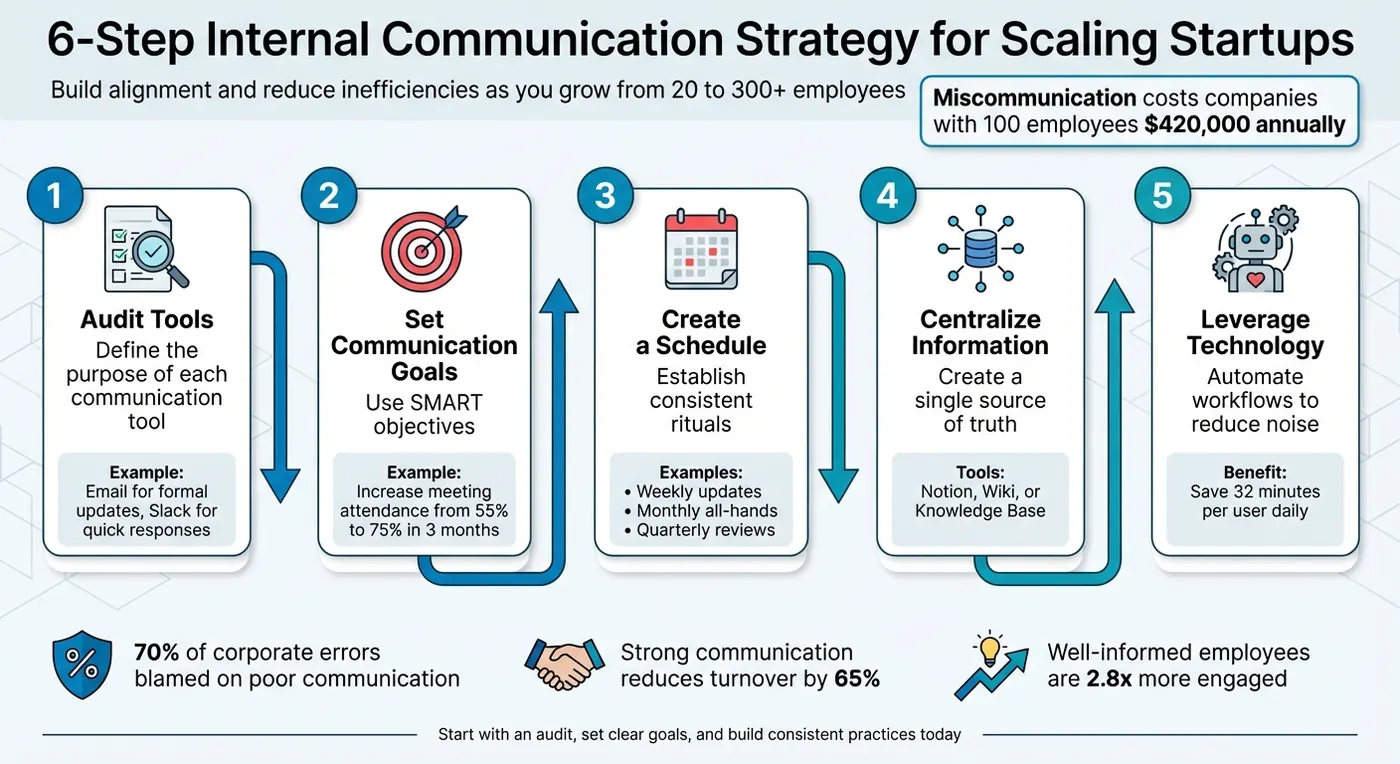
Scaling a startup from 20 to 300+ employees brings communication challenges that can slow growth, create silos, and weaken team alignment. Here's what you need to know to build an effective internal communication strategy:
- Why It Matters: Miscommunication costs companies with 100 employees an average of $420,000 annually. Clear communication improves efficiency, alignment, and culture.
- Common Issues: Tools without clear guidelines, scattered information, and mismatched leadership vs. employee preferences are common pitfalls.
- Action Steps:
- Audit Tools: Define the purpose of each tool (e.g., email for formal updates, Slack for quick responses).
- Set Communication Goals: Use SMART objectives like increasing meeting attendance or improving access to resources.
- Create a Schedule: Establish consistent rituals (e.g., weekly updates, monthly all-hands, quarterly reviews).
- Centralize Information: Use a "hub" like Notion or a wiki for critical updates and resources.
- Leverage Technology: Automate workflows with tools like Slack or Loom to save time and reduce noise.
- Reinforce Values: Highlight behaviors tied to company values and encourage feedback through surveys or open office hours.
Key Takeaway: A clear, structured communication strategy keeps your team aligned, reduces inefficiencies, and supports growth. Start with an audit, set clear goals, and build consistent practices today.
Pulling Back the Curtain: How to Scale Internal Communications | Startup Boston Week 2020
Auditing Your Current Communication Practices
Start by taking a close look at your current communication tools and their purposes. Many growing startups rely on a mix of tools like Slack, email, Asana, and Notion. The problem isn’t having multiple platforms - it’s the lack of clear, documented guidelines for each one. This confusion can lead to duplicated efforts and wasted time searching for information scattered across various channels.
To get started, make a list of all the tools your team uses, from chat apps to project management platforms and knowledge bases. Then, ask yourself: Does each tool have a clearly defined purpose? For example, email might be best for formal announcements and detailed messages with a two-business-day response time. Meanwhile, tools like Slack are better suited for quick questions that need answers within one business day. Without clear rules, teams often default to using whatever tool is most convenient at the moment, leading to critical updates getting lost in chat threads or urgent questions buried in email chains.
Mapping Your Communication Channels
A straightforward way to bring clarity to your communication tools is by creating a channel definition matrix. This document outlines each tool, its purpose, and expected response times. Alyssa Towns, an expert in internal communications, offers a helpful perspective:
"If it matters to the business, it lives in the hub. If it's not in the hub, it doesn't exist. Treat this space like your team's internal library - tidy, reliable, and always accessible".
Towns also highlights the importance of addressing the "bus factor" - the risk of critical information being stored only in the minds of a few team members rather than in a centralized, accessible location. To reduce this risk, conduct quarterly communication audits. Ask questions like: Which tools are actually being used? Which meetings could be replaced by an email? Can everyone easily access essential resources like the roadmap, customer feedback, and strategic decisions? This review helps identify where communication tools still fall short in bridging critical information gaps.
Finding Gaps in Information Flow
Delays in employees receiving important updates often signal breakdowns in communication. Poor communication is blamed for 70% of corporate errors. Look for recurring issues such as duplicated work, decisions made informally (e.g., over coffee or during Zoom calls) that aren’t documented, or an overuse of direct messages instead of public channels where everyone can benefit.
Another common issue is the disconnect between leadership’s perception of effective communication and what employees actually prefer. For instance, while 36% of employees prefer all-hands or department meetings, leaders often rely on ad-hoc emails and chat messages. Setting up feedback loops can help bridge this gap. Quick surveys after company updates or dedicated Slack threads for employee concerns can provide real-time insights into what’s working and what’s not.
Building a Scalable Internal Communications Strategy
Once you've pinpointed the weaknesses in your current communication setup, the next step is creating a strategy that grows alongside your company. This involves designing a framework that can expand as your team does. A solid framework helps maintain alignment, and setting clear goals ensures every part of your organization moves in the same direction.
Setting Communication Goals and Objectives
The first step is to identify what you want to accomplish through internal communications. Skip vague intentions and focus on SMART objectives - specific, measurable, achievable, relevant, and time-bound. For instance, you could aim to boost attendance at all-hands meetings from 55% to 75% within three months. If your team is scaling from 50 to 150 employees, your goal might be to ensure 90% of new hires can locate essential resources (like the product roadmap or customer feedback) within their first week. These detailed objectives help streamline communication and support long-term growth. To stay on track, review these metrics quarterly to evaluate the effectiveness of your strategy.
Creating a Regular Communication Schedule
Consistency beats sporadic updates every time. Establish a predictable rhythm for communication to keep everyone aligned. For example, Jason Green, CEO of Upward Farms, uses three weekly rituals: Monday "celebrations" to start the week with positivity, Wednesday all-hands for strategic alignment, and Friday "family meals" to build team connections. Similarly, beehiiv's CEO Tyler Denk holds two all-hands meetings each week - one on Monday to kick off the week and another on Friday to wrap it up - ensuring his global team of over 100 employees stays on the same page.
A tiered structure can also work wonders:
- Weekly standups: Focus on tactical updates and team-level discussions.
- Monthly all-hands: Dive into strategic priorities and share performance data.
- Quarterly reviews: Tackle big-picture goals and host company-wide Q&A sessions.
One example comes from a remote-first SaaS startup in Austin, Texas, with 350 employees. Between 2024 and 2025, they implemented a monthly 10–12 minute "CEO Signal" video, weekly Slack updates with a standardized template for each team, and quarterly virtual town halls. By Q4 2024, their town hall attendance jumped from 55% to 81%, employee NPS rose by 12 points, and mentions of "channel fatigue" in surveys decreased by 40%. A clear, consistent schedule brings order to your communication efforts.
Organizing and Centralizing Communication Channels
To avoid overwhelming your team, segment updates by function. For instance, your engineering team doesn’t need to hear about sales pipelines, and your HR department doesn’t need to know about every code deployment.
Create a centralized hub for all critical information. Tools like Notion, Guru, or a company wiki can serve as your go-to resource. This hub ensures that even if someone misses a meeting, they can access recorded sessions and key updates. For example, Boom Supersonic’s CEO Blake Scholl hosts monthly office hours, records them, and shares the recordings internally so everyone can benefit from the discussions. Centralizing information promotes consistency and keeps everyone on the same page as your company grows.
| Frequency | Format | Purpose | Audience |
|---|---|---|---|
| Weekly | Written Slack/Teams Template | Tactical progress, blockers, and learnings | Department/Team |
| Monthly | Recorded Video (10–12 min) | Strategic priorities and performance data | All Employees |
| Quarterly | Live Virtual Town Hall | Big-picture goals and interactive Q&A | All Employees |
| Ad-hoc | Push Notifications/SMS | Critical or time-sensitive alerts | Impacted Segments |
Using Technology and Tools for Better Communication
Once you’ve established your communication framework, the next step is choosing the right tools and technology to help you scale effectively. The right tools can centralize information, cut through unnecessary noise, and automate repetitive tasks - freeing your team to focus on more strategic priorities.
Automating Communication Workflows with AI
AI-powered tools can handle many of the repetitive tasks that often bog down communication. For instance, tools like Slack's Workflow Builder can automate daily standups, generate meeting summaries, extract tasks, and even track team sentiment. This eliminates the need for manual note-taking and ensures key action items are clear, saving an average of 32 minutes per user every day.
Async video tools like Loom are another game-changer. By replacing traditional status update meetings with video updates, teams can reduce meeting times by 60–80%. Distributed teams, in particular, benefit from this flexibility, as updates can be viewed on their own schedules.
Selecting the Right Platforms for Your Team
When building on these automated workflows, it’s important to select platforms that integrate seamlessly with your existing tools. For example, if your team already uses Microsoft 365, Microsoft Teams is a natural fit. It integrates with Office documents and starts at around $6 per user per month. Similarly, Google Workspace users might prefer Google Chat for its compatibility with Google’s suite of tools.
Slack remains a popular choice, offering over 2,600 integrations and top-notch search capabilities, though its Pro plan ranges from $7.25 to $8.75 per user per month. For teams looking for budget-friendly options, Discord provides unlimited users and message history for free, while Pumble offers unlimited history at $1.99 per user per month. Twist, known for its threaded communication style, costs $6 per user per month.
For teams that want a more comprehensive solution, ClickUp combines chat, tasks, and documentation in one platform for $7 per user per month. This is especially valuable for project-driven teams who need their communication tools directly linked to tasks.
Before fully committing to a platform, it’s a good idea to run a pilot program with 10–20 users from different departments. This allows you to gather feedback on how well the tool integrates with your existing systems, supports mobile access for remote workers, and provides essential security features like Single Sign-On (SSO) and Two-Factor Authentication (2FA).
Another critical step is setting clear guidelines for channel usage. Define which channels should be used for urgent, real-time updates and which are better suited for asynchronous, threaded discussions. As GlyphSignal aptly put it:
"The real problem with team chat is notification overload, not which tool you pick".
Establishing these norms early on helps prevent notification fatigue and ensures your team remains productive as you scale. By aligning your tools with clear communication etiquette, you can create a streamlined system that supports growth.
For startups aiming to implement these strategies, Patrick Frank offers consulting services to help optimize internal communication workflows and integrate AI automation for scalable success.
Integrating Company Culture and Values into Communication
As your startup grows beyond 30–60 employees, maintaining an organic company culture becomes challenging. Without deliberate efforts to nurture it, employees may start to view their work as isolated tasks rather than part of a shared mission. This disconnect can dilute your core values and weaken team cohesion. Effective internal communication plays a critical role in keeping everyone aligned with your mission and values. Here’s how you can weave these principles into your daily operations.
Reinforcing Mission and Values in Every Message
Abstract values like "innovation" can feel meaningless without clear definitions. To address this, break down each value into 2–3 specific, observable behaviors. For instance, if "innovation" is one of your core values, you might define it as "embracing failure as a learning opportunity" or "dedicating time to creative brainstorming sessions". This approach eliminates ambiguity and ensures everyone understands what these values look like in action.
Rituals are another powerful way to integrate values into your company’s daily rhythm. Jason Green, CEO of Upward Farms, uses three weekly touchpoints to reinforce culture: Monday "celebrations" to build positive energy, Wednesday all-hands meetings for tactical alignment, and Friday "family meals" to foster cross-team connections. As Green puts it, these rituals create "deliberate rhythms to build energy and create collisions…just getting folks from different teams talking to each other and appreciating each other as more than roles, but rather fulsome, colorful people". Similarly, Tyler Denk, founder of beehiiv, keeps his global team of over 100 employees aligned with twice-weekly all-hands meetings on Mondays and Fridays to frame and close out the workweek.
Public recognition also plays a key role in embedding values. Highlight employees who embody your mission during all-hands meetings or through dedicated communication channels. This not only reinforces the behaviors you want to see but also motivates others to follow suit. By celebrating these actions, you provide a clear example of what "living the values" truly means, creating a cycle of clarity and appreciation.
Creating Two-Way Communication Channels
One-way communication isn’t enough to sustain a thriving culture. To ensure alignment, you need structured feedback loops that flow in all directions - upward, downward, and peer-to-peer. For example, Blake Scholl, CEO of Boom Supersonic, hosts monthly office hours where any employee can ask questions or share concerns. These sessions are recorded, edited, and shared internally, giving the entire team access to leadership’s insights.
Pulse surveys are another effective tool for gauging alignment. Conduct quick surveys every 4–8 weeks to measure whether your mission and values are resonating with employees and to identify morale issues early on. Anonymous feedback channels, such as digital suggestion boxes, can also encourage open and honest communication without fear of judgment. However, feedback only matters if it leads to action. As Omni HR emphasizes, "A feedback culture only succeeds long-term when employees see real change".
The numbers speak for themselves: companies with engaged employees outperform others by 147%, and strong internal communication can reduce employee turnover by 65%. When employees feel heard and connected to the mission, they’re more likely to stay and perform at their best. These strategies ensure that your culture and values remain a driving force, even as your company scales.
Conclusion: Key Takeaways for Scaling Startup Communication
Scaling a startup without a clear communication strategy is like trying to steer a ship without a compass. Brad Pruente puts it perfectly:
"Good communication requires a strategy, just like sales, fundraising, operations, or any other process in your company".
The data doesn’t lie - poor communication can cost businesses around $12,506 per employee each year, while well-informed employees are 2.8 times more engaged.
Actionable Steps to Improve Communication
Start by conducting a communication audit. Take stock of every channel your team uses to identify where information is slipping through the cracks. From there, establish a centralized platform - whether it’s a wiki, Notion, or another tool - to serve as your team's single source of truth for critical business information.
Next, create consistent communication rituals to build a predictable rhythm for your team. For example:
- Monday kickoffs to energize and focus.
- Wednesday all-hands to align on strategy.
- Friday wrap-ups to reflect and close the week.
Define a clear hierarchy for communication channels so employees know where to go for key updates versus everyday discussions. Finally, set measurable communication goals to track how these changes impact your business outcomes.
Laying this groundwork today will ensure your communication practices evolve as your company grows.
Building Long-Term Communication Success
Once these steps are in place, the focus shifts to maintaining and refining your communication strategy. Internal communication isn’t static - it needs to adapt as your team and business expand. Schedule quarterly audits to evaluate what’s working: Are the tools being used effectively? Which meetings could be replaced with emails? Is important information easy to find?.
Introduce feedback loops, like pulse surveys every 4–8 weeks, and hold regular office hours to foster open conversations with leadership through executive coaching. This is especially important when you consider that 72% of employees don’t fully understand their company’s strategy, and only 27% of leaders feel their teams are completely aligned with organizational goals.
FAQs
What should be my first step when startup communication starts breaking?
As your startup begins to grow, it's crucial to acknowledge the importance of structured communication strategies. Take a close look at your current methods and identify areas that could use improvement. Introducing formal tools or processes - like collaboration platforms or regular, structured meetings - can make a big difference. These steps help keep your team aligned and reduce the risk of misunderstandings, ensuring communication remains smooth as your business scales.
How do I set communication rules without creating more bureaucracy?
To create communication rules that avoid unnecessary complexity, focus on clear and straightforward guidelines that encourage openness and adaptability. Prioritize key principles like clarity and mutual respect, and implement simple practices such as regular check-ins or team agreements to keep everyone aligned. Use easy-to-access tools for informal communication, saving formal processes for critical or high-stakes situations. Striking this balance ensures that communication remains effective as your startup grows, without bogging down workflows with excessive procedures.
Which metrics best show if internal communication is improving?
Key metrics to evaluate progress in internal communication include engagement levels, message clarity, response times, and employee feedback. These metrics offer valuable insights into how well communication efforts are performing and help pinpoint areas that may need adjustment.