
Want to connect with your audience and boost engagement? Here’s what you need to know:
Engaging your audience goes beyond likes and shares - it’s about creating meaningful interactions that drive loyalty, conversions, and visibility. This guide breaks down actionable strategies to help you build stronger connections:
Key Takeaways:
- Know Your Audience: Use segmentation (demographics, behavior, psychographics) to target specific groups effectively.
- Create Relatable Content: Focus on storytelling frameworks like the Hero’s Journey or Problem-Agitate-Solve to make your message stick.
- Leverage Interactive Tools: Add polls, quizzes, and live streams to encourage participation and gather real-time feedback.
- Personalize with Data: Tailor content based on user behavior and preferences to improve relevance and performance.
- Track Metrics That Matter: Focus on engagement quality (comments, shares, saves) and tie efforts to measurable outcomes like conversions.
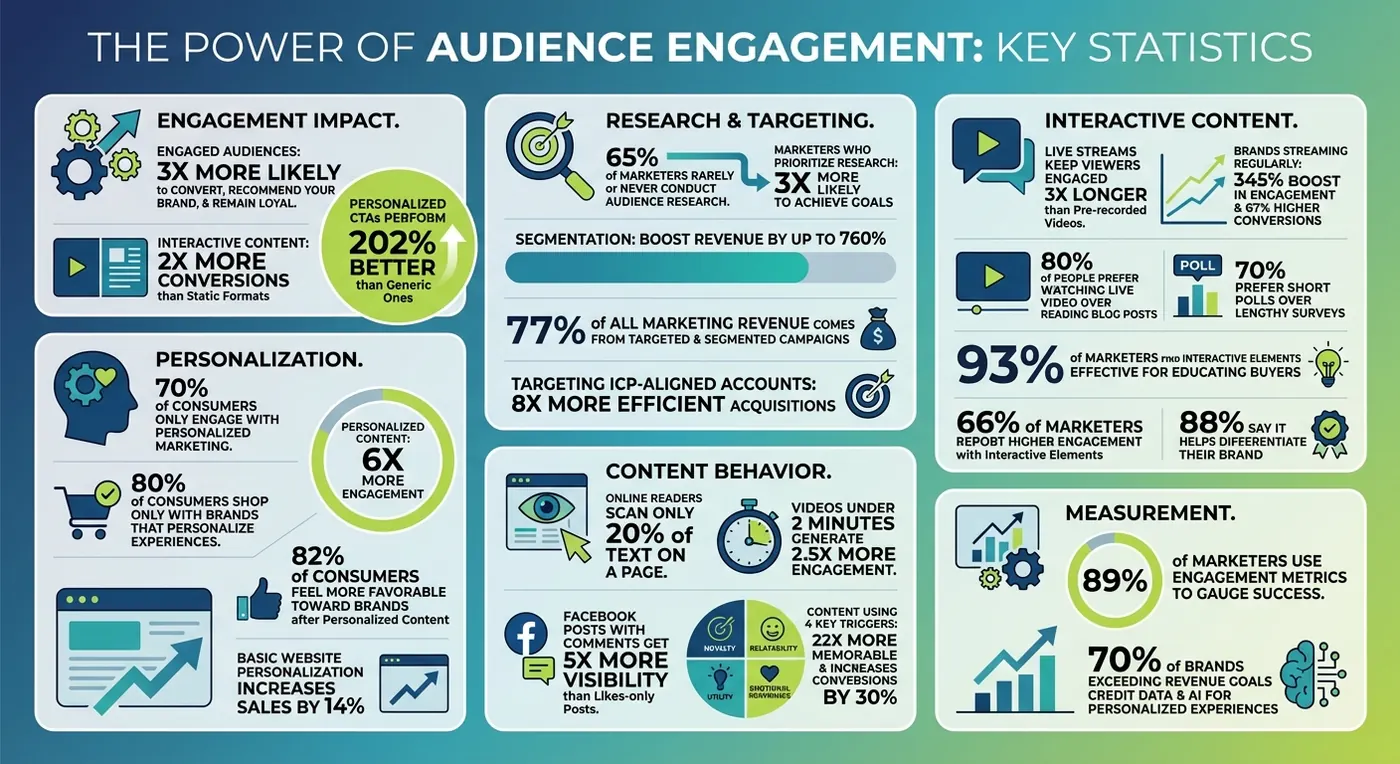
Why It Matters: Engaged audiences are three times more likely to convert, recommend your brand, and stick around. Plus, higher engagement improves algorithm visibility, making your content reach even more people.
If you’re starting out, try simple tactics like Instagram polls or short Q&A sessions. For long-term success, use data to refine your approach and consistently measure results. Let’s dive deeper into how to make this work for your brand.
3 Ingredients To Increase Audience Engagement
Know Your Audience
Understanding your audience is the foundation of effective engagement. Yet, a survey of 1,600 marketers revealed that 65% rarely or never conduct audience research. That’s a big miss, considering marketers who prioritize research are over three times more likely to achieve their goals.
Segmentation takes this understanding to the next level, with potential revenue boosts of up to 760%. In fact, targeted and segmented campaigns are responsible for 77% of all marketing revenue. When you truly know your audience, you can go beyond assumptions and build genuine connections.
How to Segment Your Audience
Segmentation involves dividing your audience into groups based on shared traits, allowing you to craft messages that resonate with each group. Here are the four main types of segmentation:
- Demographic: Includes factors like age, gender, income, and occupation.
- Geographic: Focuses on location and regional preferences.
- Behavioral: Looks at actions such as purchase history, website activity, and email engagement.
- Psychographic: Explores values, interests, lifestyles, and personality traits.
Behavioral and psychographic data often provide the clearest insights into future behavior because they reveal what people do and why they care. For instance, instead of targeting "women interested in skincare", refine your focus to "women aged 25–30 with acne-prone skin seeking professional-grade products." This shift highlights the difference between a broad target market and a well-defined audience.
In B2B settings, creating an Ideal Customer Profile (ICP) helps you zero in on the accounts most likely to convert and stay loyal. Data shows that targeting accounts aligned with your ICP makes logo acquisitions eight times more efficient.
"I think it starts off, the very first thing is understanding who your ideal customers are. What that ICP is…and making sure that you not only understand who they are, but what are the attributes that showcase that this is an ideal customer profile." – Rob Stanger, Guest on The Go-to-Market Podcast
It’s important to avoid over-segmenting. Keep micro-segmentation tied to specific business goals and review these groups quarterly to ensure they remain relevant.
Find What Your Audience Cares About
Once you’ve segmented your audience, the next step is uncovering what motivates them. Audience research can reveal surprising insights - like the specific language they use when frustrated, what builds their trust, and what drives them to act.
Tap into the knowledge of frontline teams and online communities for authentic insights. Sitting in on sales calls or customer success meetings can provide firsthand exposure to common objections, priorities, and the language customers use. Online forums are another goldmine. Use search operators like to find niche discussions, paying attention to upvotes and downvotes to understand what resonates or falls flat. You can also analyze YouTube comments with AI tools to identify recurring themes and motivations.
To truly connect, balance the “who” (demographics) with the “why” (psychographics). Understand where your audience is today and where they want to be. That gap is where your content becomes a bridge. Building detailed personas that outline daily routines, challenges, and aspirations can guide your messaging.
"Real audience research means discovering what you don't know yet." – Backlinko
Personalization is key. Over 70% of consumers engage only with marketing tailored to their interests, and 80% say they’ll shop only with brands that personalize their experience. Social media polls can be a quick, effective way to pre-validate content ideas by letting your audience vote on upcoming topics. Remember, audience research isn’t a one-and-done task - it’s an ongoing commitment to staying connected.
Create Content That Connects
Once you've identified your audience, the next step is creating content that feels genuine. In a world crowded with AI-generated material, people crave real human connection. This is how you turn understanding into meaningful engagement. The secret lies in leveraging four key triggers: Novelty, Relatability, Utility, and Emotional Resonance. Content that taps into these elements is 22 times more memorable and can increase conversions by 30%. Let’s dive into storytelling frameworks and actionable strategies that help build these connections.
Storytelling Frameworks That Work
The best stories follow a structure that mirrors real-life experiences - overcoming obstacles and experiencing transformation. One of the most effective frameworks is the Hero’s Journey, which resonates because it reflects universal human experiences. A great example of this is Harry’s Razors. They addressed customer frustration with overpriced, overcomplicated products and positioned themselves as the solution to a shared problem. Their origin story struck a chord with their audience.
For shorter content, the Problem-Agitate-Solve (PAS) framework is highly effective. Start by identifying a specific pain point your audience struggles with, emphasize the frustration it causes, and then present your solution as the answer. This approach creates an emotional connection before offering relief. Another great option is the Before-and-After framework, which works well for case studies and product stories. Walk your audience through the "before" state, highlighting challenges, then describe the turning point and actions taken, and finally showcase the "after" state with clear results and lessons learned.
"People don't remember brands. They remember stories." – HubSpot
The foundation of any storytelling framework is authenticity. Use vivid details - think about sounds, smells, and textures - to immerse your audience in the narrative. Skip the jargon and write in a conversational tone, like you’re speaking to a friend on your best day. Your characters should reflect your audience’s reality, sharing their struggles and aspirations to create a genuine emotional connection.
Build Content That Delivers Value
Once you’ve nailed your narrative structure, focus on creating content that directly addresses your audience’s needs. Whether it solves a problem, provides helpful insights, or entertains, value-driven content keeps people engaged. Use the 80/20 rule as your guide: 80% of your content should educate or entertain, while only 20% should promote your product or service. This balance builds trust and encourages repeat engagement.
To find content ideas, start by mining conversations. Search Reddit threads with specific operators, analyze competitor reviews (both glowing 5-star and critical 1-star), and talk to your sales or support teams - they hear customer concerns and questions firsthand. Use tools like Google’s "People Also Ask" feature to uncover common questions, then validate these ideas with keyword research to find topics that balance high search volume with low competition.
Presentation matters as much as substance. Online readers typically scan only 20% of the text on a page. Keep paragraphs short - three sentences max - and use clear subheadings and visual elements to break up the content. For video, you have just three seconds to grab attention, so start with a surprising stat or provocative question. Videos under two minutes long generate 2.5 times more engagement than longer ones.
Personalization takes value to the next level. Content based on first-party data gets 6x more engagement than generic material. In fact, 82% of consumers feel more favorable toward a brand after interacting with personalized content. Speak your audience’s language, address their fears and dreams, and show - don’t just tell - how your solution can make a difference.
"Your goal is to know your audience so well that they feel like you're reading their minds. When they read your content, their immediate reaction should be, 'Wow, they get me.'" – Tibo, Feather.so
Use Interactive Tactics
Interactive tactics take your content from static to dynamic, turning viewers into active participants. It’s not just about creating content anymore - it’s about creating conversations. Interactive content has been shown to deliver 2× more conversions than static formats. Live streams, for instance, keep viewers engaged for 3× longer than pre-recorded videos, while brands that stream regularly report a 345% boost in engagement and 67% higher conversions. The secret? Choosing the right format and using it effectively. Let’s break down some actionable methods like polls, Q&A sessions, and live streams to help you connect with your audience.
Add Polls, Q&A Sessions, and Quizzes
Polls are a quick and easy way to grab attention and get instant feedback. They’re a hit because 70% of people prefer responding to a short poll over a lengthy survey. A good rule of thumb? Stick to 1–2 questions and display the results immediately to keep participants engaged.
Take InfluenceCréation as an example. In 2026, they used the Outgrow platform to create a poll where users voted for their favorite content creators. The campaign brought in 94,000 leads and achieved a 56% conversion rate by making the process transparent and engaging. The takeaway? When people feel heard, they’re more likely to engage and take action.
Q&A sessions take things a step further by addressing audience concerns in real time. Platforms like YouTube’s "low latency" mode help minimize delays, allowing for smoother interactions. For larger sessions, tools that let participants upvote questions ensure you’re addressing the most pressing topics. This approach not only keeps the session relevant but also builds trust with your audience.
Quizzes are another fantastic tool, especially for generating leads and segmenting your audience. They provide instant feedback - whether it’s a personality result or a score - which keeps participants engaged and encourages them to return. In fact, 93% of marketers find that interactive elements like quizzes are highly effective for educating potential buyers. Keep your quizzes simple and visually appealing by incorporating images, GIFs, and brand-aligned colors.
Run Live Streams and Webinars
Live formats create a sense of urgency and exclusivity that pre-recorded content just can’t replicate. Did you know that 80% of people prefer watching a brand’s live video over reading a blog post? And 60% of Generation Z consumers are particularly drawn to FOMO-driven marketing strategies. The real-time nature of live streams makes viewers feel like they’re part of something special, which boosts both attendance and retention.
To keep engagement high, interact with your audience every 2–3 minutes. This could mean running a quick poll, calling out a viewer by name, or answering a question. Starting with an icebreaker like, "Where are you tuning in from?" is a great way to ease people into participating.
"I try to lead in with audience questions like where do you guys tune in from, or is there anything specific you want to hear? It's easy to get them to answer these questions through polls." – Pauline Mura, Partnership Marketing Manager, Livestorm
One key tip: prioritize audio quality over video resolution. Poor audio is the top reason viewers drop off, so invest in a good microphone before splurging on a camera. Also, have a backup plan - a 5G hotspot and a co-host can save the day if your primary feed goes down.
For the best results, keep live streams between 60–90 minutes to balance depth and retention. Shorter, 20-minute "pop-up" sessions are great for quick updates or impromptu Q&As. A great example is the Dubai Expo’s partnership with Stream Works in 2025. Over six months, they live-streamed a program that drew in 250 million virtual viewers by leveraging real-time engagement. After your stream, continue the conversation in a Discord server or Facebook Group to maintain momentum.
Interactive Format Comparison
Each interactive format serves a unique purpose, so it’s important to align your choice with your goals. Here’s a quick comparison to help guide your decision:
| Format | Best Use Case | Engagement Impact | Implementation Ease |
|---|---|---|---|
| Live Polls | Quick feedback, decision making | High (Instant) | Easy |
| Q&A Sessions | Building trust, establishing authority | Very High | Medium |
| Quizzes | Lead generation, audience segmentation | High | Medium |
| Live Streams | Community building, brand awareness | Extreme (345% lift) | Medium |
| Webinars | Lead generation, deep training | High (Conversion focus) | Hard (High production) |
Your platform choice matters too. For casual, quick interactions with younger audiences, Instagram or TikTok are great options. On the other hand, LinkedIn or platforms like Livestorm work better for professional B2B content. YouTube stands out for its range of interaction tools like Super Chat, polls, and chapters, making it a go-to for educational content.
Interactive content isn’t just a trend - it’s a proven way to build stronger connections. 66% of marketers report higher engagement rates after adding interactive elements, and 88% say it helps differentiate their brand. Start small with polls and quizzes, then expand into live streams and webinars as you grow more confident and your audience becomes more engaged.
Personalize Using Data
The difference between being ignored and driving action often boils down to personalization. For example, personalized Call-to-Action buttons can perform up to 202% better than generic ones, and even basic website content personalization can lead to a 14% increase in sales. The key? Use the data you already have to understand your audience and tailor your approach.
Analyze Behavior to Personalize
Your audience’s actions tell you what matters most to them. Look at metrics like page visits, scroll depth, feature usage, and past purchases. These insights help you figure out where someone is in their journey with your brand.
Take Orascom Hotels Management as an example. Instead of showing the same homepage banners to everyone, they customized their messaging based on the properties visitors had previously searched. This shift led to a 60.75% boost in booking conversions, with personalized bookings making up 42% of their revenue. What’s impressive is that they achieved this by using browsing history, not just complex AI.
To refine your personalization efforts, focus on first-party data (direct interactions) and zero-party data (information customers willingly share). This approach not only sharpens your strategy but also ensures compliance with regulations like GDPR and CCPA.
For instance, if someone visits your pricing page three or more times, it’s a strong signal they’re close to making a decision - offer them a discount or connect them with sales. On the other hand, if a user has been inactive for over 30 days, trigger a re-engagement campaign. Matching your actions to their behavior makes your outreach far more effective and keeps the relationship alive.
Keep Audiences Coming Back
Once you’ve engaged your audience, the next step is to keep them coming back. Consistently delivering timely, relevant content transforms one-time interactions into lasting relationships. In fact, 70% of brands that surpassed their revenue goals in 2025 credited their success to using data and AI to create ongoing, personalized experiences.
A great example is Too Good To Go, an app that helps reduce food waste. By using behavioral segmentation and real-time supply data, they connected users with nearby "Surprise Bags" at just the right time. Automated messages based on location and purchase history led to a 135% increase in CRM-attributed purchases and doubled their conversion rates. Their strategy made staying engaged feel natural and worthwhile for users.
"Customer engagement is not a campaign metric. It's a measure of how well a brand is showing up for its customers over time." – Madison Tiemtoré, Content Marketing Lead, Braze
Tracking your DAU/MAU ratio (Daily Active Users vs. Monthly Active Users) is another way to measure how often people return to your platform. A higher ratio signals that your content is "sticky", encouraging frequent visits rather than occasional check-ins. Use behavior-based triggers to keep the momentum going - send follow-ups when someone downloads a resource, or nudge them with a personalized reminder if they abandon a cart.
Track and Improve Engagement
If you’re not measuring, you’re not improving. That’s why 89% of marketers rely on engagement metrics to gauge success. The ability to grow your audience - and avoid wasting time - depends on tracking the right data and making informed decisions.
Metrics That Matter
It’s easy to be dazzled by vanity metrics like follower counts or impressions, but these don’t necessarily drive business outcomes. Instead, focus on metrics with real impact: save rates, share velocity, click-through rates, and conversion rates.
A great way to dig deeper is by calculating a weighted engagement rate. Assign point values to actions (e.g., 1 point for a like, 5 for a comment, 10 for a share) and use the formula: . This gives you a better sense of engagement quality, not just quantity.
Each platform also has its own metrics worth tracking. On Instagram and TikTok, prioritize video completion rates and average watch time over total views. For LinkedIn, focus on comment quality, profile views, and connection requests. On Facebook, posts with comment engagement receive 5x more visibility compared to those with only likes. Tailoring your strategy to these platform-specific signals helps you align with the algorithms.
Highly engaged audiences are up to 3 times more likely to convert, recommend your brand, or stick with you over time. Keep an eye on conversion metrics like click-through rates, demo requests, and sign-ups to tie engagement directly to revenue. Don’t overlook retention metrics like your DAU/MAU ratio (Daily Active Users vs. Monthly Active Users), churn rate, and repeat purchase rate. These metrics reveal whether your brand is becoming a regular part of people’s lives.
| Metric Category | What to Track | Impact |
|---|---|---|
| Depth Metrics | Saves, Comments, Dwell Time | Reflects value and intent to revisit content |
| Momentum Metrics | Share Rate, Velocity, Share-of-Voice | Indicates content spread and algorithm favor |
| Conversion Metrics | Click-Through Rate, Leads, Signups | Links engagement directly to ROI and revenue |
| Retention Metrics | Repeat Visits, Churn Rate, Referral Rate | Measures loyalty and community health |
Audit Your Engagement Strategy
Tracking metrics is just the first step - you also need to regularly evaluate your strategy. A quarterly audit can help you identify what’s working and eliminate what’s not. Start by comparing your current metrics to your baseline. For example, if you have high reach but low save rates, your content might not be compelling enough to revisit. Similarly, high engagement with negative sentiment could indicate a reputation issue. Tools like AI-powered sentiment analysis can help you catch these issues early.
Segmenting your data is another powerful way to refine your approach. Break down your audience by behavior and lifecycle stage to see how different groups interact with your brand. For instance, new visitors might need introductory content, while long-time customers may respond better to loyalty-focused messaging. Track how people move between stages - new, active, loyal, slipping - and adjust your strategy to meet them where they are in their journey.
When testing new strategies, tweak one variable at a time - such as headlines, visuals, or posting times - to pinpoint what actually drives results. Use the A.C.T. Framework for a structured approach: Acknowledge your audience segments, Create content that encourages specific actions, and Track outcomes to fine-tune your timing and messaging.
Quick response times also play a big role in engagement. Aim to reply to comments within 2–4 hours and respond to direct messages or urgent complaints in under an hour. This shows you’re actively listening and builds trust. Close the loop by using polls and surveys to ask your audience what they want, then create content based on their feedback.
"Data without context is dangerous. You can mistake noise for signal and pivot too fast." – Aziz Vahora, Senior Director of Data Engineering, Poshmark
Adopt a layered approach to monitoring: check metrics daily for immediate trends, weekly to optimize your content calendar, monthly to spot seasonal patterns, and quarterly to assess long-term goals and ROI. This method keeps you agile without overreacting to short-term fluctuations. By consistently tracking and refining your strategy, you can turn casual viewers into loyal advocates for your brand.
Conclusion
Building genuine audience engagement isn’t about chasing numbers or flooding your platforms with content. It’s about sparking real connections that transform passive viewers into active participants. This guide has laid out key strategies: understanding your audience through segmentation, crafting relatable stories, using interactive tools like polls and live streams, personalizing content with data, and consistently tracking performance. Together, these tactics create a solid roadmap for meaningful engagement.
If you’re just starting out, focus on simple, low-effort tactics like Instagram Story polls or weekly Q&A sessions. These smaller steps can generate momentum, setting the stage for more advanced strategies like gamification or AI-based personalization. Always remember: quality trumps quantity when it comes to fostering lasting connections.
To refine your approach, adopt a 90-day testing plan. Choose one or two strategies from this guide and commit to testing them over a full quarter. Use a tiered monitoring system: check metrics daily for quick adjustments, review weekly to fine-tune your content schedule, and evaluate quarterly to measure long-term impact. This approach avoids knee-jerk reactions to short-term trends while keeping you flexible enough to adapt when necessary.
The strategies outlined here work best as part of a continuous cycle. Start by listening to your audience through surveys and social listening. Then, create content that speaks to their needs. Empower your audience to contribute with user-generated content, maintain consistency through regular rituals, and personalize experiences based on their behavior. Each step builds on the last, creating a compounding effect that strengthens engagement over time.
Ultimately, your audience wants to feel heard, not just spoken to. When you implement these strategies thoughtfully and adjust them based on real data, you’ll transform casual followers into loyal advocates who actively shape your brand’s story. The tools and techniques are all here - now it’s time to take action.
FAQs
How do I pick the best engagement tactic for my goal?
To begin, pinpoint your exact objective - is it increasing brand awareness, building a sense of community, driving conversions, or encouraging participation? Once you’re clear on your goal, select strategies that align with it and appeal to your audience. For instance, interactive content can be a great choice for fostering a community, while personalized experiences are ideal for boosting event engagement. Prioritize consistent, meaningful interactions to establish trust and loyalty over time, rather than depending on single, isolated efforts.
What’s the simplest way to start audience segmentation?
The easiest way to dive into audience segmentation is by focusing on straightforward and practical criteria, like demographics or behaviors. Begin with 3–5 key segments based on factors such as age, geographic location, interests, or specific needs. Run small campaigns targeting these segments to fine-tune your strategy before expanding. This approach allows you to craft messages that connect with your audience, setting the stage for more detailed segmentation down the road.
Which engagement metrics should I track first?
The metrics you should focus on depend largely on your objectives, but it's smart to begin with those that highlight active engagement - likes, comments, shares, and click-through rates. These metrics give insight into how effectively your content connects with your audience and encourages interaction. Pay particular attention to quality interactions, such as meaningful comments and shares, as they often reflect stronger relationships and audience loyalty. This kind of feedback is invaluable for fine-tuning your approach. Be cautious not to place too much emphasis on vanity metrics like follower counts, which don’t always tell the full story.