
The cost to build a minimum viable product (MVP) depends on what it must do and who builds it. Compare the full cost of getting customers through the core task - not just a software subscription or hourly rate.
- No-code or low-code: Lower upfront cash spending, but more setup and testing falls on you. Platform limits may mean rebuilding later.
- Freelancers: Custom development without a full agency team. You still manage scope, review work, and arrange support.
- Agencies: A team handles design, development, and testing. Check exclusions, approval deadlines, and post-launch fees.
- In-house teams: More direct control, with payroll, hiring time, and work diverted from other projects.
For context, the Bureau of Labor Statistics reported median U.S. software developer pay of $133,080 in May 2024 - salary alone, not the full employer cost or an MVP project price.
I’d start with the smallest workflow that tests customer demand. Then compare quotes for the same scope, including testing, launch, maintenance, your time, and a documented handoff. Confirm who owns the code and controls the accounts before work starts. Budget and contract details are general information, not financial or legal advice; ask an accountant or lawyer where needed.
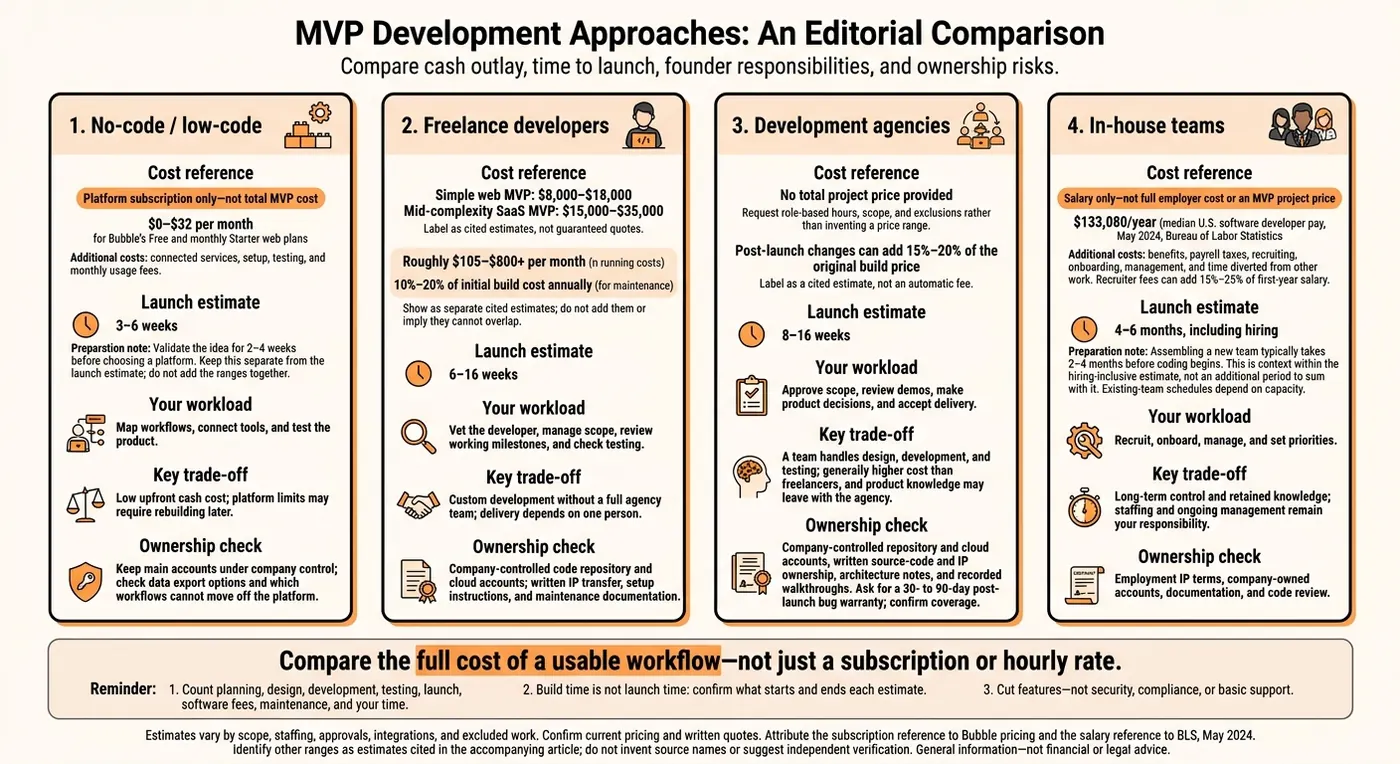
1. No-Code and Low-Code Tools
For a DIY MVP, platform subscriptions can start at $0–$32 per month, based on Bubble’s Free and monthly Starter web plans. That covers the subscription - not the full cost of building a minimum viable product (MVP), the first version customers can use.
No-code is usually the lowest-cash option if you keep that first version narrow. Bubble, Glide, and Softr support forms, accounts, dashboards, and payments. Softr suits apps built around structured data, while Bubble is better suited to web applications. Payments and data storage often depend on connected tools such as Stripe and Airtable [2][9][12].
Build and Recurring Costs
Budget beyond the platform subscription. Connected services, setup, testing, and monthly usage fees also count [3][10]. Before choosing a plan, check its user limits, usage caps, and required connections to other tools. Lower upfront costs usually come with less flexibility and room to grow.
Delivery Timeline
A cheaper no-code build isn't always a fast build. Connecting existing tools can shorten the work, but payments still need configuration, and the full workflow needs testing [2][7].
Founder Workload and Ownership
You still need to define what the app should do, organize its data, and manage access. Keep the main accounts under your control [1][6]. If someone helps build it, ask for workflow documentation and handoff instructions [11].
Check export options before committing. Logic tied to the platform may need to be rebuilt if you move elsewhere, turning a low upfront cost into a later rebuild expense [7][13].
If no-code still takes too much of your time, the next options cost more but put more of the building in someone else's hands.
2. Freelance Developers
Freelancers can add custom features when no-code falls short, without the cost of an agency. They can suit a clearly defined minimum viable product (MVP), but you still set product direction and control scope. Before asking for quotes, define acceptance criteria: what each feature must do before you consider it done [3][7].
Build and Recurring Costs
An hourly rate is not a project price. Ask for estimated hours by task, including testing and bug fixes. The cited estimates put senior full-stack freelancers at $60 to $120 per hour and rates in the U.S. and Canada at $150 to $250 per hour. They put simple web MVPs at $8,000 to $18,000 and mid-complexity software-as-a-service (SaaS) MVPs at $15,000 to $35,000 [3][7][8].
Leave room for hosting, maintenance, and fixes after launch. The cited estimates put monthly running costs at roughly $105 to $800 or more, with annual maintenance at 10% to 20% of the initial build cost [3][4].
Delivery Timeline
Ask for working milestones, and review each before the developer moves on. Unclear requirements, slow decisions, and connections to outside services can add time and cost [7]. A coding deadline is not a launch date. Allow time to test the product and fix problems before customers use it.
Founder Workload and Ownership
Review working builds, not screenshots. Check each build against your requirements, and tie payments to working milestones. The contract should spell out code ownership, intellectual property (IP) transfer, and access to cloud accounts [1][4][8][13]. This is general information, not legal advice; have a lawyer review those terms.
Before final payment, require a handoff package with access to the code repository, account credentials, and runbooks - instructions for running and maintaining the product. Confirm how long the developer will fix bugs under warranty and what support is available after launch [4][11].
If a single developer can’t cover the scope, an agency is the next cost tier.
3. Development Agencies
Agencies generally cost more than freelancers, but they can handle most of the build and leave you with less work to coordinate.
An agency quote usually covers discovery and scoping, user experience and interface design (UX/UI), development, quality assurance (QA), project management, and launch setup. The cited breakdown allocates 5% to 10%, 10% to 15%, 50% to 60%, 10% to 15%, 8% to 10%, and about 5% to those phases, respectively [8].
Compare the scope, not just the total. Check whether testing covers the full user flow and whether launch support is included. What a quote leaves out matters just as much as what it covers.
Build and Recurring Costs
Ask for estimated hours by role and a written list of exclusions. Keep launch setup separate from hosting, API usage, maintenance, and post-launch changes. Those costs usually sit outside the initial quote. The cited estimates suggest post-launch changes can add 15% to 20% of the original build price [5][4].
Compare proposals using person-weeks: the combined work across all team members. The cited estimate puts a web minimum viable product (MVP) with a single workflow at 11 to 18 total person-weeks [4].
Delivery Timeline
Request a schedule that covers discovery, design, development, testing, and deployment. The cited estimates put a typical agency MVP build at 8 to 16 weeks [6][7].
One cited 12-week plan allows 1 to 2 weeks for discovery, 2 weeks for UX/UI design, 6 to 8 weeks for development, and 1 to 2 weeks for QA and launch [5]. Ask which stages overlap; these ranges should not be treated as consecutive blocks. Also ask which tasks depend on your approval or access to outside services.
Longer schedules can increase labor costs. A shorter schedule still requires time for your approvals and prompt decisions.
Founder Workload and Ownership
An agency can manage the build, but you still own the product decisions. The cited estimate suggests about 1 founder hour for every 2.2 developer hours during development [8]. Name the person who can approve scope changes. Before extra work starts, require a written explanation of its effect on cost and timing.
Settle access and ownership before the build begins. Require contract terms assigning your company the intellectual property (IP) and source code from the start, with the code repository and cloud accounts under your control [6][1][4]. This is general information, not legal advice; have a lawyer review those terms.
Request architecture notes, setup instructions, and a recorded walkthrough of the codebase so another developer can understand how the product works [6]. Also ask for a 30- to 90-day post-launch bug warranty, and confirm which fixes it covers [6][4].
4. In-House Teams
If you already employ developers, building an MVP shifts the cost from outside invoices to your team’s time. An in-house team is an option only if it has the skills and room in its schedule to do the work.
You may spend less on outside help, but payroll time isn’t free. This approach can make sense for deep tech, proprietary algorithms, or hardware integration.
Build and Recurring Costs
In-house MVP development costs come from staff time and overhead - not a fixed project price. For existing employees, count the time diverted from other work, along with benefits and payroll taxes.
For new hires, budget for recruiting, onboarding, and management. The Bureau of Labor Statistics reported median U.S. software developer pay of $133,080 a year in May 2024. That’s a salary reference, not the full cost to the employer [6]. Recruiter fees can add 15% to 25% of first-year salary [6].
After launch, the team will still need time for security patches and dependency updates - the software libraries your product relies on.
Delivery Timeline
Before setting a launch date, ask your technical lead to confirm who can do the work and what else is on their plate. Assign responsibility for design, testing, and deployment, not just coding.
If you need to hire, allow for that delay. Assembling a new in-house team typically takes 2 to 4 months before coding begins [6][5].
Founder Workload and Ownership
An internal team still needs hiring, payroll, equipment, and oversight. You remain responsible for making sure those pieces are covered.
Address intellectual property ownership in employment contracts so the company retains control after launch [6]. This is general information, not legal advice; have a lawyer review those terms.
Put code, repositories, and cloud accounts in the company’s name from the start [4][13]. Make documentation and code review part of regular work so product knowledge stays with the business rather than with a single employee.
Launch Timelines Beyond the Build
Build time is not launch time. Discovery, design, testing, deployment, and app store review can add weeks [6][7]. Longer schedules usually increase MVP development costs because they require more labor, coordination, and revisions.
| Build approach | Typical calendar time to launch | Work required before building | Common delays |
|---|---|---|---|
| No-code / low-code | 3–6 weeks [15] | Validate the idea for 2–4 weeks before choosing a platform [15]. | Platform limits and custom logic the tool cannot handle [5][7]. |
| Freelance developers | 6–16 weeks [5] | Vet the developer, write clear specifications, and set up project tracking [7][15]. | Coordination work, uneven quality, and limited project management [5][15]. |
| Development agencies | 8–16 weeks [6][7] | Complete discovery and design, then review the contract and ownership terms [6][7]. | Unclear requirements, delayed founder decisions, added scope, and API delays [7]. |
| In-house teams | 4–6 months, including hiring [6] | Recruit and onboard the team [6][5]. | Hiring delays, notice periods, and no immediate senior oversight [6]. |
Before comparing estimates, ask what starts - and ends - the clock. Does the schedule begin when you sign the contract, finish hiring, or approve the design? Does it end with a tested product or a product customers can use? Each estimate should spell out the scope, staffing, approval steps, and excluded work.
Check integrations before committing to a launch date. Third-party application programming interfaces (APIs), which connect your app to services such as Stripe, can add 1–3 weeks because of account sign-ins, usage limits, and incomplete documentation [15][7].
Leave time for testing, fixes, and release preparation. For mobile products, that includes testing on physical devices and review by the App Store or Google Play [4]. Assign an owner to every release task before announcing a date, including deployment and handoff. Your schedule needs to account for who manages that work - not just who writes the code.
Contract and ownership details are general information, not legal advice. Have a lawyer review those terms before you sign.
Founder Workload, Ownership, and Handoff
Your build approach affects both your bill and your workload. Count your time as part of the MVP development cost. Hiring help shifts work off your plate, but you still need to make decisions, provide access, approve delivery, and plan for whoever takes over next.
| Build approach | Founder responsibilities | Main advantage | Main limitation | Ownership and handoff checks |
|---|---|---|---|---|
| No-code / low-code | Map workflows, connect tools, and test the product. | Low cash cost for testing the idea. | Platform limits can make moving elsewhere difficult. | Check whether you can export customer data and which workflows must stay on the platform. [5] |
| Freelance developers | Vet the developer, manage scope, and review quality assurance (QA) testing. | Flexible pricing. | Delivery depends on one person. | Keep code in your company’s repository from the start. Request setup instructions, tests, and documentation another developer can follow. [6] |
| Development agencies | Approve scope, review demos, and accept delivery. | A team already in place. | Product knowledge can leave with the agency. | Request notes explaining the system’s structure, recorded walkthroughs, and a 30- to 90-day bug-fix period. [6] |
| In-house teams | Recruit, onboard, manage, and set priorities. | Long-term control and knowledge kept within the business. | Hiring and day-to-day management stay on your plate. | Keep documentation and account access within the company so work can continue if someone leaves. [6] |
Hourly contracts require close budget tracking. Fixed-price contracts require a defined scope and clear rules for approving and charging for changes. [13][1]
Check access before accepting the handoff. Your company should control the code repository, hosting account, and domain. Give builders access without making them the account owners. Request system architecture notes, a setup guide, database documentation, and recorded walkthroughs. Then ask the next developer to take over using those materials without help from the original builder. [6][4]
Treat bug-fix support and maintenance as separate responsibilities. Put responsibility for security updates and application programming interface (API) upgrades in writing. Account access does not establish ownership: the contract should state who owns the code and intellectual property (IP) from the start. These are general contract considerations, not legal advice; ask a lawyer to review the ownership terms. [6][1]
With ownership and handoff settled, look at scope - the fastest way to cut the bill is to build less.
Cut Scope to Reduce MVP Costs
Cutting scope is the fastest way to lower MVP development cost, whether you use no-code, freelancers, an agency, or an in-house team. After comparing build options, focus on what the first version needs to test the core customer problem.
Workflows, user permissions, custom design, payments, integrations, mobile apps, real-time features, AI, and data migration all drive scope. Defer anything that doesn’t help test the core problem. Start with a single web workflow that works on desktop and mobile, with as few user types as possible. Use existing tools and design components. Offer fewer payment options. Handle admin tasks manually before building tools for them.
Cut features, not security, compliance, or basic support. Give each feature a clear test so you can tell whether it works. Before adding anything, approve its cost and schedule impact in writing. Expand only after you have evidence of demand.
The 90 Day “Idea To Product” Growth Plan is listed at $10,000 [14].
MVP development cost includes planning, design, development, testing, basic launch support, and software fees. Split your budget into a validation version to test demand, a usable version that lets customers complete the core workflow, and an expansion version for later features.
For each version, record the scope, delivery method, timeline, assumptions, exclusions, and who handles what after launch. This is general information, not legal, tax, or financial advice. Consult an accountant or lawyer where those questions affect your budget or launch requirements.
FAQs
How can I estimate MVP development cost before requesting quotes?
Your minimum viable product (MVP) development cost depends on what you build and how you build it. The main cost drivers are feature count, team location, and tech stack complexity - how complicated your software and supporting tools are.
I'd start with the smallest scope that lets customers use the core product. Basic sign-in costs less than enterprise-grade single sign-on (SSO), which lets users access multiple systems with one account. Existing component libraries - prebuilt interface elements - also cost less than custom design.
Budget for hosting and legal compliance, not just development. This is general information, not legal advice; ask a lawyer which requirements apply to your product. Use the startup cost calculator to refine your estimate.
How do I decide which MVP features to cut?
Use the MoSCoW method to sort features into Must Have, Should Have, Could Have, and Won’t Have. A feature belongs in Must Have only if users can’t complete the product’s core task without it.
Save anything that doesn’t directly support your product’s main value for the next version. Don’t match competitors feature for feature or build for edge cases you’ve only imagined. Cutting features reduces development time and leaves more of your budget for testing.
When is rebuilding a no-code MVP worth the cost?
Rebuilding a no-code MVP is worth the cost when the platform can no longer support your product’s needs. No-code tools work well for a simple minimum viable product - an early version built to test your idea - but custom code may make sense when performance suffers or you need business rules or complex integrations the platform can’t handle.