
I’d start with Google Search ads if your customers already search for what you sell. I’d choose Facebook and Instagram ads if people need to see your offer before they want it.
Before spending, I’d check the landing page, sales tracking, and follow-up process. Then I’d set a budget and loss limit your business can afford - and judge the test by paying customers and money left after costs, not cheap clicks.
Quick Comparison
| Decision point | Google Search ads | Facebook and Instagram ads |
|---|---|---|
| Customer behavior | Searching for a solution | Browsing, not necessarily shopping |
| Ad assets | Keywords and a focused landing page | Images or videos and a mobile-friendly purchase or inquiry page |
| Main risks | Costly or irrelevant searches; limited demand | Low buying intent; repeated ads losing their effect |
| What to measure | Cost per new customer, margin, and time to recover acquisition costs | The same measures, allowing for delayed purchases |
For a small first budget, I’d test a single channel rather than spread spending too thin. <u>I’d increase spending only after repeated sales leave enough margin to support it.</u>
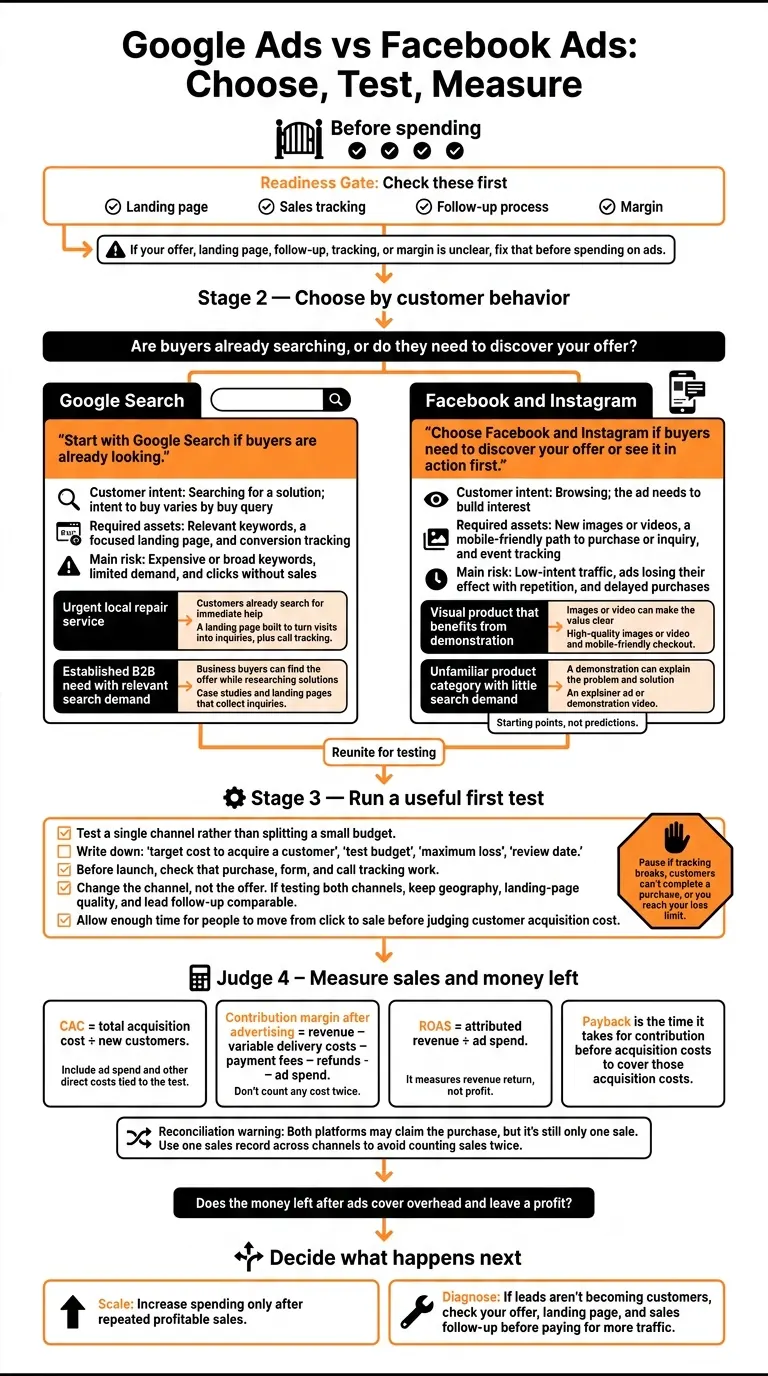
Google Ads vs Facebook Ads: Intent, Needs, and Risks
Neither platform is automatically cheaper. Compare the cost to win a customer and the margin left after the sale - not just the cost of a click. [5][9]
For your first budget, start with how people buy. Are they searching for a solution, or do they need to see your offer before they want it? Then weigh the cost of testing, the ad assets you need, and your margin.
| Factor | Google Search ads | Facebook and Instagram ads |
|---|---|---|
| Customer intent | Searching for a solution; intent to buy varies by query | Browsing; the ad needs to build interest |
| Suitable conditions | Relevant search demand already exists | Images or a demonstration can build interest |
| Required assets | Relevant keywords, a focused landing page, and conversion tracking | New images or videos, a mobile-friendly path to purchase or inquiry, and event tracking |
| Main risk | Expensive or broad keywords, limited demand, and clicks without sales | Low-intent traffic, ads losing their effect with repetition, and delayed purchases |
Google Search Ads Reach People Looking to Buy
Match your offer to the keyword, service area, and landing page. Check the actual searches that trigger your ads. Add irrelevant searches as negative keywords - terms that prevent your ad from appearing. Broad match can bring in searches you didn't expect, while a narrow market may have little search demand. [5][8]
Choose a sales or leads objective. Track purchases, inquiries, or calls - not just visits.
Facebook and Instagram Ads Introduce Your Offer
Facebook and Instagram reach people while they browse. Your visuals and message need to give them a reason to stop. A product demonstration or visual offer can build interest even when someone isn't searching for it. [7][9]
Prepare several image or video variations, and test the full path from the ad to checkout or inquiry on a phone. Repeating the same ad can reduce its effect over time. [9]
Choose leads or sales as your objective, not clicks. Install Meta Pixel and Conversions API, which send website activity to Meta, and confirm that purchase and lead events register before launch. [8][9]
Choose a Channel That Fits Your Business
Treat these options as starting points, not predictions. If your offer, landing page, follow-up, tracking, or margin is unclear, fix that before spending on ads.
Match your starting channel to the demand your business already has:
Business condition Stronger starting channel Reason Prerequisite Urgent local repair service Google Search Customers already search for immediate help A landing page built to turn visits into inquiries, plus call tracking Visual product that benefits from demonstration Facebook and Instagram Images or video can make the value clear High-quality images or video and mobile-friendly checkout Unfamiliar product category with little search demand Facebook and Instagram A demonstration can explain the problem and solution An explainer ad or demonstration video Established B2B need with relevant search demand Google Search Business buyers can find the offer while researching solutions Case studies and landing pages that collect inquiries
Budget for a Useful First Test
Set a test budget that helps you answer a clear question: which channel can bring in a customer at a cost your business can afford?
There’s no budget that works for every business. Competition in the ad auction and the time it takes to close a sale affect what you can learn. Fund a single channel first if splitting the budget would leave too little to judge either test. The goal is to learn, not just spend.
Set a Spending Limit You Can Afford
Choose a fixed loss limit your business can absorb. Track ad spend separately from ad production, setup, and measurement costs so you can see the full cost of the test.
Use the Marketing Budget Calculator to organize your plan. Treat platform forecasts as assumptions to test, not promises.
Keep Test Conditions Consistent
Change the channel, not the offer. Make the action you want people to take clear.
If you test both channels, keep geography, landing-page quality, and lead follow-up comparable. Adjust the ads to fit each platform’s format. On Meta, keep ads aimed at new customers separate from retargeting ads, which reach people who have already interacted with your business. That lets you see what it costs to reach new customers.
Schedule reviews around your sales cycle. Allow enough time for people to move from click to sale before judging customer acquisition cost.
Check Tracking and Record Results
Before launch, check that purchase, form, and call tracking work. Keep a shared record of spend, qualified leads, new customers, revenue, refunds, and fulfillment costs.
Set review dates and stop conditions before spending. Pause if tracking breaks, customers can’t complete a purchase, or you reach your loss limit. Use the records to judge margin, not just clicks.
Judge Results by Margin, Not Clicks
Use clicks and click-through rate (CTR) to check how ads perform. Use customer acquisition cost (CAC), contribution margin, and payback to decide where to spend once the test has run long enough to record sales.
| Metric | What it tells you | What it cannot prove |
|---|---|---|
| Qualified leads | Whether inquiries met your sales criteria | Whether those prospects paid |
| Customer acquisition cost (CAC) | What acquiring a new customer cost | Whether that customer generated enough margin |
| Contribution margin after advertising | What revenue remained after variable costs and ad spend | Whether that margin covers overhead and profit |
| Return on ad spend (ROAS) | Attributed revenue relative to ad spend | Whether sales produced profit |
| Payback | How long customer contribution took to recover acquisition costs | Whether future repeat purchases will happen |
Calculate Acquisition Cost and Contribution Margin
For lead-driven businesses, judge lead quality by counting only inquiries that meet your sales criteria. Then track those leads through to paying customers and collected revenue.
CAC = total acquisition cost ÷ new customers.[6] Include ad spend and other direct costs tied to the test. Apply the same cost categories each time.
Contribution margin after advertising = revenue − variable delivery costs − payment fees − refunds − ad spend.[6] Keep those categories consistent, and don’t count any cost twice. The next check: does the money left after ads cover overhead and leave a profit?
Check ROAS, Margin, and Payback Together
ROAS = attributed revenue ÷ ad spend.[6] It measures revenue return, not profit. Use the ROAS Calculator alongside your cost records - not instead of them.
Payback is the time it takes for contribution before acquisition costs to cover those acquisition costs.[6] Set an affordable CAC based on actual margins and cash needs. Don’t fund today’s ads with repeat purchases you only hope will happen.
Compare Platform Reports With Actual Sales
Platform dashboards can overstate results. A customer might discover your offer on Meta, then search on Google before buying. Both platforms may claim the purchase, but it’s still only one sale.[6]
Match platform reports against your orders, calls, customer relationship management (CRM) records, and bank deposits. Use one sales record across channels to avoid counting sales twice, and send actual sales back to Google and Meta.
Conclusion: Start With the Channel That Fits Your Offer
Start with Google Search if buyers are already looking. Choose Facebook and Instagram if buyers need to discover your offer or see it in action first.[5][10]
Before spending, check that tracking works. Write down your target cost to acquire a customer, test budget, maximum loss, and review date. Test a single channel rather than splitting a small budget.[8][5]
Give the test time to produce sales, then judge it by profit margin. Increase spending only after repeated profitable sales. If leads aren’t becoming customers, check your offer, landing page, and sales follow-up before paying for more traffic.[8][11]
General information only - not legal, tax, or financial advice. Consult an accountant or lawyer for guidance specific to your business.
FAQs
How do I check search demand before choosing Google Ads?
Before choosing Google Ads, check whether potential customers are already searching for your product or service. Use Google’s free Keyword Planner in your Google Ads account, or request a keyword research report for your industry.
If relevant search terms get high search volume, I’d start with Google Ads to reach people already looking for what you sell.
How much should I budget for a fair ad test?
Give the platform enough budget to learn from your results and adjust your ads. If your monthly budget is under $1,500, stick with one platform rather than splitting your spend [1][2].
For Google Ads, plan on at least $30–$100 per day for Smart Bidding, Google’s automated bid setting [2]. For Facebook, allow $20–$50 per day to test different ads [2]. Run your test for at least two to four weeks to give the platforms’ algorithms time to move past their initial learning phases [3][4].
How do I set a profitable customer acquisition cost?
Track sales, not just click costs. A cheap click does nothing for your business if it never leads to a paying customer. Before you launch a campaign, set your business targets and decide how much you can afford to lose.
Different ad platforms may each claim full credit for the same sale. Use blended attribution - looking at total revenue alongside spending across channels - to avoid counting that sale more than once. Document your tests, confirm that conversion tracking works, and adjust spending every few weeks based on actual results.