
GEO means helping AI tools describe your business the right way. If ChatGPT, Claude, Gemini, or Perplexity answer buyer questions without naming you - or describe you the wrong way - you can lose deals before a person even visits your site.
Here’s the short version:
- SEO gets clicks. GEO gets mentions inside AI answers.
- GEO depends on clear business facts, topic depth, proof, and clean page structure.
- I’d start by testing the same prompts across 4 tools: ChatGPT, Claude, Gemini, and Perplexity.
- Then I’d fix the pages AI is most likely to read first: About, Services, Case Studies, Pricing, and Contact.
- After that, I’d publish pages with specific results, named examples, dates, and plain-language explanations.
- Last, I’d rerun prompts and check for mention rate, accuracy, sources, and model differences.
A simple way to think about it: if your site gives mixed answers about what you do, who you help, or what results you drive, AI will often repeat that confusion back to buyers.
What matters most:
- One clear version of your brand story across core pages
- Proof-backed claims instead of vague statements
- Short sections, bullets, and direct headings
- Regular checks across AI tools, since answers can change from one model to another
If I had to sum up the full guide in one line, it would be this: GEO is less about ranking pages and more about making your business easy for AI to find, read, and repeat correctly.
Generative Engine Optimization Strategy & Tactics [Deep Dive]
How GEO Differs from Traditional SEO
SEO and GEO aim at different outcomes, even though both still need crawlable, well-structured pages. SEO is about winning the click. GEO is about shaping how your brand shows up inside the answer.
SEO vs. GEO: What Changes in AI Search
The big shift is user behavior. In traditional search, a person types in a keyword, looks over a results page, and chooses a link. In AI search, they ask a question in plain language and get a direct answer back. If your brand isn't included in that answer, users may never come across it - even if your page ranks well. That's a big change in what success looks like.
With SEO, success usually means a top spot in search and a strong click-through rate. With GEO, success means your brand is recommended the right way and cited again and again inside generated answers from tools like ChatGPT, Claude, and Gemini.
| Traditional SEO | Generative Engine Optimization (GEO) | |
|---|---|---|
| Primary Objective | Drive traffic and clicks to your website | Inclusion and accurate citation in AI answers |
| User Behavior | Keyword-based search queries | Questions and follow-up prompts |
| Optimization Target | Search engine algorithms (e.g., Google) | AI answer tools like ChatGPT, Claude, and Gemini |
| Success Signals | SERP rankings, CTR, organic sessions | Mentions and citation accuracy |
| How GEO Complements SEO | Helps AI retrieve and summarize your content correctly | Ensures content is synthesized correctly by AI |
Where SEO and GEO Overlap
GEO doesn't replace SEO. It builds on it.
AI systems still pull from public web content. So GEO still depends on crawlable pages, clear structure, steady business details, and useful content. Good content still does most of the heavy lifting. Weak pages usually don't get picked up by generative engines.
Where GEO adds a new layer is in how content is structured and presented, so AI can extract it, summarize it, and attribute it the right way.
Those same signals also affect whether AI systems trust your content and use it again. That leads straight into the visibility signals generative engines use.
What Influences Visibility in Generative Engines
Four signals shape whether AI cites your brand the right way and describes it the same way from one answer to the next. The good news: you can improve all four on your own site.
Source Clarity and Factual Consistency
AI systems look for a steady brand identity. When your name, positioning, and credentials stay the same across your site and profiles, AI is less likely to misread who you are.
The trouble starts when your descriptions don’t match. If one page says one thing and another profile says something else, AI has to pick between mixed signals. That can hurt accuracy. If you want AI answers to reflect your brand positioning correctly, this is where the work starts.
That kind of consistency gives AI a steady picture of your brand before it even starts judging your expertise.
Topical Authority and Verifiable Evidence
AI is more likely to cite a source that goes deep on a topic and backs up its claims with proof it can check and reuse. Detailed service pages, original data, case studies, and in-depth guides all show that a brand knows the subject and has something worth citing.
Generic content makes trust harder to earn. Specific examples, original data, and named experts make your content easier for AI to reference.
Once AI trusts the source, structure starts to matter just as much. That’s what affects how cleanly it can pull the details.
Content Structure and Brand Message Alignment
Structure helps AI pull your claims and reuse them the right way. Models tend to extract information more accurately from pages with descriptive headings, short paragraphs, bullet points, and short summaries. In plain English: clear structure makes your content easier to retrieve, summarize, and reuse.
Message consistency matters too. If your positioning shifts from page to page - different tone, different value proposition, different audience - AI systems can struggle to describe your business in a steady way. A stable message makes it easier for AI to talk about your business the same way across prompts.
A steady, specific point of view also helps generative engines describe you the same way each time. That’s exactly what you want when someone asks about your category.
Together, these signals make your content easier for AI to understand, quote, and repeat.
| Signal Group | Key Inputs | Impact on AI Visibility |
|---|---|---|
| Source Clarity | Consistent name, pricing, and credentials across all pages and bios | High - improves brand identity recognition and factual accuracy |
| Topical Authority | Original stats, case studies, and named expertise | High - increases likelihood of being cited as a source |
| Content Structure | Descriptive headings, bullet points, short summaries | Medium - makes content easier for AI to parse and reformat |
| Brand Alignment | Specific POV, human stories, consistent positioning | High - helps prevent being filtered out as low-quality content |
How to Apply GEO to a Business Website
Now it’s time to turn those signals into changes on your site. Start with the pages AI tools are most likely to read first, then work outward into supporting content. That makes it easier to spot gaps and decide which pages need attention first.
These steps turn consistency, authority, and structure into page-level updates.
Start by Testing Real Prompts
This step shows you the gaps before you touch the site.
Open ChatGPT, Claude, Gemini, and Perplexity. Then run the same set of prompts in each one. Focus on three areas:
- Your core services
- The specific problems customers bring to you
- The broader category terms people use when they don’t know your brand yet
Track four things each time: mention, accuracy, cited sources, and prompt/platform variation.
That gives you a baseline before you spend time making fixes. And that baseline helps you decide which pages to revise first.
Build a Clear Source of Truth on Your Site
This step fixes factual consistency across the pages AI tools pull from most often.
Once you see how AI tools describe your business now, tighten the pages they’re most likely to cite. Keep your About, services, founder bio, case studies, pricing, and contact pages in sync. Explain each service in plain language and connect it to measurable business results. When pages are clear, AI tools are more likely to cite and summarize them correctly.
Here’s a simple rule: if your pricing or process changes, update the related pages right away. AI engines rely on these source-of-truth pages for citations.
After those core pages line up, carry the same message into your supporting articles.
Publish Focused Topic Clusters and Keep Claims Current
This step builds topical authority across your site.
AI systems form their view of your expertise from more than one page. That’s why topic clusters matter. Think of them as a group of connected articles that all support the same core subject. Use them to cover the questions buyers ask before they make a choice.
Put a date on every claim, and update it when pricing, processes, or results change. That habit makes your content easier to trust and easier to keep in shape.
Next, check for errors that can weaken AI visibility.
GEO Mistakes to Avoid and Next Steps
Common Mistakes That Weaken AI Visibility
These mistakes tend to show up when your message stops being clear and consistent. In most cases, GEO problems come from fuzzy wording, thin proof, mixed signals across pages, or content that says very little.
Vague service labels make it hard for AI systems to describe your business in a precise way. If you lean on broad, generic terms, there isn’t much concrete for them to pull from. That’s a clarity problem.
Claims without proof are another weak spot. If you don’t include numbers, outcomes, or named results, AI tools have less reliable evidence to work with. That makes your authority on the topic look thinner than it should.
Inconsistent messaging across pages creates brand confusion. If your homepage says one thing and your About page says another, AI systems can’t pull out a clean, stable description of what you do.
Publishing generic AI output causes a different issue. If the content has no specifics, no point of view, and no proof, it fades into the background. That hurts both structure and voice.
- Test multiple AI tools on a regular basis; visibility changes by model.
Once you know where things break, the next move is simple: tighten your source of truth and strengthen your proof.
What to Do First After Reading This Guide
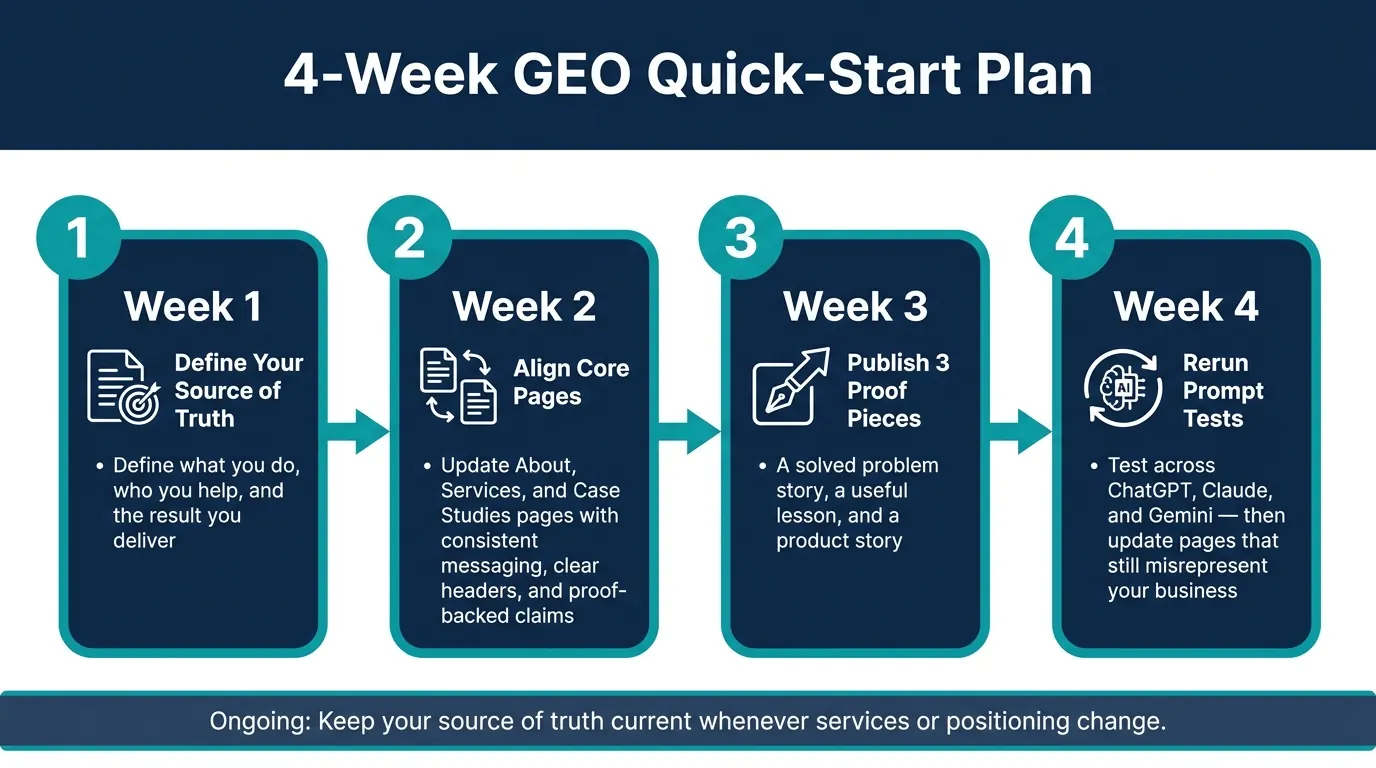
Use this four-week sequence to fix the biggest gaps first.
Week 1: Define what you do, who you help, and the result you deliver. This becomes your source of truth.
Week 2: Align your core pages - About, Services, and Case Studies - so they all say the same thing. Use clear headers and specific claims backed by real outcomes.
Week 3: Publish three proof pieces: a solved problem, a useful lesson, and a product story.
Week 4: Rerun the prompt tests across ChatGPT, Claude, and Gemini and update pages that still misrepresent the business.
Keep your source of truth current. When your services or positioning change, update the related pages right away.
FAQs
How long does GEO take to show results?
Generative Engine Optimization is an iterative process, not a one-time fix. There isn’t a set timeline for results because visibility can shift as generative engines keep indexing new data and changing how they respond.
The best way to measure progress is to watch how often your brand shows up or gets recommended in AI-generated answers. Over time, steady work on source clarity and topical authority tends to help.
Can small businesses benefit from GEO?
Yes. Small businesses can get a lot from Generative Engine Optimization (GEO) as AI-driven search tools play a bigger role in how people find information.
When a business improves how its brand shows up in AI-generated answers, it can get more visibility, earn citations or recommendations, and build trust.
How do I measure GEO success?
Measure GEO success by tracking how often your brand shows up or gets recommended in AI-generated answers. Unlike old-school search metrics, GEO is about visibility in tools like ChatGPT, Claude, and Gemini.
Use tracking tools to spot where your brand appears, where it drops out, and how that visibility shifts over time. That also helps you check whether AI systems cite and summarize your content correctly.