
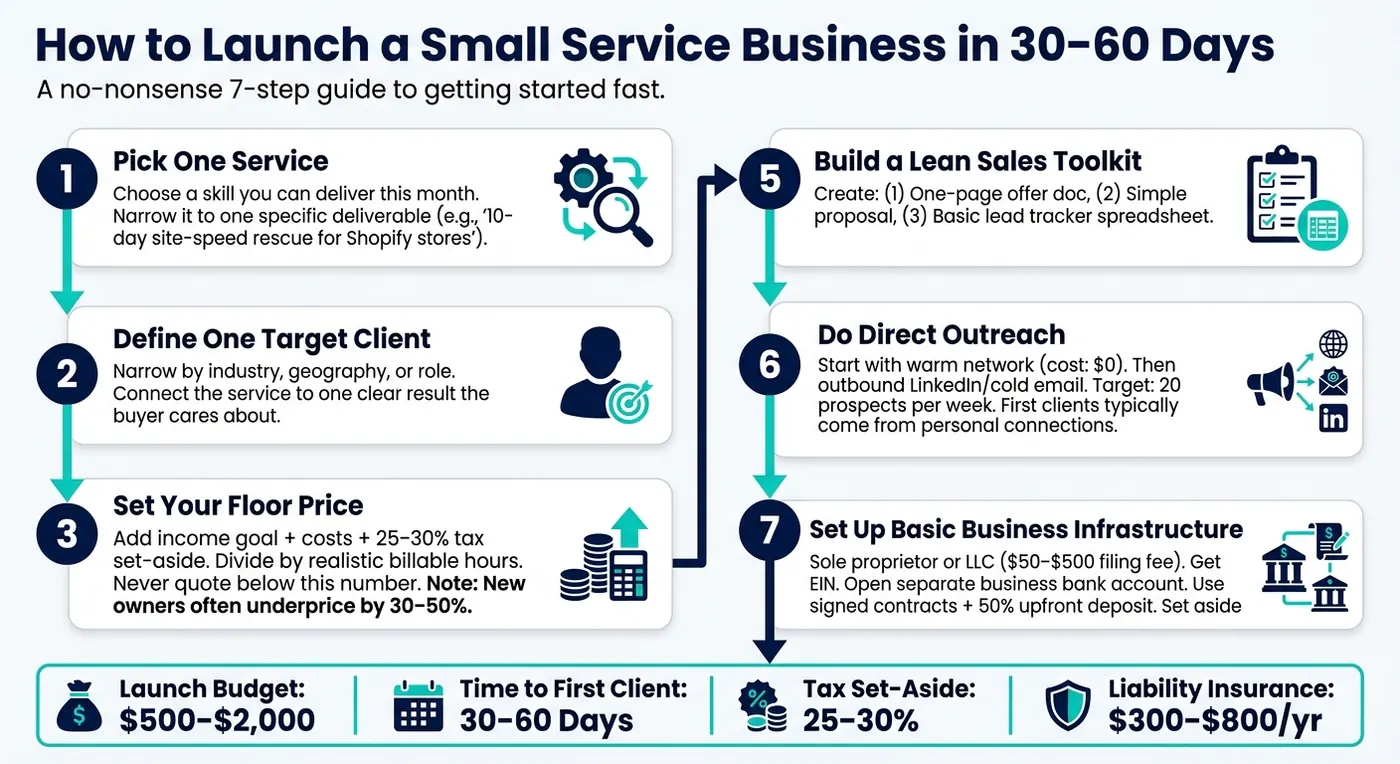
You do not need a logo, a website, or months of planning to start. If I were starting today, I’d focus on one sellable service, one type of client, one clear result, and one way to get paid.
Here’s the short version:
- I’d pick a service I can deliver
- I’d narrow it to
and - I’d set a floor price using my income goal, costs, and
- I’d test demand with
- I’d aim for first revenue in
- I’d start lean with about
- I’d use a signed contract, a
, and a separate business bank account - I’d look for early clients through
, then outbound email or LinkedIn
The article’s main point is simple: sell before you build. That means no wasting time on extra tools, heavy setup, or polished branding before someone agrees to pay.
What matters most is:
If I can explain my offer in one sentence and a buyer can repeat it back, I’m close. If I can’t, the offer is still too broad.
A few numbers stand out:
- Lean launch cost:
- Time to first client:
- New owners often underprice by
- Professional liability insurance can run
- filing fees often land between
, based on state
This guide is about getting to paid work with less delay, less guesswork, and fewer moving parts.
Pick a Service People Will Pay For
Start With a Service You Can Deliver This Month
Start with a skill you already have, then line it up with a market that already spends money on it.
The key is to turn a broad skill into one clear deliverable. “Marketing” isn’t a service. “Landing page copy for B2B SaaS startups” is. “I do websites” isn’t a service. “10-day site-speed rescue for Shopify stores” is.
Here’s a simple gut check: if you had a calendar link, a payment link, and two examples, could you sell three paid projects this week? If the answer is no, your offer is still too broad.
Once the service is specific enough to sell, tighten two more things: the buyer and the result.
Define One Target Customer and One Clear Result
Pick one narrow customer type. Buyers don’t pay for hours. They pay for an improvement to a specific business problem.
So instead of “bookkeeper,” get more specific. “Bookkeeping for dental practices” is clearer. “Monthly bookkeeping and tax-ready reports for clinics” is clearer still.
You can narrow by:
- Industry
- Geography
- Role
Then connect the service to one result, like more booked demos. That gives people something they can understand in one pass, without stopping to decode what you mean.
The table below shows the shift from a vague label to a specific offer tied to a result:
| General Offer (Hard to Sell) | Specific Outcome-Based Offer (Easier to Sell) |
|---|---|
| "I do social media" | "30 days of LinkedIn outreach for B2B founders" |
| "I build websites" | "10-day site-speed rescue for Shopify stores" |
| "I do bookkeeping" | "Monthly bookkeeping and tax-ready reports for clinics" |
Specificity is the whole game here. If your offer is easy to describe, it’s usually much easier to sell.
Write a Simple Offer Statement
Once you have the service and the customer, boil it down to one sentence.
Use this formula: "I help [target market] solve [problem] with [service]."
For example:
"I help Shopify store owners fix slow load times using a 10-day site-speed rescue."
"I help Shopify store owners fix slow load times using a 10-day site-speed rescue."
That’s enough. One sentence is plenty. If a potential client can repeat it to someone else, your offer is clear enough to sell.
Use that line in your outreach, your bio, and your proposal. Saying the same thing the same way each time helps people understand what you do fast.
Set Your Price and Build a Minimum-Viable Offer
Choose the Simplest Pricing Model That Fits the Work
Pick a pricing model based on how steady the scope is. If the work may change, charge hourly. If the deliverables are clear, use a flat fee. If the client needs monthly help, use a retainer.
Here’s the tradeoff at a glance:
| Pricing Model | Quote Speed | Revenue Predictability | Ease of Understanding | Scope-Creep Risk |
|---|---|---|---|---|
| Hourly | Fast | Low | Moderate | Low |
| Flat-Fee | Moderate | Moderate | High | High |
| Retainer | Slow (initial) | High | High | Moderate |
A good starting point is flat-fee pricing for tightly scoped work. Then, when the work starts to repeat month after month, add a retainer. After that, figure out your floor price before you send any quote.
Set a Floor Price Based on Time, Costs, and Taxes
A lot of new service business owners price too low - often by 30% to 50%. That’s a hard hole to climb out of, so do the math first.
Add up:
- Your target monthly income
- Your software subscriptions
- Any insurance costs
- Taxes you need to set aside
Professional liability insurance often costs $300–$800 per year. On top of that, set aside 25%–30% of every dollar you earn for U.S. self-employment taxes.
Then divide that total by your realistic billable hours per month. Not your calendar hours. Billable hours are lower than most people think because admin work, travel, client messages, and sales calls all eat up time.
That final number is your floor price. Don’t quote below it.
"Charge what the market pays, not what you feel comfortable saying out loud." - Erika Batsters
"Charge what the market pays, not what you feel comfortable saying out loud." - Erika Batsters
Next, make sure the scope lines up with the price.
Package the Work So Clients Know What They Are Buying
Before you send a proposal, spell out the work in plain English. If a client can’t tell what they’re getting, confusion starts early.
| Offer Component | What to Include |
|---|---|
| Scope | Exactly what tasks will be performed - and what won't |
| Deliverables | Tangible items the client receives, such as a PDF report or login access |
| Timeline | A specific turnaround, such as "delivered in 10 business days" |
| Communication | How and when updates happen, such as a weekly email update |
| Revisions | How many edit rounds are included - one for starter projects, two for larger ones |
| Exclusions | What is explicitly not included |
| Payment Terms | Deposit amount, final payment trigger, and accepted methods |
For project work, a 50% deposit upfront and 50% before final delivery is a clean setup. For retainers, bill monthly in advance.
If you’re sending proposals to U.S. clients, use MM/DD/YYYY date formatting and always name the time zone for deadlines or calls, like Eastern Time or Pacific Time. That small detail can save you from annoying scheduling mix-ups.
With price and scope in place, you’re ready to test the offer with real prospects.
Confirm Demand and Land Your First Clients
Test the Offer With Real Conversations Before Building Anything Else
Before you build anything else, talk to 10 potential clients. The goal is simple: find out what’s frustrating them, what they pay now, and what kind of result they want. Don’t guess. Have the conversations, confirm the pain, and then try to sell the first paid slot.
Ask direct questions about the problem they’re dealing with, what they spend now to fix it, and what a good outcome looks like. If you can’t get 10 conversations, that’s a warning sign. Change the niche.
When it’s time to pitch, keep it short. Explain:
- the problem you solve
- what your service does
- your price range in USD
- the result they should expect
"A launchable service solves an obvious pain, can be delivered in days and is easy to explain in one sentence that a buyer can repeat to their boss." - Matt Haycox
"A launchable service solves an obvious pain, can be delivered in days and is easy to explain in one sentence that a buyer can repeat to their boss." - Matt Haycox
If people show clear interest and you get a few direct yeses, move to simple sales materials. Once the pain point is clear, turn it into a one-page offer and a short sales process.
Use a Lean Sales Toolkit: Offer Doc, Proposal, and Lead Tracker
You do not need a big setup to start. A one-page offer doc, a simple proposal, and a basic lead tracker are enough.
| Toolkit Component | What to Include | Why It Matters |
|---|---|---|
| One-Page Offer Doc | Headline, scope, deliverables, price, inclusions/exclusions | Gives prospects a clear, repeatable summary of what they're buying |
| Simple Proposal | Scope, timeline, payment terms | Builds trust and sets expectations before work begins |
| Lead Tracker | Lead name, source, last contact date, current stage, expected deal value in USD | Keeps your pipeline visible so no lead gets lost |
A plain spreadsheet works fine at the start. Track each lead by source, stage, last contact, and next step. Nothing fancy. You just need a clear view of who’s in the pipeline and what should happen next.
Once calls start getting booked, add an intake form. Ask a few questions about the prospect’s current challenges, budget range, and urgency so you can show up prepared.
Focus on Outreach Channels That Can Produce Revenue Fast
Once the offer is defined, put your time where first revenue is most likely to come from. Most service businesses get their first five clients through personal connections, not paid ads or SEO. That’s the best place to begin.
Use the same offer doc and proposal in every channel. That way, your message stays consistent.
| Channel | Speed to First Client | Cost | Time Required | Fit for New Founder |
|---|---|---|---|---|
| Warm Network / Referrals | Very Fast | $0 | Low | Very High - best starting point |
| Outbound Outreach (LinkedIn, cold email) | Fast | Low | High | High - requires a clear target client |
For cold outreach, use a 3-part message structure: start with a specific observation about their business, name the problem you solve, then offer to send a few ideas.
AI writing tools can help you move faster here. Use them to draft personalized outreach messages and summarize prospect research before a call. Then pair that with a booking link and a payment link.
A good starting target is 20 prospects a week. Check replies every week, see where response is strongest, and put more effort there.
Set Up Basic Delivery, Money, and Growth Systems
Handle the U.S. Basics: Business Structure, Banking, Contracts, and Invoicing
Once a client says yes, the job changes. You're not selling anymore. Now you need to deliver the work cleanly and make sure payment comes in on time.
Most solo service founders begin as either a sole proprietor or a single-member LLC. A sole proprietorship is the simplest and lowest-cost option. An LLC gives you liability protection and can make you look more established to clients. LLC filing fees usually fall between $50 and $500, depending on your state.
After you choose a structure, get an EIN (Employer Identification Number) from the IRS and open a separate business bank account. Mixing personal and business money creates a mess fast. Keeping them separate makes bookkeeping easier and helps preserve the liability shield an LLC is supposed to give you.
For contracts, simple is fine. But written is non-negotiable. Every project should have a signed agreement that spells out the scope, deliverables, timeline, and what happens if the client asks for extra work halfway through. Take a deposit upfront, put the rest of the payment schedule in writing, and give clients easy ways to pay, including ACH and major credit cards. As each payment lands, move the tax portion into a separate savings account right away. If your work involves advice or judgment calls, add professional liability insurance.
Build a Repeatable Client Workflow From First Call to Final Delivery
Use the same steps on every project so small details don't slip through the cracks.
| Workflow Phase | Key Action |
|---|---|
| Discovery | Discovery call + intake questionnaire |
| Proposal | Scope, price, and timeline in writing |
| Agreement | Signed contract + deposit collected |
| Onboarding | Kickoff call + shared folder |
| Execution | Milestone updates on a set schedule |
| Delivery | Final walkthrough + file handover |
| Wrap-up | Final invoice + referral request |
After your first project, turn that flow into a one-page checklist and use it again for every client. That one move saves mental energy and cuts down on avoidable mistakes.
Conclusion: Keep It Simple, Get Paid Early, Then Add Systems
Build after you sell. Pick one service, one customer, one price, and one outreach path. That's enough to get moving.
Once the first few clients come in, the systems tend to show you what you need next. If the same process works more than once, trim it down even more. Start manual with docs, hand-sent invoices, and spreadsheet tracking. Add tools only when a task starts repeating or when mistakes keep popping up. AI and automation can give you leverage, but only after you know exactly what you're automating.
Start lean. Get paid. Then build systems that fit the business you actually have.
The 5 Steps to Starting a Profitable Service Business
FAQs
How do I choose the right niche?
Pick a niche where your skills and interests line up with a group of people who have an urgent, high-cost problem they already spend money to fix. Think of it as a 30-day experiment, not a forever choice.
Start by listing your skills, past projects, and interests. Then score 2 to 3 niche ideas based on:
- Interest
- Demand
- Competition
- Recurring revenue potential
After that, talk to at least 10 potential buyers. Use those conversations to sharpen your thinking, write a one-line pitch, and test the idea with a paid pilot.
What if I can’t get 10 prospect conversations?
If you can’t start 10 conversations, that’s usually a sign that something needs to change. Most of the time, it’s your offer or the audience you’re going after. That’s normal. Don’t panic and change everything at once.
Instead, adjust one variable at a time:
- your audience
- the problem you solve
- your offer
- your proof
That way, you can see what’s working and what isn’t.
Your outreach also needs to feel focused and personal. Generic messages usually fall flat. Use LinkedIn to find 30 prospects who match your ideal customer profile, and note why this problem matters to each person. That small bit of homework can make your message far more specific.
If you still don’t get traction after several weeks, it may be time to pivot to a different niche or a different offer.
When should I form an LLC?
Form an LLC when you want liability protection, a more professional image with prospective clients, or extra tax options.
A lot of founders begin as sole proprietors because it’s simple. Then, as the business grows, they move to an LLC. That shift often makes sense once there’s more money coming in, more client work on the line, or more risk to manage.
If net income gets to about $40,000 a year, you may also want to look at S corporation status to help cut self-employment taxes.
No matter which setup you choose, keep a separate business bank account from day one.