
Most startup ideas fail for one simple reason: people do not need them enough. If 42% of startup failures come from weak market need, the job is not to build faster. The job is to test demand before you spend months making something no one will buy.
Here’s the short version: I would validate a business idea in this order - define the buyer and problem, run interviews, check current workarounds and competitors, test a landing page, and ask for money or a clear commitment. The best proof is not praise. It is a deposit, a pilot, an LOI, or a booked call with the person who controls budget.
If I were doing this from scratch, I’d focus on these checkpoints:
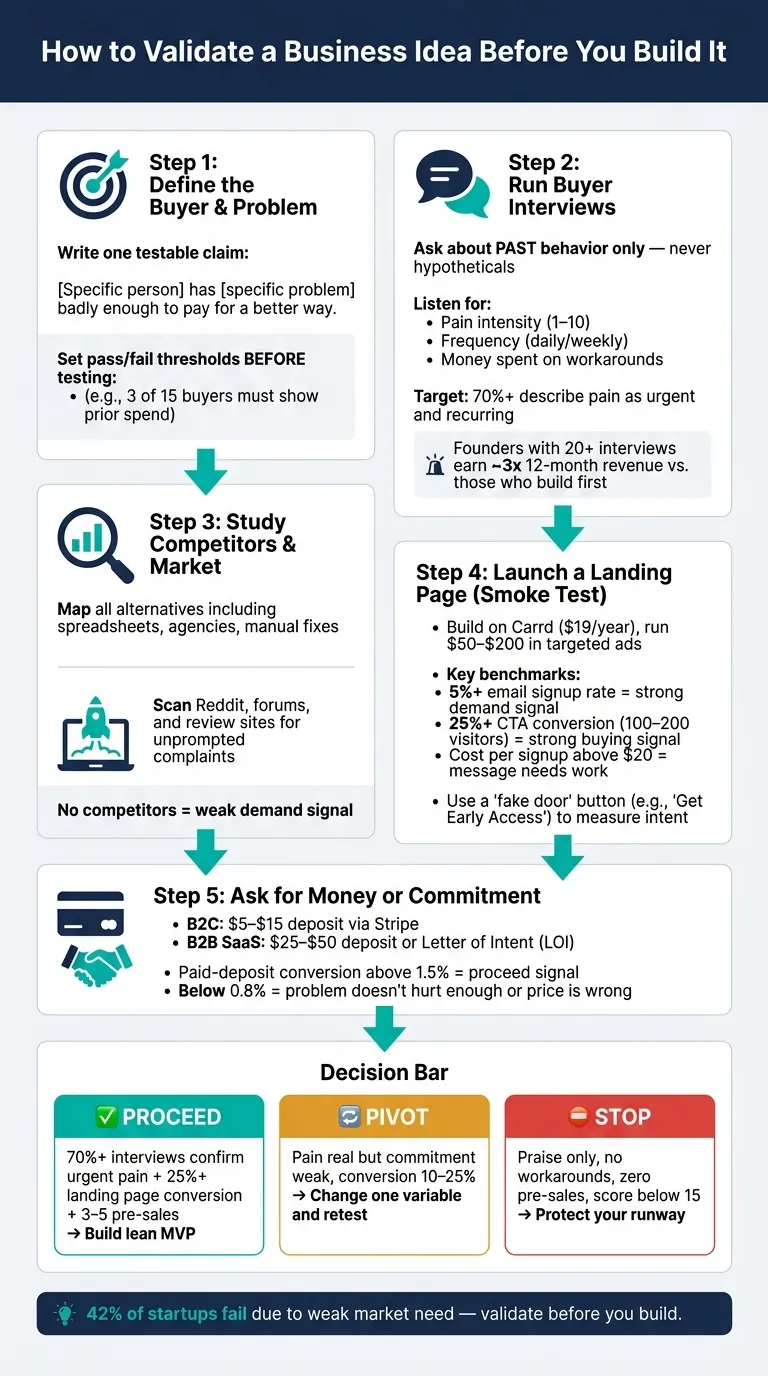
- Write one testable claim: [specific person] has [specific problem] badly enough to pay for a better way.
- Set pass/fail rules first: for example, if fewer than 3 out of 15 target buyers have spent time or money on the problem, I stop.
- Run buyer interviews: look for pain, frequency, and money already spent on workarounds.
- Use outreach to book calls: LinkedIn works well for B2B if I target a narrow buyer group.
- Study alternatives: software, agencies, spreadsheets, and manual fixes all count.
- Launch a simple landing page: measure clicks, signups, and segment-level interest.
- Ask for payment or a written commitment: this is the clearest demand check.
- Choose one path: proceed, pivot, or stop based on what buyers did.
| Step | What I’m testing | Best signal |
|---|---|---|
| Problem | Does this hurt enough? | Past pain + active workaround |
| Market | Do these buyers exist and care? | Replies, calls, referrals |
| Demand | Will strangers act? | Landing page conversions |
| Willingness to pay | Will they commit? | Deposit, pre-order, pilot, LOI |
Bottom line: I would not trust compliments, waitlist size, or gut feel on their own. I’d trust behavior, money, and clear next steps.
How to Validate Your Startup Idea for $50 (Same Method That Built a $100M Brand)
Define the problem, customer, and assumptions
Before you test anything, write one sentence you can prove or disprove:
"[Specific person] has [specific problem] badly enough to pay for a better way."
That line does a lot of work. It forces you to name who the customer is and what problem they have. No hand-waving. No vague market talk. Then turn that claim into a short brief and test it with real buyers.
Write a one-page validation brief
Keep it to one page.
Your brief should spell out:
- the customer
- the specific job they need done
- the pain they feel today
- the workaround they use now
- the result you expect
- why they would pay
- the price point you assume
Be specific about the customer. "Solo SaaS founders at $1K–$10K MRR who manage their own onboarding" is a segment you can test. A narrow segment is easier to find, reach, and learn from.
Use the brief to find the one assumption that would kill the idea if it's wrong. Test that first.
"Validation is a risk-reduction sequence, not a vibe check." - Patrick Frank, Founder, DoWhatMatter
This brief then becomes the backbone for your interviews, outreach, and landing page tests.
Set go, pivot, and stop criteria before you start testing
Set your thresholds before you test. If you don't, it's too easy to move the goalposts later.
A good starting point: if fewer than 3 out of 15 target buyers have already spent money - in time or dollars - trying to solve this problem, stop. For problem interviews, at least 70% need to describe the pain as urgent and recurring.
Use those thresholds to read every signal that comes next.
| Decision | What It Looks Like | Next Step |
|---|---|---|
| Go | Target customers describe the same painful problem and agree to a next step | Narrow the segment and test the offer |
| Pivot | The problem is real, but the urgency or segment is off | Test a sharper wedge with a different buyer profile |
| Stop | No urgent pain, no workaround, no willingness to commit | Save runway and move on |
Founders who conduct at least 20 user interviews before building have about 3x the 12-month revenue of those who build first. A stop decision saves runway.
Validate the problem with interviews, outreach, and market research
Once you have your brief, talk to actual buyers. Interviews, LinkedIn outreach, and competitor analysis help you check whether the problem is real before you build anything or spend on traffic. Start with interviews first. They show you whether the pain is there before you test any offer.
Run customer interviews focused on past behavior
Skip hypothetical questions. They give you opinions, not proof. Each question should pull out past behavior, not guesses about the future.
What tends to work is asking about what already happened: "When did this problem last happen?" "What did you do next?" and "What have you already tried to fix it?" Those questions rebuild what happened in the real world instead of inviting wishful thinking.
"Ask what someone did the last time the problem hurt, not what they would do, because only the past tells the truth." - Vincent, Founder of Preuve AI
During each interview, listen for three signals: pain intensity (ask them to rate it 1–10), frequency (daily, weekly, or monthly), and money currently spent on workarounds. Pay close attention to patched-together fixes like spreadsheets, internal tools, manual workarounds, or agencies. Those are signs that people are already spending time or money to deal with the problem.
Then compare what you hear with your pass/fail criteria.
End each interview with a high-friction ask: a follow-up call, an introduction to the budget owner, a pilot agreement, a letter of intent, or access to internal workflow data. A prospect who introduces you to the person controlling the budget is giving you a much stronger signal than someone who just says the idea sounds good.
| Evidence Level | What It Reveals | Strength of Signal |
|---|---|---|
| Opinion | "That sounds like a great idea." | Weak (Politeness) |
| Problem Story | Specific account of a recent pain point | Moderate |
| Current Behavior | Active use of spreadsheets or manual workarounds | Strong |
| Commitment | Deposit, signed LOI, or introduction to budget owner | Strongest |
Use LinkedIn outreach to reach ideal buyers
If interviews are tough to book, use LinkedIn to reach the same buyer profile faster. For B2B ideas, LinkedIn is a practical way to contact strangers who fit your ICP. Use LinkedIn Sales Navigator to find 30+ prospects, and track their names, roles, and the exact reasons the problem would matter to them. Ask for a 15- to 20-minute conversation about their workflow, not a sales pitch.
In a focused 7-day sprint, messaging 30 targeted prospects should ideally bring in at least 5 replies to count as a useful signal. Track which roles and company types reply first. That pattern shows you where your best entry point in the market may be.
A reply tells you the buyer exists. A referral to the budget owner tells you the problem has buying power. Once you know who feels the pain, look at what they already use and what they still complain about.
Study competitors to find demand and gaps
No competitors often points to weak demand or bad economics. What you want is proof that the market already spends time or money trying to solve this.
"The honest competitor to most B2B ideas is 'a virtual assistant and a Google Sheet.'" - Preuve AI
Map every alternative your target buyer uses today, including manual workarounds. For each one, find the thing it refuses to do well. That's your opening.
Then check public pricing. If the market is paying $9/month for the closest option, but your model needs $200/seat to stay alive, the unit economics are telling you something pretty plain about viable demand.
Also scan Reddit threads, niche forums, and review sites for unprompted complaints. When strangers complain about the problem on their own, that's an organic demand signal.
If these checks confirm demand, move to landing page and pre-sale tests.
Test demand with landing pages, waitlists, and pre-sales
Interviews and competitor research can tell you a problem is there. But a landing page test shows something more concrete: whether strangers will click, sign up, or pull out a card. That's the difference between polite interest and market demand.
These tests are cheap, too. A full validation sprint can cost under $200, and you get behavior data before writing a single line of code.
Launch a landing page and run a smoke test
A smoke test puts your value proposition in front of real buyers before the product exists, so you can see how they react.
Build a simple page on Carrd for $19/year. Keep it tight: one clear headline that names the painful outcome, a sub-headline, three to five benefit bullets, and one call to action. Skip the feature dump. Focus on the result the buyer wants most.
Once the page is live, send targeted traffic to it. A small ad budget of $50 to $200 on Meta, Google, or LinkedIn is usually enough to reach your target buyer and get a usable signal.
A few numbers matter here:
- A 5%+ email signup rate is a strong demand signal.
- A 25%+ conversion rate on a main call to action across 100–200 visitors is a strong buying signal.
- If cost per signup goes above $20, your message or targeting likely needs work.
One tactic that works well is the "fake door" test. Add a button like "Start Free Trial" or "Get Early Access" that leads to a coming soon waitlist. That click gives you a read on intent to pay before you build anything.
| Method | Speed | Cost | Signal Strength |
|---|---|---|---|
| Landing Page | 3–7 days | $50–$100 | Medium-High |
| Fake Door Test | 1–2 days | Low | Medium (measures feature intent) |
| Smoke Test (Pre-sale) | 1–2 weeks | Free | Very High (measures willingness to pay) |
Use the click data to spot which roles and segments react first.
Build a waitlist to measure interest by segment
A plain email signup doesn't tell you much. Add a short form for role, stage, and urgency with Typeform or Google Forms.
What matters isn't the size of the waitlist. It's the quality. A list of 50 people who describe a clear, urgent pain point is worth more than 500 generic signups. When people mention active workarounds or a budget, flag them for direct follow-up. That's where the best leads usually show up.
Once you've found the highest-intent leads, ask them to pay.
Ask for pre-sales to test willingness to pay
Pre-sales are the strongest demand test.
Set up a Stripe Payment Link or a simple checkout page. Offer early access in exchange for a small deposit or upfront payment. For B2C, a $5–$15 deposit works well. For B2B SaaS, $25–$50 is a fair ask.
Be direct about what you're offering. Say the product is in pre-launch, share a delivery timeline, and offer a full refund if the project doesn't move forward.
For enterprise B2B, a non-binding letter of intent (LOI) can work when asking for money isn't realistic. It still means something. The buyer is putting their name and reputation behind the deal, and that's a useful signal.
Track the conversion rate from page visit to payment. A paid-deposit conversion rate above 1.5% is a strong proceed signal. Below 0.8% usually means the problem doesn't hurt enough, or your price is wrong.
| Waitlist | Pre-sale | |
|---|---|---|
| Commitment | Low (email only) | High (financial or reputational) |
| Revenue Signal | None | Direct |
| Risk of false interest | High (may not convert to buyers) | Low (demand is already paid for) |
Before launch, write down your kill criteria: the exact number of pre-sales or conversion rate that would make you stop. If you don't set that line in advance, it's way too easy to explain away weak results.
Decide whether to proceed, pivot, or stop
After the pre-sale test, the choice is pretty clear: proceed, pivot, or stop.
At this point, you have something far better than gut feeling. You have interview notes, landing page conversion rates, waitlist sign-ups, and pre-sale results. Use what buyers did, not how excited you feel.
Use a simple evidence scorecard
Score your idea across five pillars: problem validation, market validation, demand validation, solution validation, and pricing and revenue model validation. For each pillar, use the strongest proof you have.
- Score 20–25: proceed
- Score 15–19: pivot
- Below 15: stop
The table below shows how common evidence patterns point to the next move:
| Decision | Evidence Pattern | Next Move |
|---|---|---|
| Proceed | 70%+ of interviews confirm urgent pain; 25%+ landing page conversion; 3–5 pre-sales | Build a lean MVP focused only on the validated value |
| Pivot | Pain is real but commitment is weak; conversion between 10–25% | Change one variable at a time: price, audience, or framing, then retest |
| Stop | Praise only; no workarounds described; zero pre-sales; score below 15 | Kill the idea and protect your runway |
One benchmark matters here: in a 2026 review of more than 4,000 ideas, only 18.3% earned a clear go signal. So if your results look weak, that doesn't mean you failed. It means the process did its job before you spent months building the wrong thing.
If the score is strong, move straight into manual delivery.
Turn validation findings into a 90-day execution plan
If the scorecard says go, start by delivering manually. Handle the first few commitments by hand using spreadsheets, calls, or direct service before you automate anything. That manual-first path shows you what people need before you build systems around it.
A tight 90-day plan can look like this: spend the first 30 days delivering the outcome manually and checking that early paying users get clear value. Use days 31–60 to build a lean version based only on what those early users actually used or asked for. In the final 30 days, set up a weekly feedback loop with your first 10–20 qualified users and track one outcome metric.
"If your first five serious conversations do not reveal who approves the purchase, you are not validating a company yet, only a complaint." - Ali Hajimohamadi
Set a written stop trigger before you start. For example: "If we don't have 3 paid pilots by day 60, we stop." That line matters more than it seems. Without a stop trigger, it's way too easy to keep shifting the goalposts and burn runway.
FAQs
How many interviews are enough to validate an idea?
There’s no magic number here, but many frameworks point to 10 to 20 interviews with people who fit your target customer profile.
You’ve probably done enough once new conversations stop giving you new takeaways. At that point, you’ll start hearing the same pain points, the same phrases, and the same objections again and again. The goal is spotting patterns, not statistical significance.
What if people like the idea but won’t pay yet?
If people say they like your idea but won’t pay for it, that’s curiosity - not customers. Nice comments and positive feedback can feel good, but they don’t prove demand.
To turn interest into proof, ask for commitment. That could be a pre-order, a refundable deposit, or a paid pilot. Money changes the conversation.
If people won’t share a payment method or make a formal commitment, something is probably off with your audience, pricing, or positioning. In that case, don’t build yet. Fix those pieces first.
Should I build anything before asking for pre-orders?
No. Don’t build or write code before you ask for pre-orders.
Start by finding clear proof that your target audience has an urgent problem and is willing to pay to fix it. Look for pre-orders, refundable deposits, or signed pilot contracts. Those are strong signals.
Compliments and free email signups might feel good, but they’re much weaker signs of demand.