
A personal brand website should explain who you help, what you offer, why buyers should trust you, and how to get in touch. Start with a clear statement such as “I help restaurant owners write menus,” then support it with work samples - not just a biography.
Include:
- Your offer: What buyers get, how the work happens, and how to request pricing.
- Your proof: Relevant projects, case studies, credentials, and approved testimonials.
- Your background: An About section that connects your experience to the work you sell.
- Your contact path: Clear navigation and a button that leads to the right form, email address, or calendar.
Before publishing, check every claim and link, review the site on mobile, and submit the contact form to confirm it works. Build only what you can keep current.
Support Your Offer With Proof
Show visitors evidence that you can deliver what your offer claims. Choose a few proof items with clear sources: case studies, live projects, publications, or metrics. Link each item to the case study, live project, or original publication. Add a short metrics block only when you have solid numbers to back it up. [1][2][3]
Choose Relevant Work and Credentials
Choose work that matches the service you sell and the result your buyer wants. That could include products or companies you built, relevant roles, published work, talks, or credentials. If you have little client work, use a personal project that shows the same skills your service requires. [2][3][6]
Use testimonials only with permission and accurate attribution. Ask clients to explain what you did and what changed, rather than offer vague praise. [2][7]
Show Your Role and Results in Case Studies
Start with the outcome. Then explain the situation, the challenge, and your role. Be clear about what you handled and what teammates did. Pair screenshots with metrics or original source material so readers can check the claim. [1][5]
Use the strongest source available for each claim.
| Weak | Better | What to include |
|---|---|---|
| “Helped a client grow” | Describe the measured change and your role. | Result data and role documentation. |
| “Built the product” | Name the features you owned and the team’s role. | Live product or approved project record. |
| “Featured in major publications” | Name the publication; distinguish authorship from a mention. | Link to the original piece. |
| “Clients love working with me” | Use an approved quote with a specific result. | Permission and accurate attribution. |
For confidential work, share only what you have permission to publish. Ask whether you can use an anonymized description, a redacted image, or an approved description of the outcome without numbers. If permission excludes numbers or client names, leave them out. [1][2]
Explain Your Offers and Process
Once visitors trust you, make it clear what they can buy. List services, products, speaking, and brand partnerships separately on your personal brand website - not under a catch-all label. Visitors should be able to scan the page and find the offer that fits. [1][3]
Define What Each Offer Includes
Give each offer a clear name and a short “who I work with” line. Explain the problem it solves, what the buyer gets, and how you deliver it. Make the format clear: a live session, downloadable product, event ticket, or recurring membership. State what’s included - and what isn’t. [1][4]
Walk buyers through the steps from inquiry to delivery. Include a timeline and a fixed price, starting price, or price range in U.S. dollars. If the price depends on the scope, explain how to request a quote and which details you need to prepare it. [1][4][5][6]
Give Each Offer a Clear Next Step
Make the button say what happens next.
Use “Book a call” or “Discuss your project” for services, “Buy” or “Download” for products, a brand partnership inquiry form for brand partnerships, and “Request availability” or “Book me to speak” for speaking. [1][4][5][6][8]
Link each button directly to the right form, checkout, or calendar. For project inquiries, ask for a name and email address. For higher-priced services, also ask about goals, scope, budget range, and timing. Speaking forms should request the event date, audience size, and topic. Tell visitors what happens after they submit, and give a response window only if you can meet it. [1][4][5][6][8]
Plan Your About Page, Navigation, and Contact
Your About page, navigation, and contact path should help visitors decide whether to work with you. Once they understand your offer and see proof, make it easy to check your background and get in touch.
Write an About Page for Buyers
Your About page should explain why buyers can trust you to deliver the offer you’ve described. Tell them why you do this work and how your background helps you solve their problems. They don’t need a list of every job you’ve held.
Name your current company, role, or memberships. Link to projects or publications that back up your claims so visitors can check your work.
Explain the principles that guide your work and how your experience shaped them. Keep the career details that support those principles. Cut the rest. Let that story shape how you describe your work across the site.
Choose a Site Structure You Can Maintain
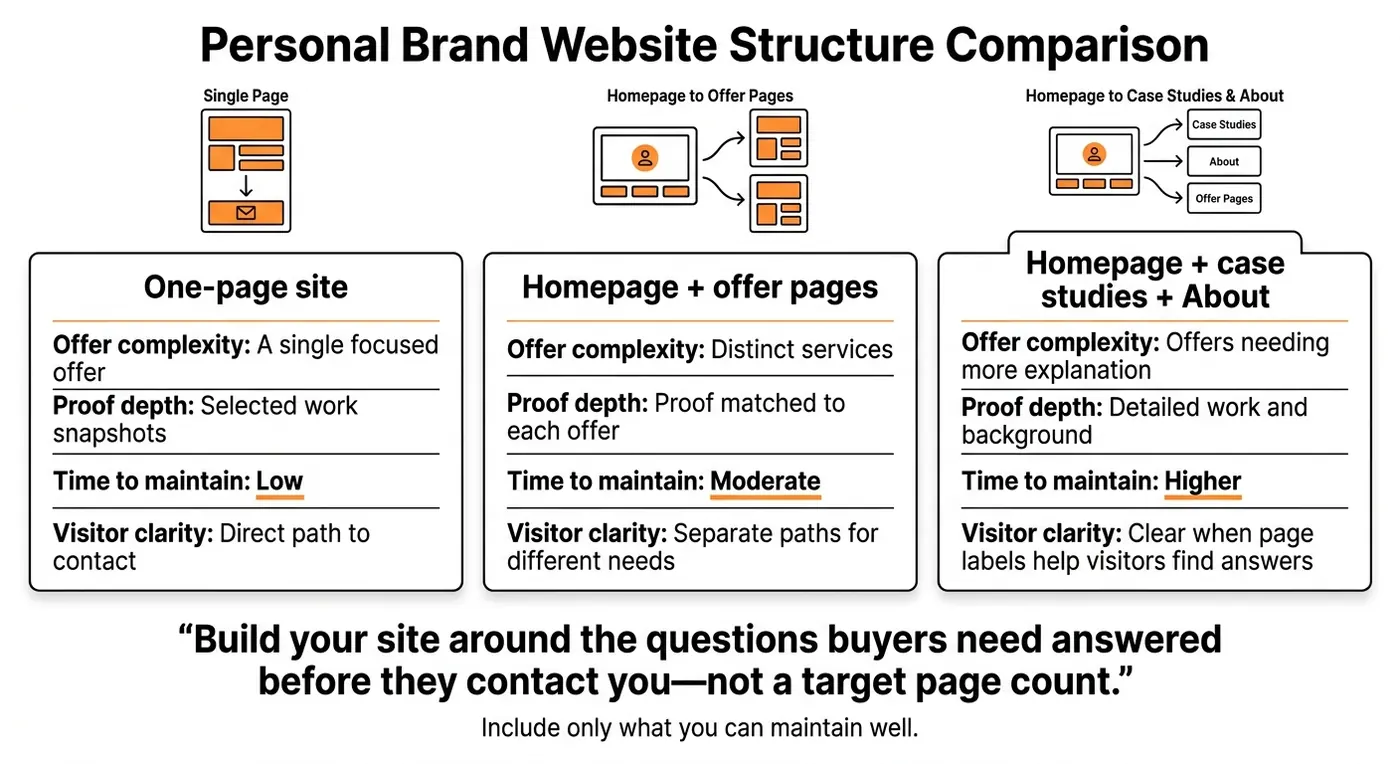
Build your site around the questions buyers need answered before they contact you - not a target page count. A focused page can be enough to test an offer or guide visitors toward a clear next step.
| Site structure | Offer complexity | Proof depth | Time to maintain | Visitor clarity |
|---|---|---|---|---|
| One-page site | A single focused offer | Selected work snapshots | Low | Direct path to contact |
| Homepage + offer pages | Distinct services | Proof matched to each offer | Moderate | Separate paths for different needs |
| Homepage + case studies + About | Offers needing more explanation | Detailed work and background | Higher | Clear when page labels help visitors find answers |
Use familiar navigation labels: About, Services, Case Studies, and Contact. Add a Writing page only if you can keep it current.
Every page needs upkeep. Include only what you can maintain well. An up-to-date work section serves buyers better than a neglected blog.
Make It Easy to Contact You
Give visitors a clear way to reach you after they’ve read your offers and proof. Don’t make them search for the next step.
State which inquiries you accept. Then provide a professional email address at your own domain or a simple contact form. Ask only for the information you need.
Keep your main contact method in both the header and footer. If you state a response window, choose one you can reliably meet.
Launch Your Personal Brand Website
Launch when a buyer can understand your offer, check your proof, and contact you easily. Add pages only when they answer a buyer’s question.
Once your pages are written, run a final pre-launch check on desktop and mobile.
Test Your Content, Links, and Contact Form
Make sure the published site matches your plan. Your homepage should say who you help and what you sell. Your proof and About page should back up that same claim. Use the brand identity checker to check for consistency.
On desktop and mobile, check that headings are readable, buttons are easy to tap, and links work. Submit the contact form and confirm the email arrives. Fix anything that gets in the way of contacting you.
Verify Examples and Claims Before Publishing
Open every public example on its source site. Check that each linked source still supports the claim you’re making. Remove anything you can’t verify or don’t have permission to share.
Publish client details and testimonials only when you have written permission to use them.
FAQs
Do I need a personal website if my company has one?
Yes. Your company website explains your product. Your personal website explains who you are and shows your work - the details investors, clients, and partners often look for first.
Use your personal site as a home base you own, with links to your profiles and business. Keep product details on your company site, and let your personal site give people a reason to visit it.
How can I attract the right visitors to my site?
Your first screen should tell visitors who you help and what they get. Support that message with clickable work samples and proof that backs up your claims. Keep your offers focused, and choose a primary action: book, buy, or join.
Make it easy to reach you by email or through a short form. Add a booking link if it fits how you work. Point active social profiles to the page that best matches what those visitors need, and keep your branding consistent so they know they’re in the right place.
How do I know if my site brings in opportunities?
Your site is working when visits lead to business results you can measure. Track visits, conversion rates - the share of visitors who opt in or complete checkout - and which pages get the most attention.
Check the quality of inquiries from your contact form or scheduling link, too. Do people arrive knowing what you offer, who you serve, and why it matters? That’s a sign your main headline and work samples are setting clear expectations.