
A brand messaging framework is a shared guide to who you help, what you promise, and why buyers should believe you. Start with a single offer, use customers’ own words, and include only claims you can support.
This fill-in template covers your audience, problem, promise, value proposition, proof, and voice rules. Use it to keep your website, sales pitch, and social posts aligned - then update the copy that differs most from your approved message.
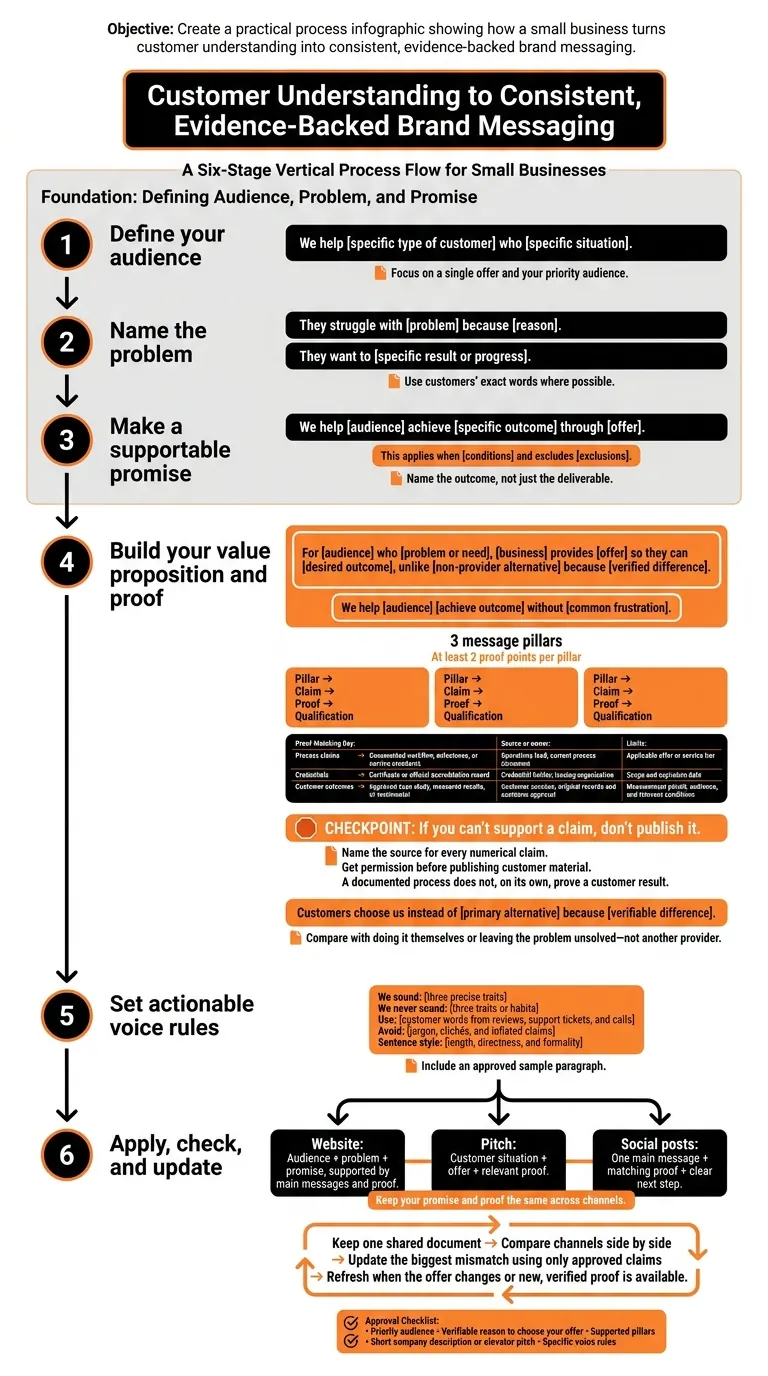
Define your audience, problem, and promise
Turn your research into the core of your brand messaging framework. Focus on a single offer: who it serves, what problem it solves, and what outcome you can back up.
Audience: Who do you help?
Fill in:
We help [specific type of customer] who [specific situation].
Choose your primary audience - the group that matters most to your business right now. This customer profile will guide your message.
Describe the group in terms buyers recognize: their role, business type, or buying situation. If you serve other audiences, keep them in a separate matrix rather than trying to fit everyone into the same message.
Problem: What do customers want to change?
Name the problem your audience needs solved and what it stops them from doing.
Fill in:
They struggle with [problem] because [reason].
They want to [specific result or progress].
Use customers’ exact words where possible. Skip internal labels that buyers wouldn’t use. Make the obstacle and the desired progress clear.
Promise: What outcome can you support?
Turn the problem into a specific outcome your business can support with proof.
Fill in:
We help [audience] achieve [specific outcome] through [offer].
Name the outcome, not just the deliverable. Be clear about what customers can work toward through your offer, without promising more than your evidence supports.
Add a boundary note so buyers know where the promise applies:
This applies when [conditions] and excludes [exclusions].
Write your value proposition
Put your audience, their problem, and your promise into one sentence. Make it clear who you help and why your offer matters.
Fill in the value proposition template
Combine your worksheet answers using the full template first. Then shorten it for your website or other public copy.
For [audience] who [problem or need], [business] provides [offer] so they can [desired outcome], unlike [non-provider alternative] because [verified difference].
Compare your offer with doing it themselves or leaving the problem unsolved - not with another provider. For the shorter version, use:
We help [audience] [achieve outcome] without [common frustration].
Keep the wording specific. Then choose evidence that supports the promise you’ve made.
Back your message pillars with proof
Create three message pillars - the main points behind your offer. Give each a theme, claim, proof, and limit. If you can’t support a claim, don’t publish it.
Pillar: [short theme]
Claim: [what the business does or enables]
Proof: [verified evidence]
Qualification: [limits, conditions, audience, or time period]
| Claim type | Proof to attach | Source or owner | Limits or conditions |
|---|---|---|---|
| Process claims | Documented workflow, milestones, or service standards | Operations lead; current process document | Applicable offer or service tier |
| Credentials | Certificate or official accreditation record | Credential holder; issuing organization | Scope and expiration date |
| Customer outcomes | Approved case study, measured results, or testimonial | Customer success; original records and customer approval | Measurement period, audience, and relevant conditions |
Name the source for every numerical claim. For customer results, record what you measured and over what period. Get permission before publishing customer material.
Match the proof to the claim. A documented process can show how you work. It does not, on its own, prove that a customer achieved a result.
Next, narrow your difference to a reason buyers can verify and care about.
Check what sets your offer apart
Customers choose us instead of [primary alternative] because [verifiable difference].
Could another business use that sentence without changing a word? If so, replace broad claims with specific proof. Cut labels such as best, forward-thinking, and trusted; state what you can verify instead.
Set your voice and use your message
Keep your promise and proof the same across channels. Adjust the opening, length, and detail to fit where people will read it.
Then set clear rules for how your business sounds, whether someone lands on your website, hears your pitch, or reads a social post.
Write clear voice rules
Give writers rules they can use, not just traits they have to interpret.
“Friendly” means natural and direct, never overly familiar. “Knowledgeable” means clear, not jargon-heavy.
Fill out this voice card:
We sound: [three precise traits]
We never sound: [three traits or habits]
Use: [customer words from reviews, support tickets, and calls]
Avoid: [jargon, clichés, and inflated claims]
Sentence style: [length, directness, and formality]
Add an approved sample paragraph, then check it against your rules. Use US spelling and words your customers use. Make the sample specific enough that another writer can follow it without guessing what “friendly” means to your business.
Map your message to your website, pitch, and social posts
Start with your most important website page. Then carry that message into your pitch and social posts.
Website: Lead with who you help, the problem they face, and your promise. Support that promise with your main messages and proof. For help putting the page together, see how to write website copy that makes people care.
Pitch: Describe the customer’s situation, explain your offer, and share the proof that best addresses their concern.
Social posts: Focus each post on a main message rather than repeating the whole framework. Open with a problem your readers recognize, add a matching proof point, and give them a clear next step. Keep the core promise unchanged.
Conclusion: Put your framework to work
Keep your brand messaging framework in one shared document. Use it as the source for all new copy.
Check your framework for consistency
Before approving the framework, make sure it names your priority audience, clearly explains why they should choose your offer, and supports every messaging pillar with at least two proof points. Include a short company description or elevator pitch. Give specific voice rules that tell writers what to do - not just adjectives.
Read your website, pitch, and social posts side by side. Flag anything that doesn’t match. Update the framework when your offer changes or you have new, verified proof. If you serve several groups, keep the document focused on your priority audience.
Choose which copy to update next
I’d start with the biggest mismatch, often your homepage headline or sales intro. Rewrite it using only approved claims. If you need a new claim, add it to the framework for review before publishing. Then check other channels for the same mismatch.
For writing help, see Patrick Frank’s copywriting services.
This is general information, not legal, tax, or financial advice.
FAQs
How can I test whether my brand messaging resonates?
Ask colleagues in sales, marketing, and customer success to describe your company without checking your documentation. If their answers differ, your messaging may be unclear.
Then share your value proposition - the reason customers should choose you - and your main talking points with your best clients. Ask what sounds true to their experience and what doesn’t.
Test that language in your LinkedIn headline, sales emails, or discovery calls. Listen for prospects using your phrasing and asking fewer questions about what your services include.
What proof can I use without customer case studies?
Build trust with facts buyers can check and clear standards for your work. Show the industry certifications, professional accreditations, or third-party audits you’ve earned. Share your documented process, such as an onboarding sequence with clear milestones buyers can verify.
You can also put a formal guarantee or service commitment in writing - but only if you’re prepared to honor it. These details give buyers a way to check your reliability and understand how your work gets done.
How do I adapt my framework for multiple offers?
Check whether each offer fits how you already position your business. If it does, add key messages or evidence to support it within your current messaging framework. If it serves a different audience, give it a short, separate framework so your brand message stays clear.
When your existing audience has different needs, keep your core brand identity consistent. Adjust the lead message, benefits, and supporting evidence to match what matters most to each group.