
If AI tools can’t explain your company in one clear sentence, you have a visibility problem. More buyers now start with ChatGPT, Perplexity, Claude, or Google AI Overviews before they ever visit a site. That means your job is no longer just to rank. It’s to make sure AI can name your company, describe it right, cite the right sources, and show current facts like pricing, use cases, and proof.
Here’s the short version:
- Define your company in one sentence: what you do, who you help, and why someone should pick you.
- Repeat that same message everywhere: homepage, About page, LinkedIn, founder bio, product pages, and directories.
- Publish pages that answer buyer questions: category, problem, solution, process, proof, comparison, and pricing.
- Use proof AI can cite: screenshots, case studies, pricing, feature details, and third-party mentions.
- Check AI answers every month: test prompts, review citations, and fix bad or old information at the source.
A simple way to think about AEO: I want my company to answer four questions fast - what it is, who it serves, what problem it solves, and why people should believe it.
A few points stand out from the article:
- Buyers often form opinions before they reach your website.
- Pages with vague copy get mislabeled or ignored.
- Hidden or old pricing can lead AI tools to show the wrong numbers.
- Third-party sources matter, but message match matters more than volume.
- Monthly reviews help catch errors before they shape buyer opinion.
If I were starting today, I’d do this in order:
- Fix company language
- Align core pages and schema
- Publish answer-first pages
- Build outside proof
- Track how AI describes the brand each month
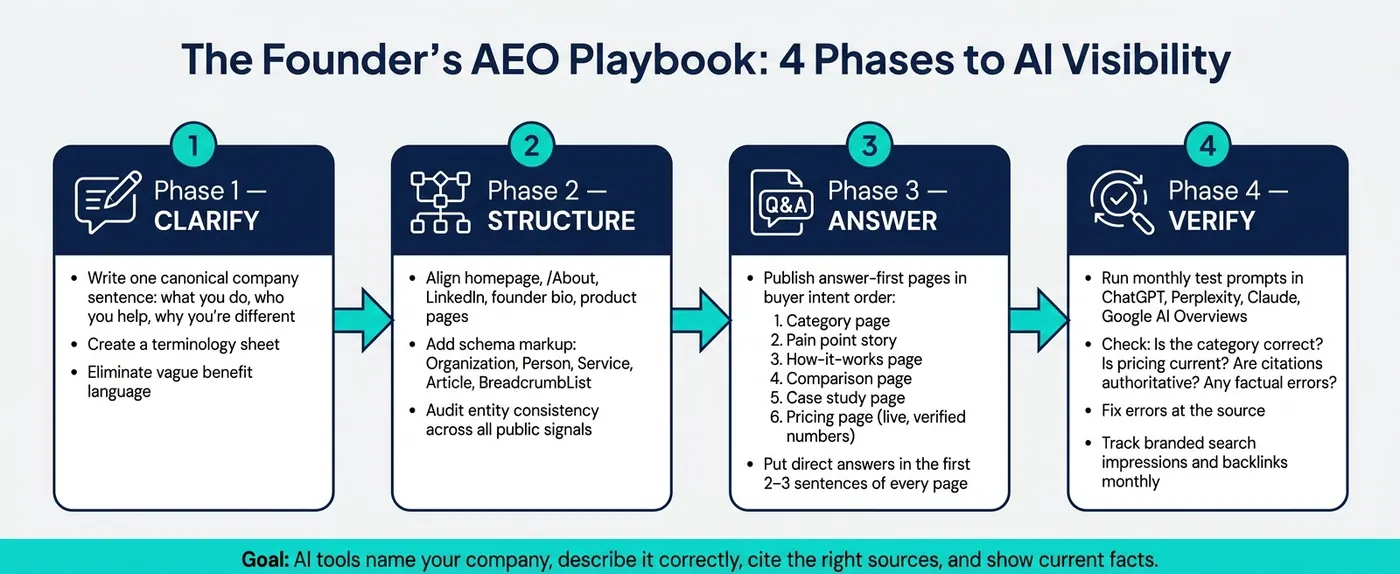
That’s the playbook in plain English: clarify, structure, answer, and verify.
Complete AI SEO Course for Beginners: Learn AEO in 86 Minutes
Build a clear company and product identity machines can understand
AI answer engines use public signals to decide if your company belongs in the category you want to own. They pull from your homepage, About page, LinkedIn, directories, and press mentions. When those signals don’t match, the engine may label you the wrong way or leave you out of the answer altogether.
Start with one canonical company sentence and repeat it across every page and profile.
Standardize your core company language
Use one canonical sentence that says what you are, who you serve, and why you’re different.
"If you need 3 pages to explain how you're different, it's like then we're getting into esoteric details that don't really matter." - Peep Laja, Founder, Wynter
Vague benefit language can blur your category. “Empowering teams to do more” sounds nice, but it doesn’t say anything concrete.
Create the pages and markup that anchor entity clarity
Your homepage, /about page, founder page, product or service page, and pricing page should all repeat the same category, audience, and outcome. Those are the main signals AI engines use to confirm who you are and what you do.
Schema markup should back up clear page copy, not replace it. If the writing is vague, markup won’t save it. For a founder-stage company, the most useful schema types are , , or , , and .
Once your page copy lines up, review every core entity across channels and make sure it says the same thing.
Entity clarity audit table
Use the table below to spot mismatches across your public signals. Each row covers a core entity your company needs to define clearly and repeat the same way everywhere.
| Entity | Required Description | Where It Should Appear | Common Inconsistency |
|---|---|---|---|
| Company | Canonical category + distinctive angle in one sentence | Homepage, /About, LinkedIn | Described as "tool" on one page and "platform" on another |
| Founder | Specific expertise tied to the product category | Founder page, LinkedIn, /About | Generic "entrepreneur" bio vs. a specific, credentialed role |
| Flagship Service | Exact method or function, not fluffy claims | Product/service page, pricing page | "AI-powered" with no explanation of what the AI actually does |
| Target Customer | ICP defined by industry, role, and company size | Homepage, case studies, landing pages | "Businesses of all sizes" instead of a named segment |
| Primary Outcome | A quantifiable result or verifiable claim | Homepage hero, proof sections | "Better efficiency" instead of a specific, measurable improvement |
If the answer changes from page to page, that’s a signal mismatch. Fix it at the source before you move to content strategy.
Publish answer-ready pages for the questions prospects actually ask
Once your company language is clear, turn that clarity into pages AI can quote. Entity clarity only helps if your pages repeat it in a way machines can parse. Publish pages that answer buyer questions fast and in plain English. For founders, each page should reinforce your category, audience, and proof at a glance.
Cover category, problem, solution, process, comparison, proof, and pricing intent
Prospects tend to move through the same set of questions before they buy. First, they try to understand the category. Then they look for a company that gets their exact problem. After that, they want proof. Last, they compare options. Every one of those moments is a page you either own or give away.
A case study from Peep Laja's message testing work shows what happens when you skip that job: IntelligenceBank, a Digital Asset Management platform, had "above the fold" copy so vague that prospects confused it with project management software.
"Phrase what you are and who you're for in the simplest terms." - Peep Laja, Founder, Wynter
For founders, the page types that matter most are:
- A category page that explains your space in simple terms
- A pain point story that names the exact failure mode your prospect is dealing with
- A case study page that shows how you fix it
- A how-it-works page that explains your process in concrete terms
- A comparison page that shows the line between you and the default alternative
- A pricing page with live, verified numbers
If pricing is hidden, AI answers may surface outdated pricing.
Structure every page for direct answers and evidence
Put the direct answer in the first two or three sentences. Use headings that match the way a prospect would ask the question. Define jargon before you use it. Keep each section tied to one idea.
Just as important, split fact from opinion. If you claim a measurable outcome, show the number, the timeframe, and the context. Vague claims like "better efficiency" give AI systems nothing to cite, and they give prospects no reason to trust you.
Skip generic stock images. Use real screenshots or actual output examples instead. That kind of proof backs up what the page says and gives AI systems more context to work with. End each page with one clear next step that fits buyer intent.
Question-to-page map
Build these pages in order of buyer intent, starting with the questions prospects ask first.
| Prospect Intent | Question Pattern | Recommended Page | Proof Required | Qualification Signal |
|---|---|---|---|---|
| Category | "What is [Category]?" | Category / Educational | Clear category claim, industry definitions | Prospect identifies with the category you define |
| Problem | "Why is my [process] failing?" | Pain Point Story / Audit | Specific frustration examples, case study data | Prospect names the exact bottleneck you solve |
| Solution | "How do I solve [problem]?" | How-To Guide | Step-by-step screenshots, measurable quick win | Prospect implements your method before buying |
| Process | "How does [product] work?" | How-It-Works Page | Specific AI logic, real outputs, transparent failures | Prospect requests technical documentation |
| Comparison | "[Brand] vs. [alternative]?" | Comparison / Alternatives | Feature-outcome matrix, clear category claim | Prospect is in the final selection stage |
| Proof | "Does this work for [industry]?" | Industry Case Study | Measurable outcomes tied to a named industry | Prospect asks for an industry-specific example |
| Pricing | "How much does [service] cost?" | Pricing Page | Live, verified pricing tiers updated regularly | Prospect is checking budget alignment |
Next, turn these pages into stronger external proof and measurable visibility.
Strengthen external proof and measure how answer engines describe you
Once your pages are answer-ready, check whether the rest of the web tells the same story.
Your site is the starting point. But AI systems also look at what other sites say about you. If third-party sources use a different category name, old pricing, or fuzzy results, those versions can show up in answers. Founders can’t control every mention. They can control the claims they put out, the sources they pursue, and how often they review what’s showing up.
Earn third-party mentions that confirm your claims
Third-party signals like G2 reviews, niche blogs, podcast interviews, and industry publications help back up what your brand says about itself.
The key is simple: keep your name, positioning, and proof points aligned across those sources. Use reporter queries, podcast interviews, and customer reviews to repeat the same message. More mentions can help, sure. But consistency matters more than volume.
"If your brand is invisible to AI search, you're missing the next wave." - Patrick Frank, Founder
Track prompts, citations, and search signals with a simple tool stack
Once your claims line up across the web, check whether answer engines are pulling from the right places.
Run monthly test prompts in ChatGPT, Perplexity, Claude, and Google AI Overviews. Use a mix of prompt types:
- Category questions: “What tools help with [your category]?”
- Problem questions: “How do I fix [the exact problem you solve]?”
- Brand questions: “What does [your company] do?”
Record what each engine says and which sources it cites.
Perplexity is handy here because it shows its citations, which makes source issues much easier to spot. Pair that with Google Search Console to watch impressions for “brand + [problem]” queries. Then use Ahrefs to monitor new backlinks and unlinked brand mentions over time.
Measurement framework and founder review cycle
This review cycle helps you spot gaps between your company’s core language and how answer engines describe you in the wild. Here’s a simple way to track it:
| Signal | Tool | What to Record | Desired Direction | Review Cadence |
|---|---|---|---|---|
| AI Brand Presence | LLM SEO Monitor | Frequency of brand appearance in AI answers | Increase | Monthly |
| Factual Accuracy | Perplexity / ChatGPT | Accuracy of pricing, features, and founder bio | 100% accurate | Monthly |
| Citation Quality | Perplexity Source Inspection | Authority and relevance of cited domains | High-authority sources | Quarterly |
| Branded Search Impressions | Google Search Console | Impressions for "brand + [problem]" queries | Increase | Monthly |
| Backlinks and Unlinked Mentions | Ahrefs | New backlinks and unlinked brand mentions | Increase | Monthly |
| Schema and Speed Health | Schema Validators / PageSpeed Insights | Structured data validity and site load speed | Zero errors / Faster | Monthly |
Each review should answer four questions:
- Is the AI describing your category correctly?
- Is the pricing current?
- Are the cited sources authoritative?
- Are there any factual errors to correct?
If an answer is wrong, fix the source. That might mean updating your page. Or it might mean getting a stronger third-party mention that reinforces the correct version.
Conclusion: A founder roadmap for Answer Engine Optimization
AEO runs in four phases: clarify, structure, answer, and verify. Use that sequence as your working plan.
Phase 1 and 2: Clarify and structure
Start with a one-sentence company definition and a terminology sheet. Then apply that language across your core pages, schema markup, and product screenshots.
The order matters. First, lock the language. Then publish it and check how the market reflects it back.
Phase 3 and 4: Answer and verify
Publish your highest-priority answer pages first. After that, review prompts, citations, and branded search every month.
That monthly loop helps keep your AI descriptions accurate, improves brand recall, and brings in qualified demand. Then run the cycle again the next month.
FAQs
How long does AEO take to show results?
There’s no fixed timeline for Answer Engine Optimization (AEO) results. AEO is an iterative process, not a one-time fix, and visibility can shift as generative engines index new data and change how they respond.
Because progress depends on topical authority and source clarity, treat AEO as a long-term play. A simple way to track it is to test buyer prompts on a regular basis in ChatGPT, Perplexity, and Gemini, then watch how often your brand gets cited or recommended.
What if AI tools describe my company incorrectly?
AI tools often get things wrong when your site sends mixed signals.
If your homepage, About page, and service pages say slightly different things, use fuzzy service names, or make claims without proof, AI systems can misread what your company does. And once that happens, your brand can come across the wrong way.
The fix is pretty simple: get your core pages on the same page.
Use clear headings, plain language, and specific outcomes backed by data. Add schema markup so machines have cleaner context to work with. That gives tools like ChatGPT, Claude, Gemini, and Perplexity fewer chances to fill in the blanks on their own.
It also helps to test your brand on a regular basis in those platforms. Run a few prompts, check how your company is described, and look for mistakes. If the answers are off, your site may still be saying too many different things at once.
Which pages should I create first for AEO?
Start with your core pages. They’re the main source of truth for AI engines: About, Services, Founder Bio, Case Studies, Pricing, and Contact.
Keep these pages consistent. Use plain language. And connect your services to measurable business results in a clear way.
From there, add supporting content that helps fill in the gaps, such as:
- Detailed guides
- Strategy memos
- Topic clusters that answer the key questions prospects ask before they buy
That extra content gives people and AI systems more context about what you do, who it’s for, and the outcomes you help drive.