
If you want people to find your company in 2026, you need both SEO and GEO. SEO helps your pages rank in Google and Bing. GEO helps AI tools like ChatGPT, Perplexity, Gemini, and Claude mention or cite your brand in direct answers.
I’d sum it up like this: SEO gets the click. GEO gets the mention. If I only focus on Google rankings, I can still miss buyers who now ask full questions in AI tools instead of searching with short keywords.
Here’s the short version:
- SEO is about rankings, impressions, clicks, CTR, and indexed pages
- GEO is about mentions, citations, source-page references, and how AI describes my brand
- Google users often search with short phrases like best CRM
- AI users often ask full questions like Which CRM works best for a 5-person startup?
- Pages that do well in both usually have:
- a direct answer near the top
- clear headings
- short paragraphs
- schema markup
- strong internal links
- proof, examples, and source-ready content
A few numbers and facts stand out. The article points to 40–60 words as a strong answer length for AI-ready summaries. It also shares one case where a business reached #1 on Google in 3 months after page and internal link updates. That shows the main idea well: structure matters for both search engines and AI systems.
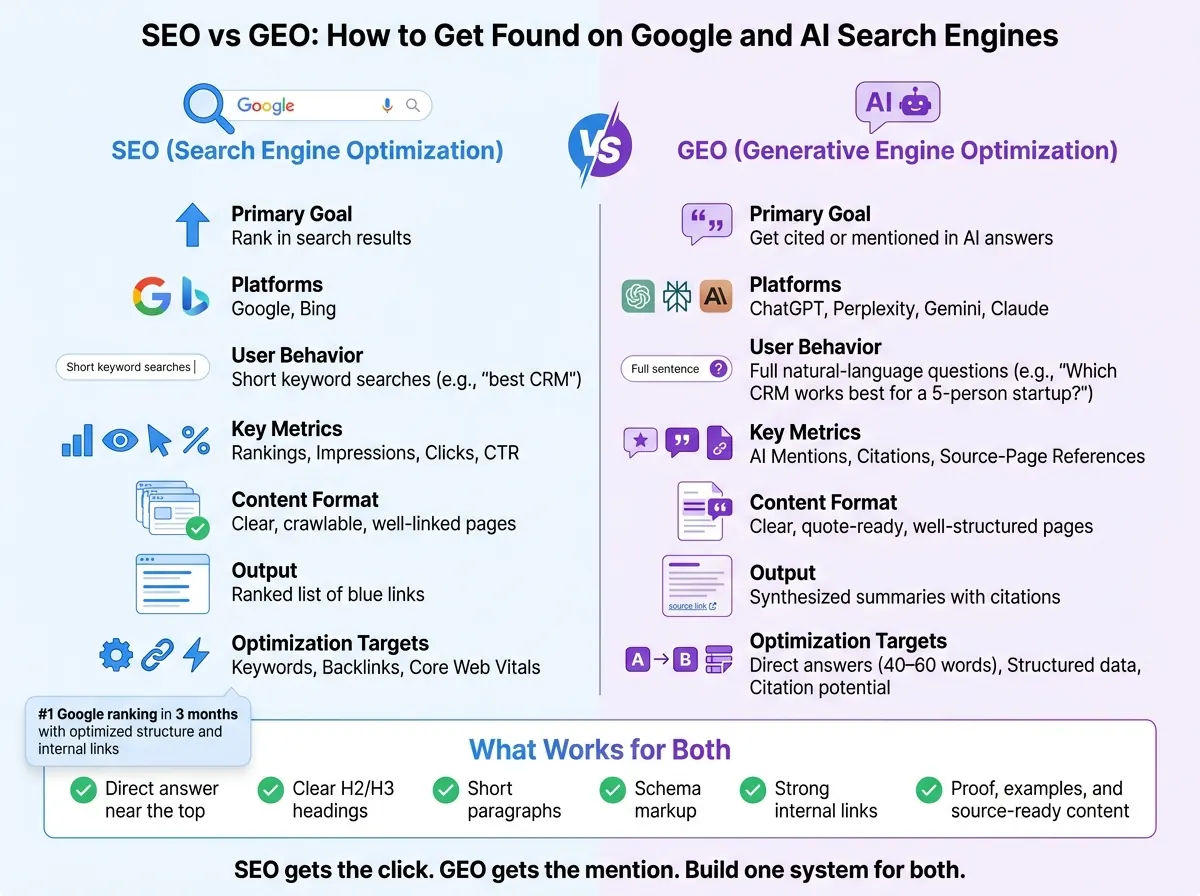
GEO vs SEO: How to Win AI Search (Without Hacks)
Quick Comparison
| Area | SEO | GEO |
|---|---|---|
| Main goal | Rank in search results | Get cited or mentioned in AI answers |
| Main platforms | Google, Bing | ChatGPT, Perplexity, Gemini, Claude |
| User behavior | Short keyword searches | Full, natural-language questions |
| Main metrics | Rankings, impressions, clicks, CTR | Mentions, citations, source usage |
| Best page format | Clear, crawlable, well-linked pages | Clear, quote-ready, well-structured pages |
What I like about this piece is that it doesn’t treat SEO and GEO as separate jobs. The core message is simple: build one strong content system that Google can crawl and AI can quote.
SEO vs GEO: Search Rankings vs AI Answers
SEO helps pages rank in Google. GEO helps AI tools find, trust, and cite your content. Put simply, one is about winning the click. The other is about earning the citation.
You can see that split in both the search result and the numbers you track.
| Feature | SEO | GEO |
|---|---|---|
| Primary Platforms | Google Search, Bing | ChatGPT, Perplexity, Gemini, Claude |
| Output Type | Ranked list of blue links | Synthesized summaries with citations |
| Optimization Target | Keywords, backlinks, Core Web Vitals | Direct answers, structured data, citation potential |
| Query Style | Short keywords (e.g., "best CRM") | Full questions (e.g., "Which CRM works best for a 5-person startup?") |
| Core Metrics | Impressions, clicks, rankings | AI mentions, source-page references, citation frequency |
| Content Format | Clear, structured, sourceable content | Clear, structured, sourceable content |
The gap starts with how people search.
How User Behavior Differs Across Google and AI Search Tools
Google search usually begins with keywords and ends in clicks. AI search usually begins with full questions and ends in direct answers. That changes what a page needs to do.
If someone types best CRM into Google, they’ll likely scan a list of links. If they ask an AI tool, Which CRM works best for a 5-person startup?, they expect a straight answer. So each page should answer one question clearly enough to be quoted.
That change also affects how founders should think about visibility.
What Founders Should Measure in SEO and GEO
With SEO, most teams watch impressions, clicks, click-through rate (CTR), and keyword rankings. Those metrics show how often your pages appear and whether people decide to visit.
GEO needs a different view. Here, you're tracking citations and mentions: how often your brand or content shows up when someone asks a related question in ChatGPT, Perplexity, or Gemini. Tools like LLM SEO Monitor now track this as its own metric, separate from standard search rankings.
"If your brand is invisible to AI search, you're missing the next wave." - Patrick Frank, Co-Founder, PatientPartner
Track both. That’s how you see whether your visibility comes from rankings, citations, or a mix of the two.
Next comes the site structure that helps Google and AI tools read your pages the right way.
SEO: Build a Site Google Can Crawl, Read, and Rank
Once you separate rankings from citations, the next move is simple: make your site easy for Google to read.
Google ranks pages it can access and understand. That means clean URLs, clear site navigation, fast load times, and HTML Google can process. If your site structure is messy, strong content alone usually won’t save it.
"Technical SEO - Speed, mobile-friendliness, HTTPS, clean URLs - these are the backbone of good SEO." - Puja Sharma, Digital Marketer
At the page level, use:
- a unique title tag
- a clear meta description
- one H1
- canonical tags
- a clean XML sitemap
Page Structure That Supports Service Discovery and Conversions
When page structure and internal links line up, rankings tend to move faster. Picture the path: someone lands on an article about AI workflow automation. From there, an internal link sends them to the matching service page. Another link leads to a case study with proof. That flow - article → service page → proof - helps both people and search bots move from early interest to action, instead of leaving pages isolated.
Internal linking should support lead generation. Each click should bring the visitor closer to booking a call or filling out a form, not just push them deeper into the site with no clear next step.
For example, Patrick Frank optimized Conscious Body Recovery's site with targeted internal linking and refined meta tags for the keyword "Contrast Therapy San Diego." The business reached the #1 Google ranking within 3 months.
How to Track SEO Performance With Google Tools
Google Search Console (GSC) is the best place to begin. It shows which queries trigger your pages, how many impressions you get, your click-through rate (CTR), and whether Google has indexed your key pages. The Coverage report points out blocked pages and errors. The Links report shows the internal and external links Google sees.
Then pair GSC with Google Analytics. Search Console tells you about visibility. Analytics tells you what visitors do next: book, submit, or leave.
Once Google can read your site, the next step is making your content easy for AI systems to quote.
GEO: Publish Content AI Systems Can Quote, Cite, and Summarize
AI tools tend to cite content they can scan fast, check with little friction, and sum up cleanly. That means structure matters just as much as the words on the page.
Start with the answer in 40–60 words, then go deeper. Use question-led H2s and H3s, short paragraphs, and clear definitions. When each subtopic is easy to spot, AI systems have a much easier time pulling out a quote, citation, or summary.
Not every content format gets cited the same way.
Content Formats That Increase Citation Potential
Some formats are simply easier for AI systems to reference. Frameworks, processes, roadmaps, and measured results tend to perform well because they give the model something specific to point to.
A founder playbook that walks through a real process gives AI a concrete source to cite. Implementation roadmaps work well because they break work into steps. Benchmark-based comparisons help because they include data an AI can surface directly. And a plain-language service page is often easier to cite than a vague growth claim.
How to Check AI Visibility Without Overclaiming Results
To check visibility, test with real buyer prompts in ChatGPT, Perplexity, and Gemini. Then log what happens:
- Does your brand appear?
- How is it described?
- Which pages get cited?
Tools like LLM SEO Monitor can automate part of this by tracking how often a brand shows up across AI-driven answers from ChatGPT, Claude, and Gemini. Run the same prompts on a regular schedule and log the results in a simple spreadsheet. Watch what gets cited, what gets ignored, and whether the AI describes your services correctly.
"If your brand is invisible to AI search, you're missing the next wave." - Patrick Frank, Co-Founder, PatientPartner
The next step is combining this content structure with technical markup and a repeatable publishing workflow.
One System for Both: Structured Data, Content Workflow, and Priority Order
After you measure rankings and citations, the next move is to use one publishing system to improve both. A single well-built page can rank in Google and get cited by AI if it's clear, easy to scan, and backed by proof. Schema markup helps search engines and AI systems understand what the page is about and what type of page it is.
| Page Element | SEO Benefit | GEO Benefit |
|---|---|---|
| Schema Markup | Improves rich snippet eligibility | Helps AI identify page type and topic |
| Direct Answer (40–60 words) | Increases featured snippet chances | Primary source for AI summary generation |
| Bullet/Numbered Lists | Improves readability and dwell time | Makes content easy for AI to extract |
| Internal Links | Helps crawlers move through the site | Connects related topics for AI |
Once the page structure is in place, the publishing process makes this repeatable. In plain English: each new page should follow a system, not feel like a one-off post.
A Repeatable Publishing Workflow for Patrick Frank Content
The workflow doesn't need to be complicated. Start with the actual questions founders are asking. Then group closely related subtopics into one page instead of spreading them across several thin posts.
From there, lead with the answer. After that, add proof and context. Then layer in original analysis, specific results, or a founder point of view that only you can offer.
When the draft is ready, connect it to the matching service page. Validate the schema markup before publishing. Once it goes live, track Google rankings and AI citations.
"AI removes the real reason most founders stop publishing: the time cost of a blank page." - eChai Ventures
That's the key shift. The value doesn't come from the AI draft alone. It comes from the examples, the results, and the clear point of view added on top.
Conclusion: The Difference Between Being Indexed and Being Referenced
Being indexed means Google can find your page. Being referenced means an AI model trusts your page enough to quote it when a buyer asks a related question. Most businesses get the first part. Far fewer get the second.
That gap usually comes down to three things:
- Content quality
- Schema structure
- Brand authority built over time
SEO gets you into the results. GEO gets you into the answer.
FAQs
Do I need SEO and GEO?
Yes. SEO still matters for visibility in Google search. Things like user experience, site speed, and high-quality content all help your pages rank.
At the same time, GEO helps keep your brand in front of people in AI answer engines like ChatGPT, Perplexity, and Gemini. Use both, and you can show up for classic search intent while also appearing as a source AI tools are more likely to cite.
How do I measure GEO results?
Measure GEO by tracking how often your brand shows up or gets recommended in AI-generated answers. The goal is simple: see where your brand appears, where it fades, and where you have room to improve. Specialized tools can help you spot those patterns without digging through responses by hand.
Traditional SEO metrics like traffic and rankings still matter for Google. But GEO adds another layer. You also need to watch visibility across AI platforms like ChatGPT, Perplexity, and Gemini to see whether your content is being cited and surfaced.
What pages are easiest for AI to cite?
AI search engines tend to cite pages that are well organized, trusted, and easy to check. In practice, that often means detailed guides, strategy memos, and well-researched articles that answer the user’s question directly.
Schema markup helps AI understand how your site is set up. And strong brand authority, along with E-E-A-T signals, can make your content more likely to be treated as a reliable source.