
If AI tools can’t read your site, they won’t mention it. If your pages don’t answer buyer questions fast, they probably won’t cite them either.
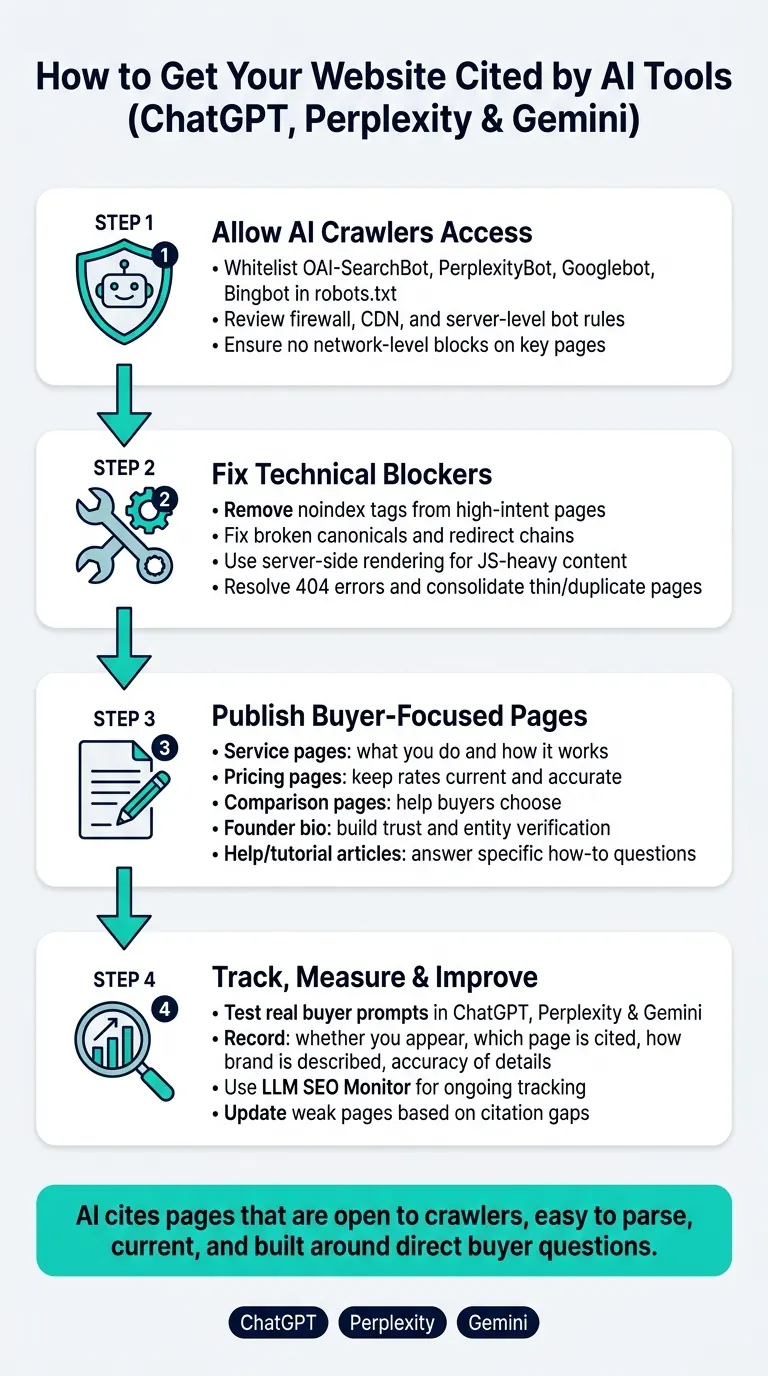
When I boil this down, it comes to four jobs:
- Let AI crawlers access your pages
- Fix page issues that block indexing or quoting
- Publish pages that answer buying questions directly
- Track which prompts mention your brand and update weak pages
That’s the whole game.
A lot of sites miss out because of small problems: blocked bots, tags, broken canonicals, redirect chains, or key text hidden behind JavaScript. Then, even when access is open, the content still has to earn a mention by being clear, current, and easy to quote.
Here’s the short version of what I’d focus on first:
- Check robots.txt and make sure major crawlers like OAI-SearchBot, PerplexityBot, Googlebot, and Bingbot are allowed
- Review server and firewall settings so approved bots aren’t blocked elsewhere
- Use server-side rendering for main text if your site depends on JavaScript
- Keep service, pricing, comparison, help, and founder pages updated
- Add schema that matches visible content
- Test buyer-style prompts in ChatGPT, Perplexity, and Gemini and log what shows up
One point stands out: AI visibility is not the same as ranking in old search results. Your brand may get seen inside the answer before anyone clicks a link. For decision-stage searches like pricing, vendor picks, and service comparisons, that can shape who gets the lead.
A simple way to think about it is this:
| Area | What AI needs | What I’d check |
|---|---|---|
| Access | Can the bot reach the page? | robots.txt, firewall, CDN rules |
| Readability | Can the bot read the main text? | HTML output, JavaScript reliance, render state |
| Relevance | Does the page answer the prompt? | Service pages, FAQs, comparisons, help content |
| Accuracy | Are details current? | Pricing, dates, claims, offers |
| Identity | Is the business easy to verify? | Founder bio, contact info, public profiles, schema |
Bottom line: if I want my site to show up in ChatGPT, Perplexity, and Gemini, I need pages that are open to crawlers, easy to parse, current, and built around direct buyer questions.
Below, I’ll walk through the steps in plain English.
How to Speed Up Your Website for AI Visibility & Discoverability
Make Your Website Crawlable and Technically Eligible
AI can only cite pages it can reach and read cleanly. And a lot of sites get tripped up by small settings that quietly block crawlers.
Allow the Right Crawlers and Search Bots
Start with your file. It should not block OAI-SearchBot, PerplexityBot, Googlebot, or Bingbot. If a bot is blocked, it can't read your page. And if it can't read your page, it can't cite it.
That said, isn't the only place things go wrong. Firewalls, CDNs, and security tools can still stop approved crawlers at the network level. So it's worth checking those settings too, especially on the pages you want surfaced.
Fix the Technical Issues That Keep Pages from Being Cited
Once access is open, the next step is making the page easy to index and cite. One of the biggest trouble spots is JavaScript-rendered content. If the key details only show up after a client-side script runs, crawlers may get a blank page or only part of the content. For critical text, server-side rendering is the safer bet.
Here are the most common blockers:
| Problem | Likely Effect | What to Inspect | Recommended Correction |
|---|---|---|---|
| Noindex tags | Page is excluded from indexing | HTML <head> for noindex meta tag | Remove the tag from high-intent pages |
| Broken canonicals | AI may cite the wrong URL | <link rel="canonical"> URL | Point to the single, authoritative URL |
| Redirect chains | Slower crawling | Server headers and hop count | Link directly to the final destination URL |
| JS-only content | Crawlers miss key content | Can the page be read without JavaScript? | Use server-side rendering for critical text |
| 404 errors on linked pages | Broken crawl paths | Internal links and server response codes | Fix or redirect broken URLs |
| Thin or duplicate pages | Lower citation likelihood | Content depth and canonical consistency | Consolidate duplicates and expand thin pages |
These problems can stop citation before content quality even enters the picture.
Use Google Search Console to spot issues on the pages you want cited.
Once crawl access is fixed, publish pages that answer buyer questions directly.
Publish Pages That Directly Answer Buyer Questions
Once your site is crawlable, the next step is simple: make each page answer a buyer’s question fast.
Build pages around the questions people ask before they contact you. AI systems tend to cite pages that give clear answers. And buyers usually want the same core things: what you do, who you help, how the process works, and what it costs. Those are decision-stage questions, so your pages should meet them head-on.
Page Types That Match High-Intent Queries
Each page type has a different job.
A service page answers “what do you do and how does it work?” A founder bio page answers “who is behind this and can I trust them?” A comparison page answers “is this the right fit for my situation?” Help articles answer “how do I actually do this?” Tool and resource pages answer “what should I be using for this task?”
For Patrick Frank, that means publishing service pages, pricing pages, founder bios, help articles, and comparison pages.
A detailed service page for the 90 Day AI Integration Roadmap answers the process question. A pricing page with current rates like 1-on-1 Strategy Sessions at $150/hour or the 90 Day Growth Plan at $10,000 answers the cost question. Keep those pricing pages live and current. Old pricing can hurt citation accuracy.
"Verify every price and claim on the live sites because models routinely quote stale pricing." - eChai Ventures
Write for Direct Answers
Page type matters. But page structure is what helps AI quote the answer fast.
Put the main answer near the top. Use headings that mirror the question. Define technical terms the first time they appear. And if a claim can change over time, add a date so AI systems don’t treat it like it’s always current.
Here’s how each page type lines up with the question it answers and the business goal behind it:
| Page Type | User Question It Answers | Information to Include | Business Objective |
|---|---|---|---|
| Service/FAQ | How does the process work? | Step-by-step workflow, timelines, expected outcomes | Lead generation / Trust |
| Comparison | Which option fits my use case? | Feature grids, pricing tables, positioning | Decision-stage conversion |
| Founder Bio | Who is behind this and why? | Proof of expertise, project history, wins and failures | Brand authority / Verification |
| Help/Tutorial | How do I solve this specific problem? | Actionable steps, technical definitions, quick wins | AI visibility |
| Tool/Resource | What do I need to accomplish this task? | Curated tools, templates, workflow links | Lead magnet / Traffic |
Strengthen Brand, Founder, and Structured Data Signals
After answer-first pages, tighten the signals that show AI who your business is and why people should trust it.
AI systems need a clear entity trail. Your site, business name, services, and expertise should all point to the same company. If your name, title, or service descriptions shift across your site and public profiles, AI is less likely to see your site as an authority.
Make Patrick Frank Easy to Verify as an Entity
Keep Patrick Frank’s name, title, and service language consistent across the site and external profiles so AI systems can verify the same entity. Use the founder bio page to connect Patrick Frank to specific outcomes and published work.
Your contact details, business name, and service descriptions should match across the website, LinkedIn, and other public profiles. Even small differences - a changed job title here or a fuzzy service description there - add friction. That makes AI systems less likely to treat your site as a source they can lean on.
Once that entity is consistent across profiles, use schema to confirm the identity on the page itself.
Use Schema Markup That Matches the Visible Page
Schema markup tells AI systems what a page means, not just what the words say. The main rule is simple: schema must match what users can see on the page. If your FAQ schema includes an answer that doesn’t appear in the visible copy, that’s a mismatch. And it can hurt more than help.
Use schema that fits each page type and lines up with the visible content:
| Page | Most Relevant Schema | Key Properties | Validation Requirement |
|---|---|---|---|
| Homepage | Organization or ProfessionalService | name, url, logo, sameAs (social links), contactPoint | Must match visible contact info on the page |
| Founder Bio | Person | name, jobTitle, worksFor, alumniOf, award | Link to authoritative profiles that verify the same person |
| Service Pages | Service | serviceType, provider, areaServed, description | Must align with the specific outcomes described in the copy |
| FAQ | FAQPage | mainEntity (Question and Answer) | Answers must be direct and match the visible text on the page |
| Articles | Article or BlogPosting | headline, author (Person), datePublished, publisher | Author name must link back to the verified Person entity |
| Tool Page | WebApplication | applicationCategory, operatingSystem, offers | Clearly define the tool's purpose, such as AI visibility monitoring |
One detail on schema is worth getting right: use the property to link to Patrick Frank's LinkedIn profile, TEDx talk, and other authoritative profiles that verify the same person. This helps AI systems confirm that the person on your site is the same person recognized on outside platforms.
Earn Third-Party Mentions That Support Expertise
Schema and on-site content set the base. But AI systems also look beyond your website when deciding whether to cite you. External mentions - especially ones with clear context - work like outside proof.
A detailed case study, a third-party newsletter mention, or an expert quote in a trade publication can all strengthen the link between Patrick Frank and the topics buyers are already searching for inside ChatGPT, Perplexity, and Gemini. Build that trail with guest articles, podcast appearances, and expert quotes in relevant publications.
With identity, schema, and mentions lined up, the next move is tracking which pages actually show up in AI answers.
Measure Visibility, Improve the Right Pages, and Take Action
Once your identity signals and schema are set, the next job is simple: check if they’re working and spot what needs attention when they’re not.
Track Citations Using Real Buyer Prompts
Start with the exact questions buyers ask. For Patrick Frank's services, test prompts like "Who is the best consultant for AI agent strategy or business workflow automation?" in ChatGPT, Perplexity, and Gemini.
Each time, record four things:
- Whether you appear
- Which page is cited
- How the brand is described
- Whether the details are accurate
If an AI brings up stale details, like old pricing or wrong features, that points to a content gap you need to fix. Perplexity is especially useful here because its cited answers make it easier to see which pages are being used as sources.
For tracking over time, LLM SEO Monitor shows how often a brand is recommended across ChatGPT, Perplexity, and Gemini.
Then use those prompt results to improve the pages AI systems already seem to trust.
A Simple Order for Getting This Done
Use this sequence to move from audit to action:
- Audit access, fix technical blockers, and confirm key pages are crawlable.
- Clarify core pages - make the homepage and service pages a clear source of truth.
- Strengthen founder and service signals - tighten the entity trail across the site and public profiles.
- Add and validate schema.
- Earn authoritative mentions - build the external proof layer.
- Retest with your prompt set - after pages are updated and recrawled, run the same buyer prompts again and compare results.
Measure success by looking at citations, accurate AI descriptions, and qualified inquiries.
FAQs
How long does it take to show up in AI answers?
There’s no fixed timeline for showing up in AI-generated answers.
Generative Engine Optimization is an iterative process, not a one-time fix. Your visibility can shift as AI systems pick up new data and change how they respond.
The best way to measure progress is to test buyer prompts on a regular basis in ChatGPT, Perplexity, and Gemini. You can also use tracking tools to watch brand citations and visibility over time.
Do AI tools need schema markup to cite my site?
Not always. AI systems mostly depend on crawlable, high-quality content. But schema markup gives them extra structure, which helps them spot your page type, topic, and business details.
In plain English: schema markup adds context around the page. That can make your content easier to scan, understand, and summarize. And when that happens, your site may have a better shot at being cited.
What pages should I create first for AI visibility?
Start with your core business pages: About, Services, Case Studies, Pricing, and Contact.
Those pages should be accurate, consistent, and written in plain language. Why? AI systems may use them as a source of truth when they describe your company.
Then add supporting content like founder bios, help documentation, and detailed guides that answer specific questions. Keep your claims up to date, and add dates where it makes sense, so AI can summarize your current offerings accurately.