
You can use Perplexity to check a business idea in about 1 hour before you spend months building the wrong thing. I’d use it to answer five questions fast: Is the problem real? Are people in the U.S. paying for fixes? How crowded is the space? What do prices look like in USD? And is there still a gap worth testing?
Here’s the short version:
- I start with one clear idea statement
- I ask Perplexity to list assumptions, questions, and proof needed
- I look for demand signals in cited sources, Reddit, forums, and reviews
- I compare direct competitors, substitutes, and pricing
- I verify claims by hand, especially pricing on live sites
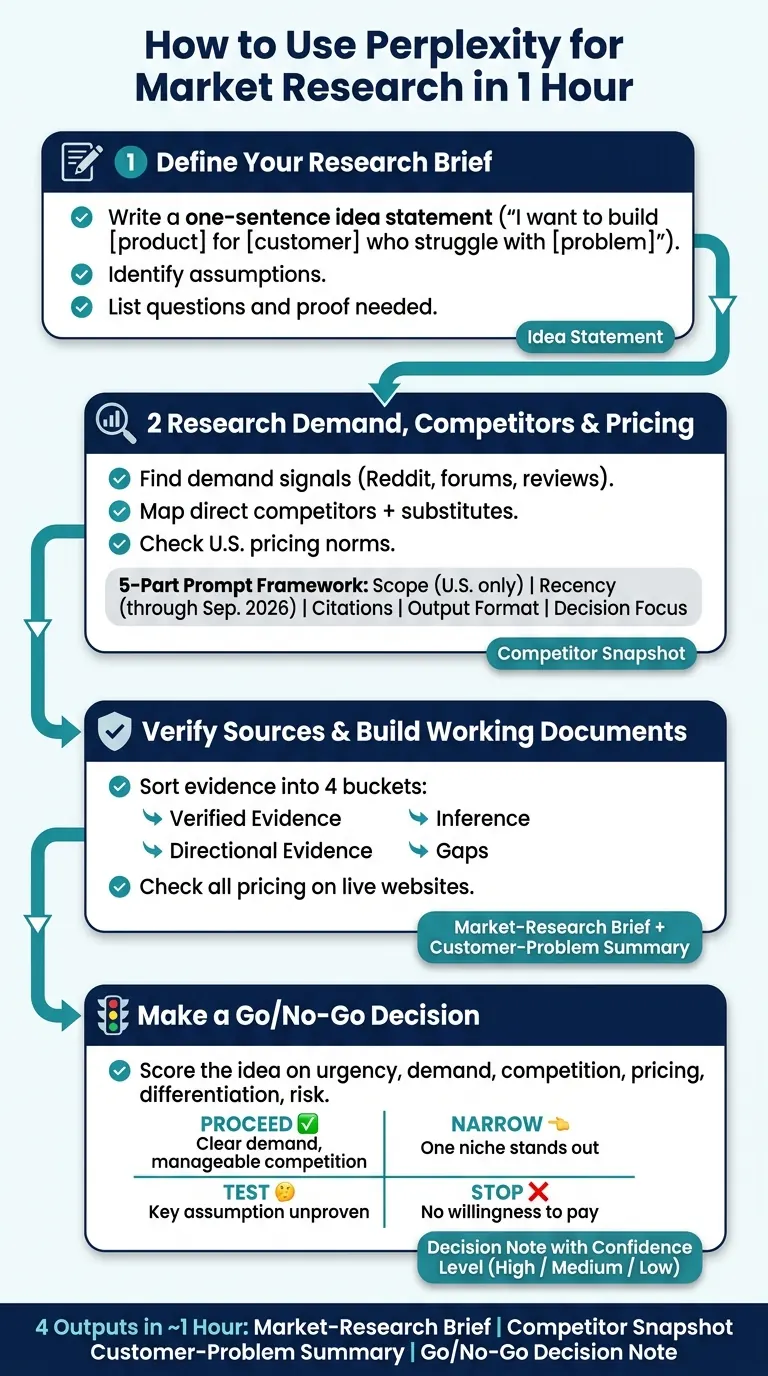
- I turn the research into 4 outputs:
- a market-research brief
- a competitor snapshot
- a customer-problem summary
- a go / no-go decision note
This process is not for perfect certainty. It is for making a better call with less guesswork. If I can find repeated pain points, proof of spending, and room to stand out, I move to a small test. If I can’t, I narrow the idea or stop.
A few points matter most:
- Use U.S.-only prompts
- Ask for sources current through September 30, 2026
- Separate verified facts from my own guesses
- Treat AI pricing as unconfirmed until I check the seller’s website
- End with one next step: Proceed, Narrow, Test, or Stop
One useful way to think about it: if even 1 weak assumption can break the idea, that assumption should be the next thing I test.
| What I’m checking | What I want to find |
|---|---|
| Demand | Repeated pain, urgency, and signs people already spend money |
| Competition | Who already serves the market and where they fall short |
| Pricing | What buyers expect to pay in the U.S. and how rivals charge |
| Gaps | Missing features, bad user feedback, or weak substitutes |
| Decision | Proceed, Narrow, Test, or Stop |
If I were doing this from scratch, I’d use Perplexity as a starting tool, not the final judge. It helps me get to the right next question fast, then I verify the facts and test the riskiest assumption in the market.
How To Use Perplexity AI For Market Research (Step-By-Step)
1. Define Your Research Brief Before You Search
A research brief helps keep Perplexity locked on one launch decision. Before you type anything, write down the product or service, the target customer, the problem that customer is dealing with, the U.S. market you want to study, how the business will make money, and the decision this research needs to support.
Don’t stop at age, income, or job title. Add the customer’s motivations and buying habits too. Why do they buy? What slows them down? What pushes them to act? That brief becomes the filter for every search you run.
Start With a One-Sentence Idea Statement
Before you open Perplexity, write your idea like this: "I want to build [product or service] for [specific customer] who struggle with [specific problem]."
It’s simple, but it does a lot of work. It forces you to get specific about what you’re building, who it’s for, and why it matters.
Then paste that sentence into Perplexity and ask it to list:
- assumptions
- follow-up questions
- the evidence needed to test them
That gives you a cleaner starting point than tossing in a broad search and hoping something useful comes back.
Use a Prompt Framework for U.S. Market Research
A vague prompt usually leads to a vague answer. So give each Perplexity query the same five-part structure:
| Prompt Element | What to Include |
|---|---|
| Scope | U.S. only |
| Recency | Current through Sep. 2026 |
| Citations | Authoritative sources with direct links for each claim |
| Output format | Evidence, Assumptions, Uncertainties, Implications |
| Decision focus | Go/no-go for [idea] |
This setup keeps the research tight and makes results much easier to compare across searches. The "Uncertainties" section matters a lot because it shows where Perplexity is making an inference instead of pointing to a direct source.
Use this brief to test demand, competitors, and pricing in the next step.
2. Research Demand, Customer Problems, and Competitors
This step is about checking three things: demand, competitor positioning, and pricing.
Find Evidence of Demand and Unmet Needs
Start with Perplexity. Ask it to show who has the problem, how common it is, and what people do right now to deal with it. A good prompt looks like this: "Who in the U.S. experiences [problem], and what workarounds or tools do they currently use to manage it? Cite sources published after Jan. 2024."
Then go straight to places where people speak plainly: Reddit, niche forums, and review sites. Look for phrases like "I wish…" or "How do I solve…?" That’s where you’ll find frustration in plain English. If the same complaint keeps showing up across different sites and from different users, pay attention. That usually points to a real gap, not a random complaint.
As you review what people are saying, capture:
- the segments hit hardest
- repeated pain points
- signs of urgency
- open questions people still can’t answer
Once you have those pain points, check which competitors handle them well and which ones fall short.
Map Competitor Positioning, Substitutes, and Pricing
Use those demand signals to judge where current offers miss the mark. Then map out who already serves the market. Ask Perplexity for direct competitors, indirect options, and niche players. Don’t ignore substitutes. A DIY workaround, like a spreadsheet or a manual process, can tell you a lot about unmet demand.
For each competitor, have Perplexity pull:
- target customer
- core promise
- pricing model
- complaints from review sites like G2 or Reddit
A useful gap-analysis prompt is: "Based on user reviews on G2, Capterra, or Reddit, what are the most common complaints or missing features for [Competitor Name]?"
One big caution here: always check pricing on the competitor’s live website. AI pricing data can go stale.
Keep your notes short. A one-line summary per competitor makes it much easier to compare positioning fast.
| Competitor | Segment | Core Promise | Pricing Model | Price (USD) | Key Weaknesses | Source |
|---|---|---|---|---|---|---|
| Competitor A | - | - | - | See live site | - | Live site |
| Competitor B | - | - | - | See live site | - | Live site |
| Substitute (spreadsheet) | - | Manual workaround | None | $0 | - | Forums |
The goal here is simple: anchor your positioning against other choices in the market, not just your product features.
Then compare those offers with category pricing and demand trends.
Check Market Trends and U.S. Pricing Norms
The last pass tells you whether the category is growing, shrinking, or changing shape. Ask Perplexity for category pricing benchmarks so you can see what U.S. buyers already expect to pay.
| Source Type | Checks | Limits |
|---|---|---|
| Industry report | Category direction and pricing context | Broad definitions |
| Review or forum post | Recurring pain points and workarounds | Small samples and bias |
| Competitor pricing page | Current pricing model and entry price | Verify on the live site |
"Pricing is the moment of truth - all of marketing comes to focus in the pricing decision." - E. Raymond Corey, Professor, Harvard Business School
Don’t just log cited facts. Flag your inferences too. Those are often the loose threads that need validation next.
Next, sort the strongest sources and turn them into a working brief.
3. Check Your Sources and Turn Findings Into Working Documents
Now take the best findings and turn them into evidence you can rely on. Perplexity notes are a starting point, not the final word. Before you use them to guide a decision, check them by hand.
Sort Evidence by Strength and Reliability
Every claim from Step 2 needs a quick manual review. Open each Perplexity citation, read the source itself, and ask two simple questions: Does this source back up the claim? And is it current enough to matter?
Then sort each finding into four buckets:
- Verified evidence - the source clearly backs up the claim and is recent enough to matter
- Directional evidence - the source is related, but it’s older or only partly backs up the claim
- Inference - your read of a pattern, not a direct quote or hard data point
- Gaps - places where you still don’t have a solid source
If AI surfaces pricing, treat it as unverified until you confirm it on the live pricing page.
Before you write the brief, run an audit prompt to catch holes or conflicts in the evidence. Use this prompt:
"List the main sources supporting demand, competition, and pricing in [your category]. Note publication dates and flag contradictions."
Build the Market-Research Brief and Customer-Problem Summary
Once your evidence is sorted, turn your notes into two working documents that help you make a call.
First, create a market-research brief. Include the idea, scope, target customer, demand evidence, competition, pricing norms, trends, unmet needs, assumptions, limits, and the next test.
Then create a customer-problem summary. Spell out who has the problem, how often it comes up, what people do now, and where current options fall short.
"If you can demonstrate that customers actually need a product and are willing to pay for it, everything else will flow from there." - Michael Lepech, Stanford University
The point here is simple: make your assumptions and blind spots easy to see. These documents become the base for your go/no-go decision.
4. Make a Go/No-Go Decision and Pick Your Next Test
Use your market-research brief and customer-problem summary to make the launch call. Then use Perplexity to stress-test the evidence before you decide.
Use a Simple Decision Framework: Proceed, Narrow, Test, or Stop
Ask Perplexity to score the idea using only verified sources from your research. This prompt works well:
"Using only verified sources from this research, score this idea on customer urgency, evidence of demand, competition, pricing potential, differentiation, distribution feasibility, and execution risk. Flag any factor where the evidence is weak or missing."
Once you have the score, pick one of four paths:
| Decision | When It Applies | Next Step |
|---|---|---|
| Proceed | Clear demand, identifiable customers, manageable competition | Move to launch planning |
| Narrow | Broad interest, but one niche or feature stands out | Refocus the offer on that segment |
| Test | Uncertain demand or a critical assumption still unproven | Run an MVP, landing page, or early-access offer |
| Stop | No evidence of willingness to pay or risk you can't get around | Return to research or abandon the idea |
This keeps the decision grounded in evidence instead of gut feel. If the signals are strong, move forward. If one part of the market stands out, tighten the focus. If the big question is still unanswered, run a small test before you put more time or money on the line.
Final Output: Decision, Confidence Level, and Next Validation Step
Write a short decision note with six items:
- Final decision
- Confidence level
- Positioning hypothesis
- Key risks
- Next validation step
- Success threshold
Use High, Medium, or Low for confidence based on source freshness and verification.
For example, if you land on Test, the next move could be a simple landing page or early-access offer with a clear success threshold, like getting 100 users within two months.
Perplexity helps you move through this step faster, see your sources more clearly, and zero in on the assumptions that carry the most risk before you commit to a launch.
FAQs
How do I know if a market gap is real?
A market gap is only real when it points to existing demand and a problem people already want solved. Weak competition by itself doesn't prove much. Sometimes a market looks open simply because no one cares enough to enter it.
A better signal is this: people are already spending time or money on substitutes, patchwork fixes, or clunky workarounds. That tells you the pain is there. You should also look for unprompted complaints on Reddit, niche forums, review sites, and community threads. When people complain without being asked, that's often where the truth slips out.
Next, check the gap with objective competitor mapping and current public pricing. Who already serves this need, even partly? How are they positioned? What do they charge? This step helps you tell the difference between a gap in the market and a gap in your own research.
After that, run a commitment test. Not a survey. Not polite feedback. Something concrete, like deposits, paid pilots, or another form of clear buyer commitment. Set kill criteria ahead of time so you don't move the goalposts after the fact. If people won't pay or won't confirm the problem in a meaningful way, the gap isn't real.
What should I verify outside Perplexity?
Verify anything from Perplexity that involves pricing, product claims, or live facts. Go to the competitor’s own website and check each price and claim there, because models can be stale or just plain wrong.
Then confirm demand with primary proof: deposits, paid pilots, pre-orders, or LOIs. On top of that, test your assumptions with real buyer interviews and landing pages or priced smoke tests. The goal is to measure action, not just interest.
What’s the best first test before launch?
The best first test before launch is customer pre-sales that show people are willing to pay. Ask for a deposit, a paid pilot, or an LOI instead of leaning on praise or soft feedback.
You can also run a “fake door” waitlist to measure intent.